
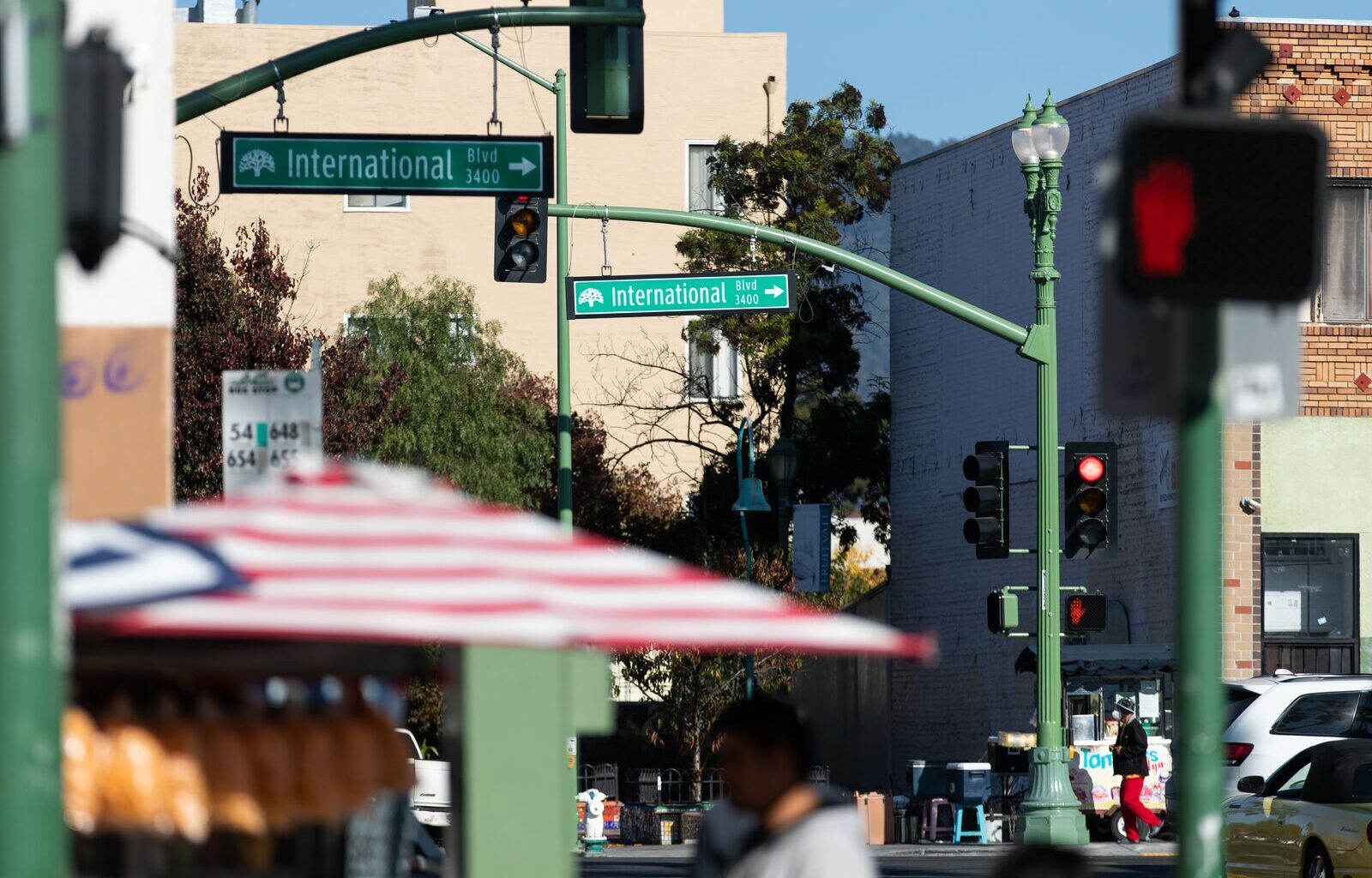
For years, parts of International Boulevard in East Oakland, known as “the Blade,” have been hot spots for sex trafficking.
Now, an Oakland City Council member representing a portion of the Blade is trying to disrupt this by temporarily closing streets.
As part of an initiative authored by District 2 Councilmember Charlene Wang, the city will barricade Ninth, 10th, and 11th avenues between International Boulevard and East 15th Street for six months starting early fall.
The barricades, which the council approved Tuesday night, aim to make it harder for buyers to use concealed side streets to solicit sex and to make it easier for police to see criminal activity.
“The behavior of the buyers relies on these side streets to facilitate these transactions,” Wang said at the council’s Public Safety Committee meeting on June 23. “That is why closing these side streets is a pilot we want to pursue.”
Wang said the initiative draws on crime prevention through environmental design principles and is modeled after a similar program in Houston that police say reduced prostitution solicitation and other crimes in that city’s red-light district in 2023. The program will be paid for by the District 2 council office’s discretionary funds.
Wang described the effort as a “community-led initiative,” with neighbors and business owners in the San Antonio neighborhood long advocating for the city to enact measures to combat trafficking.
“I’m always going to be fighting for San Antonio,” Wang said at the meeting. “It is the most working-class part of my district.”
Evangelina Lara, who lives in the San Antonio neighborhood, said she supports the initiative because trafficking has long affected the community.
“My oldest son and my daughter left Oakland looking for a better environment for their kids, and I don’t see them as much,” she told council members at a committee meeting last week.
Yesenia Ortiz, a resident of 10th Avenue for more than 20 years, said persistent trafficking in the neighborhood led her to stop walking her son to school.
“As he’s gotten older and started seeing the ladies standing there almost naked, he started asking questions, and I knew walking to school wasn’t an option anymore,” said Ortiz during public comment. “Now, I have to drive him to school and go around certain streets, hoping there’s none of them standing in the street.”
Wang told The Oaklandside the closures are intended to be a part of a holistic strategy to combat commercial sexual exploitation.
Earlier this year, the council approved another proposal by Wang that imposes fines on people who buy sex and on traffickers. Revenue from those fines is supposed to go to a Human Trafficking Survivor Support Fund for nonprofits serving survivors of commercial sexual exploitation. Wang said it is the first fund of its kind in California.
The council may extend the street closures as many as eight consecutive times, with each extension lasting up to 18 months. OakDOT has not announced an exact date for installing the barriers, according to Bridget Ruiz Rivezzo, policy director for Wang’s office.
The Oakland Police Department and OakDOT will collect data to analyze the program’s effectiveness after it ends, Wang said.
This isn’t the first time the city has closed streets to try to divert sex trafficking. In 2023, the city installed barriers along East 15th Street to move solicitation out of the neighborhood, according to Ruiz Rivezzo. David Kakishiba, executive director of East Bay Asian Youth Center, located in the San Antonio neighborhood, said he was part of the community’s efforts to push OakDOT to temporarily place water containers along East 15th Street in February 2023 to divert sex trafficking.
“It was a night-and-day transformation,” he told The Oaklandside. “Normal life returned to East 15th.”
Sex trafficking survivors’ advocates feel conflicted about the proposal
 Councilmember Charlene Wang, seen here on Jan. 12, 2026, says the pilot is modeled after a similar one in Houston that police say led to a reduction in prostitution solicitation arrests. Credit: Roselyn Romero/The Oaklandside
Michelle Badue said she was kidnapped, beaten, raped, and trafficked for 15 years, much of which was spent on International Boulevard in Oakland. She now supports trafficked youth as a transformation coach with MISSSEY, an Oakland nonprofit that empowers survivors of commercial sexual exploitation.
Badue has doubts that the road closures will reduce the overall levels of sex trafficking in Oakland.
“Traffickers don’t disappear — they adapt,” she said. “If one area is closed, they’ll simply move victims to another street, another city, or another neighborhood.”
If the city wants to end sex trafficking, she said, street closures are not enough. The city needs to offer more housing, education, mental health and substance use treatment, jobs, and long-term support for survivors. The city also needs to be better at holding traffickers and buyers accountable, she said.
“Survivors need resources that help them rebuild their lives, not just temporary solutions that move the problem somewhere else,” said Badue.
Other community members expressed concerns that the street closures would simply move the problem elsewhere, rather than addressing the root causes of trafficking.
John Jones III, an East Oakland resident, told the council’s Public Safety Committee on June 23 that he’s neither for nor against the effort.
“I understand that you want to do something about it,” he said. “But it’s not really helping those people out there.”
Dr. Aisha Mays, founder of the Dream Youth Clinic, an Oakland-based nonprofit that aims to support young survivors of commercial sexual exploitation, said she feels “heartened” by the city taking action but acknowledged it alone won’t solve the issue.
“We can’t not do anything because the issue seems too large or too insurmountable. That is how we got here,” she said. “We have to try different solutions to address and eradicate the issue.”
“*” indicates required fields