
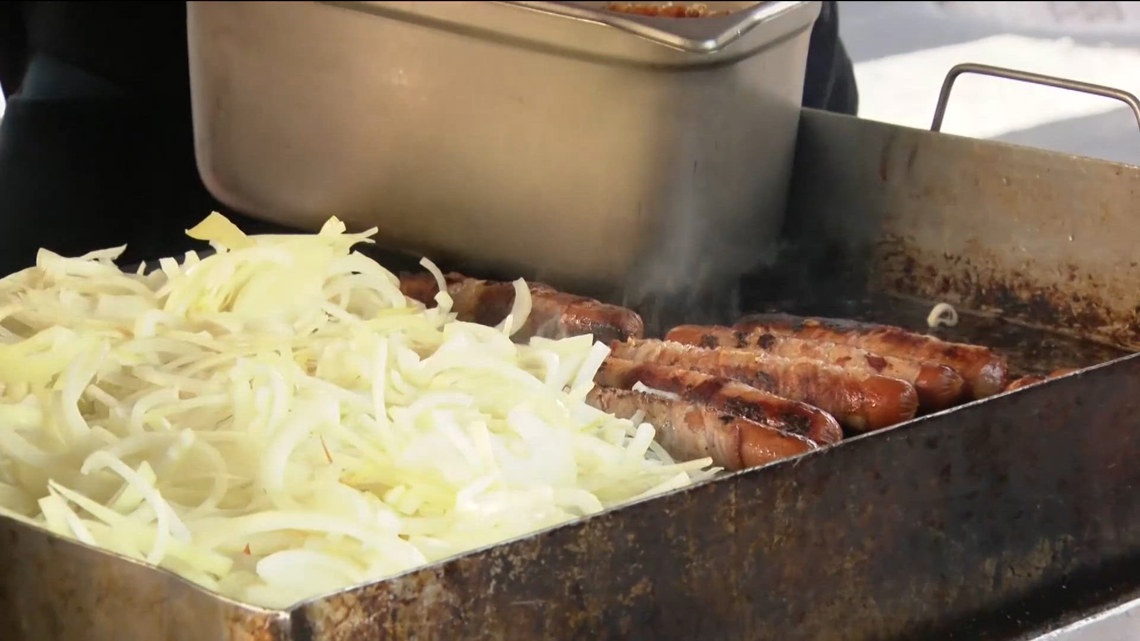
Organizations like the Gaslamp Quarter Association report they’re frustrated by the City moving to not crack down on street vendors.
SAN DIEGO — Court rulings have forced the City of San Diego to halt cracking down on street vendors.
“I’ve had food trucks in the past. And I started seeing the hot dog vendors in Pacific Beach. And I saw those guys making money. More money than me, with my food trucks. And I start saying ‘it’s not fair,’ because I pay permits. Permits, rent and they don’t pay anything,” Christian Alvarez, a hot dog vendor in the Gaslamp Quarter, said.

This story continues below.
Alvarez told CBS 8 he started vending hot dogs on streets about five years ago.
Organizations like the Gaslamp Quarter Association report they’re frustrated by the City moving to not crack down on street vendors, like Alvarez. This move was triggered by a state appeals court ruling in January that the City was illegally impounding the carts and other property of vendors. The City ultimately chose not to appeal the ruling.
The defeat returns San Diego to square one in its longtime effort to grapple with a 2018 state law that decriminalized many aspects of street vending.
“Not only do we have the hot dog vendors, but we also have anyone who comes down to set up a 10×10 to sell whatever they want. Set up a karaoke booth, with nacho bars, pop up restaurants. Every weekend it is a free-for-all in the Gaslamp Quarter. And PD does not enforce due to the fact that City Hall does not have the directive that they are no longer enforcing,” Michael Trimble, Executive Director of the Gaslamp Quarter Association, said.
A spokesperson for the San Diego Police Department told CBS 8 that the court rulings have limited what police officers can do to enforce street vending laws.
“For example, officers currently cannot impound vending equipment, and enforcement in the Ballpark District is restricted. Because most street vending violations are administrative, not criminal, officers also have fewer enforcement options available to them,” Ashley Nicholes, a Communications Manager with SDPD, said. “Those legal limits come on top of ongoing staffing shortages, limited overtime resources, and the need to prioritize emergency calls and violent crime. Together, these factors have reduced the Police Department’s ability to proactively enforce street vending regulations and have resulted in a more limited enforcement approach.”
For vendors like Alvarez, he told CBS 8 he is just trying to make a living.
“In one part for me, it’s ok. Nobody bothers us. I know it’s their job [SDPD]. If they move us, we need to move. And for me, it’s ok,” Alvarez said. “I put myself in the position of the restaurant owners. And I say, it’s not fair for them. But we are not doing anything bad. We are just doing this for our families. But this a balance, wherever I put my stand its never outside a restaurant, because it’s not fair. We just sell on the streets. And the restaurants owners, they’re paying $15-20k in rent.”