
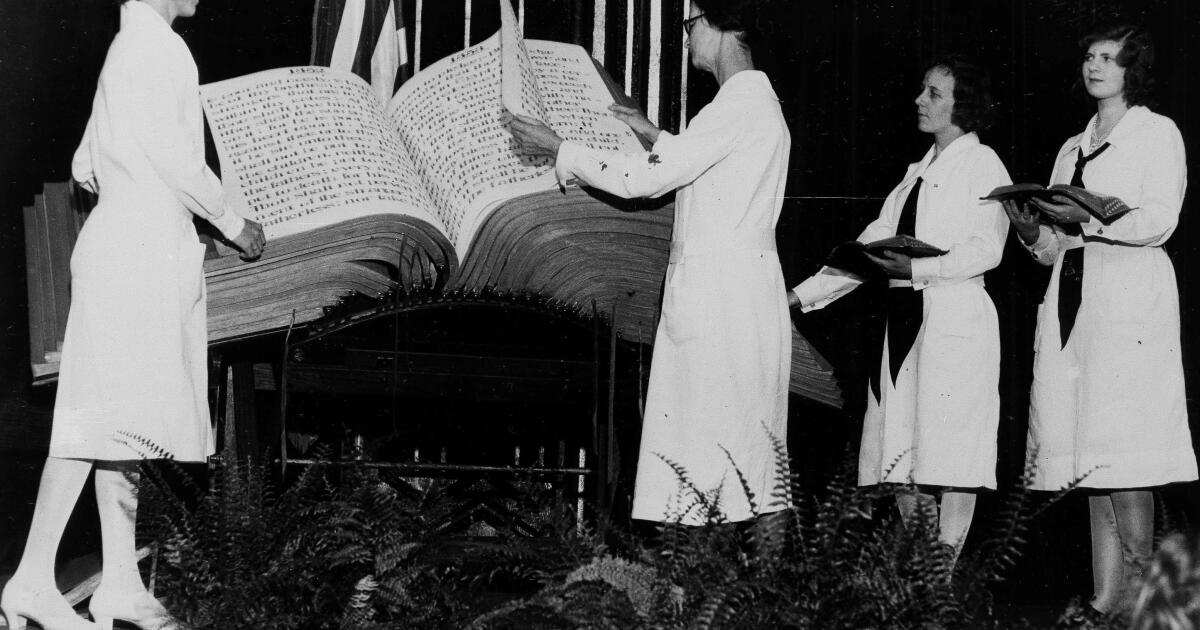
Aimee Semple McPherson was equal parts prophet and performer, a charismatic Canadian farm girl who stormed into boomtown Los Angeles with “ten dollars and a tambourine.” The church she built, the lavishly domed and pillared Angelus Temple in Echo Park, resembled both a movie palace and the colosseum.
She wrapped old-time religion in Hollywood razzmatazz. She made Pentecostalism mainstream and the Bible a vaudeville show. She was the biggest spectacle in a town rapidly building its identity on it.
Draped in dazzling robes and capes, she eschewed fire-and-brimstone rhetoric in favor of a sunnier, more optimistic message. She preached to 7,000 people a day with a brass band and an orchestra. She reenacted the scriptures with live camels, lions and lambs. She topped her church with radio towers to reach the sinning masses. At her touch, it was said, broken limbs were mended and the blind gained sight. During the Great Depression, she fed thousands.
She was one of the most famous women in America, but tantalizingly sphinx-like, then and now. The enduring mystery of her life remains what motivated her vanishing act during a five-week period from May to June 1926.
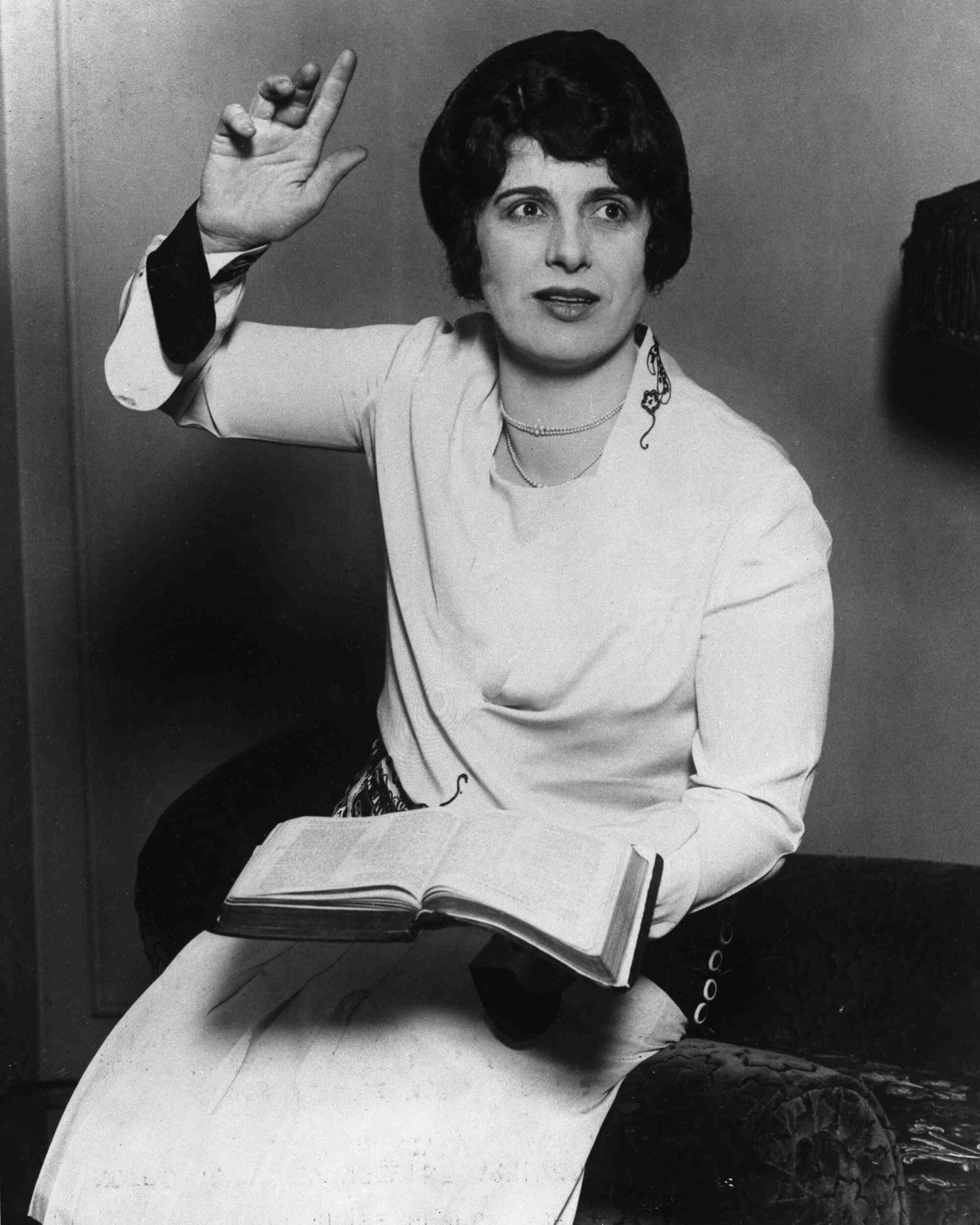
Aimee Semple McPherson in September 1928 in New York.
(Associated Press)
McPherson, 35, had been sitting under an umbrella on Venice Beach, working on a sermon called “Light & Darkness.” As far as her panicked secretary could tell, she then walked into the water and never came out.
A May 19, 1926 edition of the Los Angeles Record featured five front-page stories about the disappearance and presumed death of “the world’s greatest woman evangelist.” One story reported that “the ocean opened its arms and embraced in death the pastor.”
Thousands crowded the beach as divers searched for her. According to journalist Claire Hoffman’s new biography, “Sister, Sinner: The Miraculous Life and Mysterious Disappearance of Aimee Semple McPherson,” one diver died of hypothermia and a despairing disciple drowned herself.

In this series, Christopher Goffard revisits old crimes in Los Angeles and beyond, from the famous to the forgotten, the consequential to the obscure, diving into archives and the memories of those who were there.
Two days after her memorial service, the prophetess was back. She had emerged from the Mexican desert bearing a story decked out with elaborate and unverifiable potboiler detail.
She claimed she had walked out of the Pacific Ocean and into an abduction plot. That she’d been lured to a car by a couple who needed her healing touch on a sick baby. That she was drugged and imprisoned in a desert shack. That her captors threatened to sell her into slavery if her church didn’t produce a $500,000 ransom. That she managed to saw through her ropes with the discarded lid of a syrup can, climb out a window and flee across 22 miles of desert sand to Agua Prieta, just south of the Arizona desert.
It sounded like super-heated pulp, or more precisely the invented tale of a pulp-fiction character who hadn’t thought things through. It was full of holes. Police looked hard but never could find the shack, or the kidnappers. Skeptics wondered why she hadn’t shown any special thirst, after her ordeal in the desert sun, or why her skin wasn’t burned, or why her feet had only a couple of blisters.
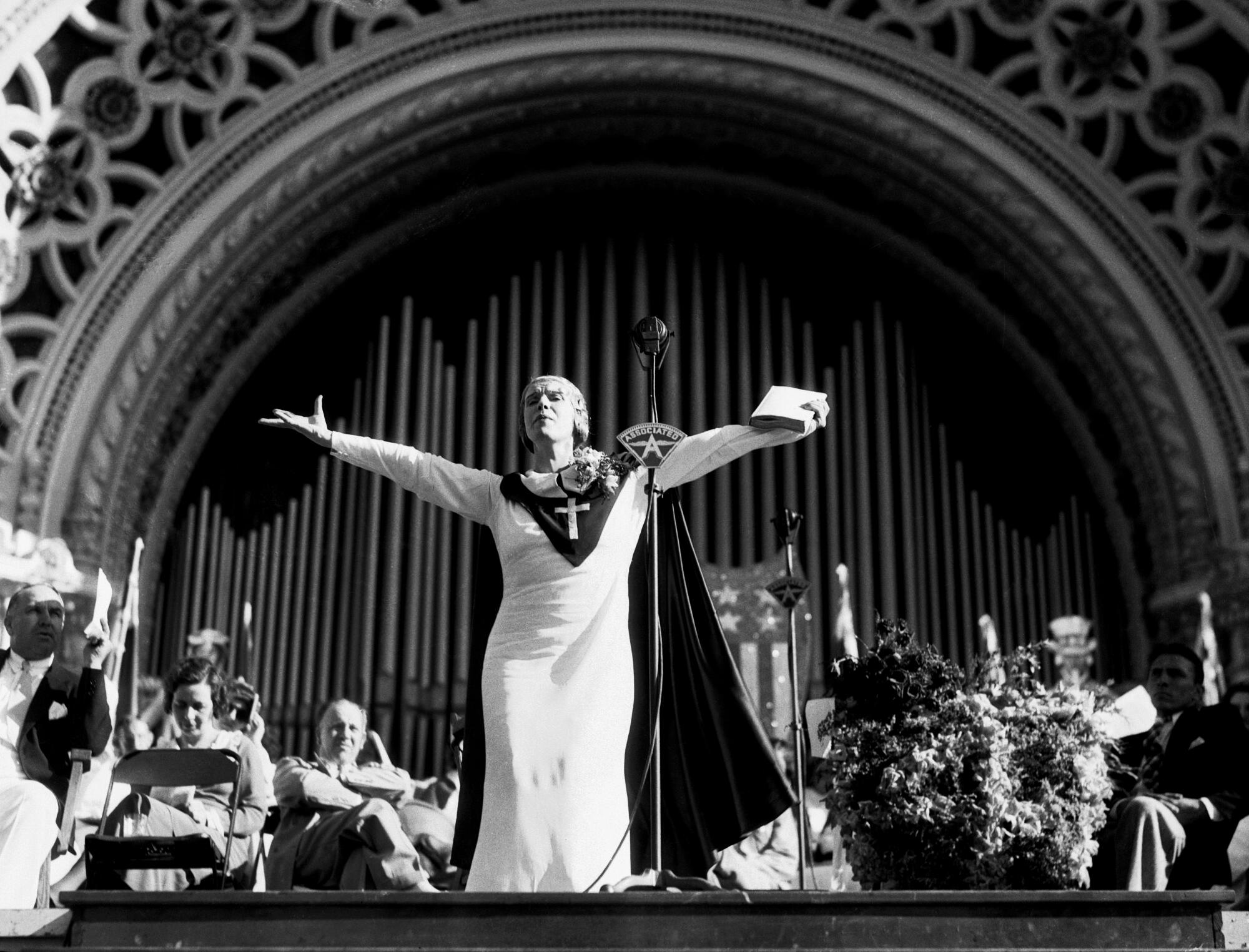
More than 3,000 of her followers accompanied Aimee Semple McPherson on a visit to the California Pacific International exposition at San Diego.
(Getty Images)
Even before her disappearance, rumors swirled of McPherson’s relationship with her married radio engineer, Ken Ormiston, a bald-headed dandy with alluring eyes and a bad limp. Soon after her reappearance, witnesses emerged to say they had spotted the pair at a “love nest” in Carmel during her missing month.
The district attorney concluded she’d made up the abduction story to hide the affair and bilk the faithful of money. Newspapers warred for scoops. A living saint in a sex scandal was irresistible copy. She endured a grand jury proceeding and a preliminary hearing, charged with conspiring to suborn perjury and obstruction of justice. Hints of her secret life played out in court. Witnesses described her wearing a disguise of thick goggles in her paramour’s company.
She portrayed herself as a persecuted prophet and blamed the prosecution on a conspiracy of Satanic forces. She had glimpsed L.A.’s underworld, a “kingdom which exists just beneath the thin-veneered surface,” and the “hordes of darkness” were coming for her.
H.L. Mencken came to town, bearing acid. The journalist — a famous enemy of religion — called McPherson a “commonplace and transparent mountebank.” Her temple was “large and hideous.” Her sermons were “time-honored evangelical hokum.” Commanding assistants on stage, she resembled “the Madame of a fancy-house on a busy Saturday night.” She was popular because “there were more morons collected in Los Angeles than in any other place on earth.”

Aimee Semple McPherson is tended to by nurse Bessie Silva in August 1931, following what the Associated Press described as “either a nervous breakdown, blindness or overwork, or, as her mother says, recovery from a face-lift operation.”
(Associated Press)
Yet Mencken considered the criminal prosecution obscene, since it hinged on whether she lied to disguise an affair. “It is unheard of, indeed, in any civilized community for a woman to be tried for perjury uttered in defense of her honor,” Mencken wrote.
The D.A. abruptly dropped the charges in January 1927 — possibly because McPherson blackmailed publisher William Randolph Hearst to use his sway with local prosecutors, a theory with some support in FBI reports. (The dirt on Hearst: rumors of a love-triangle murder on his yacht.)
The scandal amplified McPherson’s profile, and her following doubled. In the 1930s she was big enough to be name-dropped in the lyrics of “Hooray for Hollywood.” But her tone grew darker and more paranoid, and her relationships curdled. Debt swamped her church. She became embroiled in lawsuits and alienated from her mother and daughter. She died in 1944 from an overdose of sleeping pills that may or may not have been accidental.
Her life has since inspired musicals and novels, films and songs, and arguably the best episode of the original “Star Trek,” in which Captain Kirk falls in love with a version of her. The Foursquare Church she founded now has more than 8 million members worldwide, but her name has faded from textbooks. The Angelus Temple also endures, with twice-weekly livestreamed services, an innovation its tech-savvy founder would have embraced.
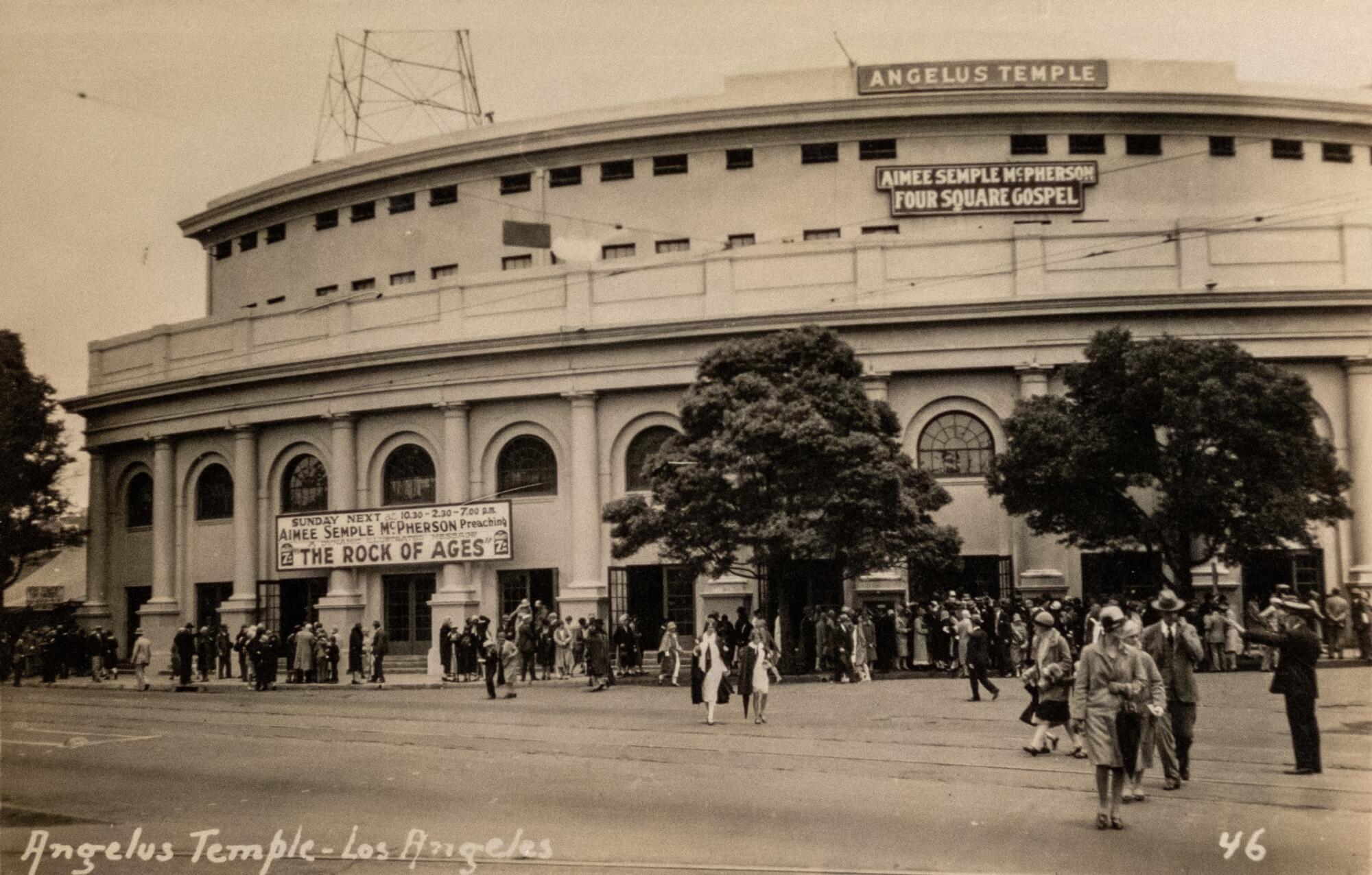
The Angelus Temple, as seen on a vintage postcard.
(Francine Orr/Los Angeles Times)
Hoffman’s new biography withholds conclusive judgments about whether the disappearance was a hoax, but she considers it likely. A detail that undermined the abduction story, in Hoffman’s view, was the thin wristwatch a camera captured on the evangelist soon after her reappearance. If she’d walked into the sea in just a swimsuit and bathing cap, where had the watch come from?
“I couldn’t unsee that,” Hoffman told The Times in a recent interview. “The case against her was pretty damning.”
Hoffman considers her a formative figure in 20th century American religion, a pathbreaker for women who became a cautionary tale about the corrosive nature of fame — and who remains forever elusive. “You kind of can’t put your arms around her,” Hoffman said. “There’s this kind of unknowable aspect to her.”
Whatever motivated her disappearance, Hoffman doesn’t believe it was staged for publicity. “There’s something about it that feels very spontaneous to me,” she said.
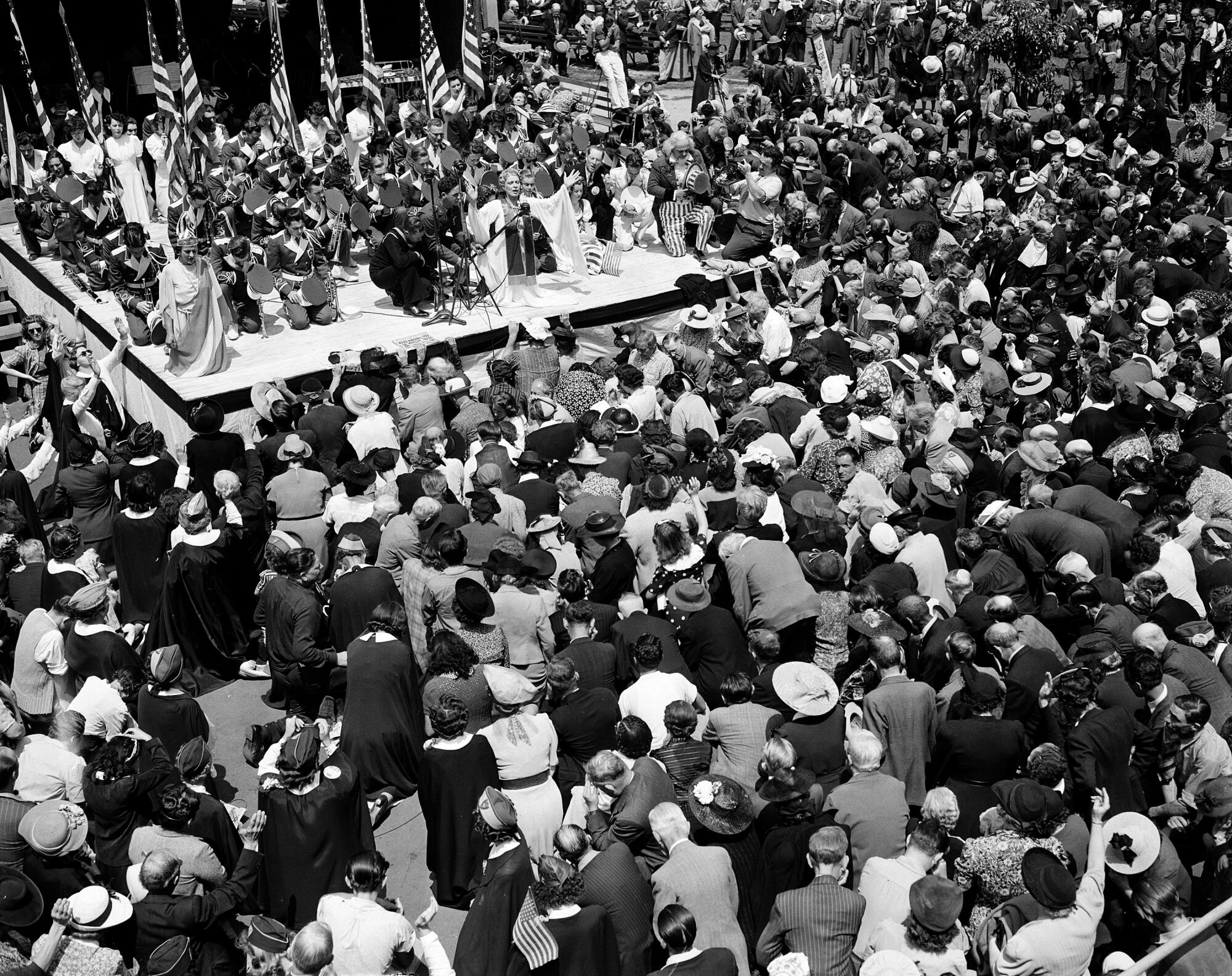
Led by evangelist Aimee Semple McPherson, rear center, thousands of people drop to their knees and pray for an Allied victory at a bond-selling rally in Pershing Square on June 20, 1942.
(IRA W. GULDNER/AP)
McPherson stuck to her abduction story, telling it and retelling it her whole life. For biographer Gary Krist, fatal to her credibility is the letter her mother received a month after the disappearance. It was supposed to be from the kidnappers, who called themselves “The Avengers.”
Instructing her to “raise the dough,” it sounded less like a real note than the snappy slang of the hard-boiled imagination.
“We’ve moved her to a safe place now and have doped out a plan of ransom payment,” the letter said. “We are sick and tired of her infernal preaching, she spouts scripture in answer to everything. We took her for two reasons — First to wreck the damned Temple and second to collect a tidy half million.”
“It was such an obvious fake, and she tailored her story to that note, or rather the note was tailored to her story,” Krist told the Times. His 2018 book “The Mirage Factory” portrays McPherson as one of the visionaries (along with D.W. Griffith and William Mulholland) that built Los Angeles.
“It’s perfectly possible she just had a mental break and said ‘I’ve got to get out,’ and she didn’t really think it through,” Krist said. “Quite soon she realized, ‘I don’t want to give up my life entirely.’ So she had to construct this wild story to explain her absence.”
Daniel Mark Epstein, who wrote the 1993 biography “Sister Aimee,” said the evangelist seems to have been overwhelmed by her own success and in a desperate state.
“This is kind of a classic case of ‘be careful what you wish for, because you might get it,’” Epstein told The Times. “She needed to escape.”
But escape was the easy part; finding a way to come back was impossible.
“I think that’s the part where the lies come in. I think it undermined her own sense of herself,” Epstein said. “I think in some ways she never really recovered from that lie. I think it remained a psychic wound.”
The particulars of McPherson’s wild narrative — of being abducted for sale into slavery south of the border—reflected a well-known moral panic in 1920s America.
“When McPherson tells that story, it’s not coming out of thin air,” historian Matthew Avery Sutton told the Times. “She’s slipping into a trope that’s very current at the time. As shocking as that seems to us today, it would have been less shocking in 1926.”
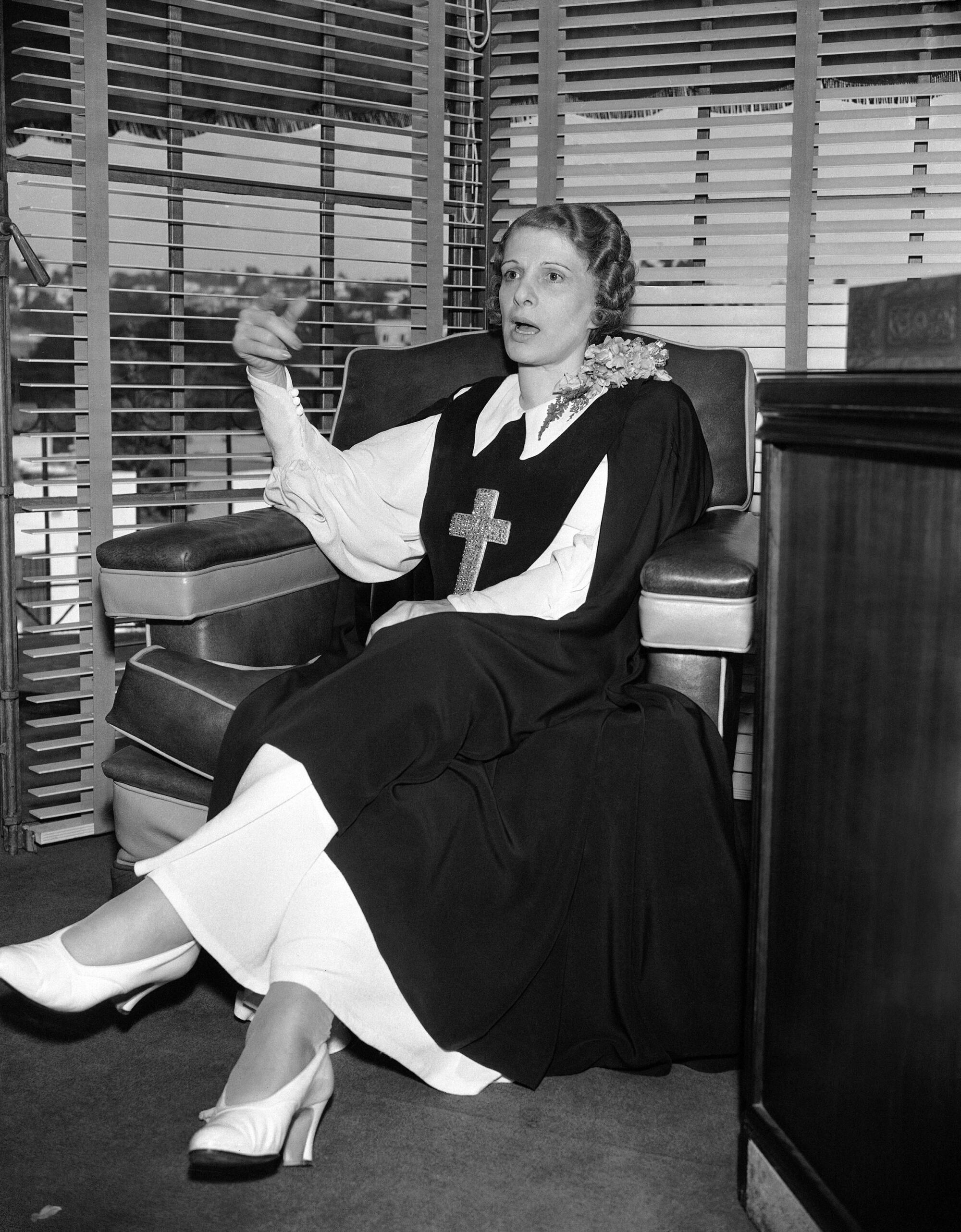
Aimee Semple McPherson in October 1938.
(Associated Press)
Many of her parishioners did not budge in their belief in her; on the contrary, the scandal might have deepened it.
“We see that over and over again with other evangelists and their scandals,” said Sutton, who wrote the 2009 book “Aimee Semple McPherson and the Resurrection of Christian America.”
“People want to believe that there’s this diabolical scheme out there to bring down God’s anointed.”
She almost certainly shacked up with Ormiston during the missing month, Sutton said, but it has remained a circumstantial case.
“There was never that smoking gun that proved once and for all she made up the story,” he said.