
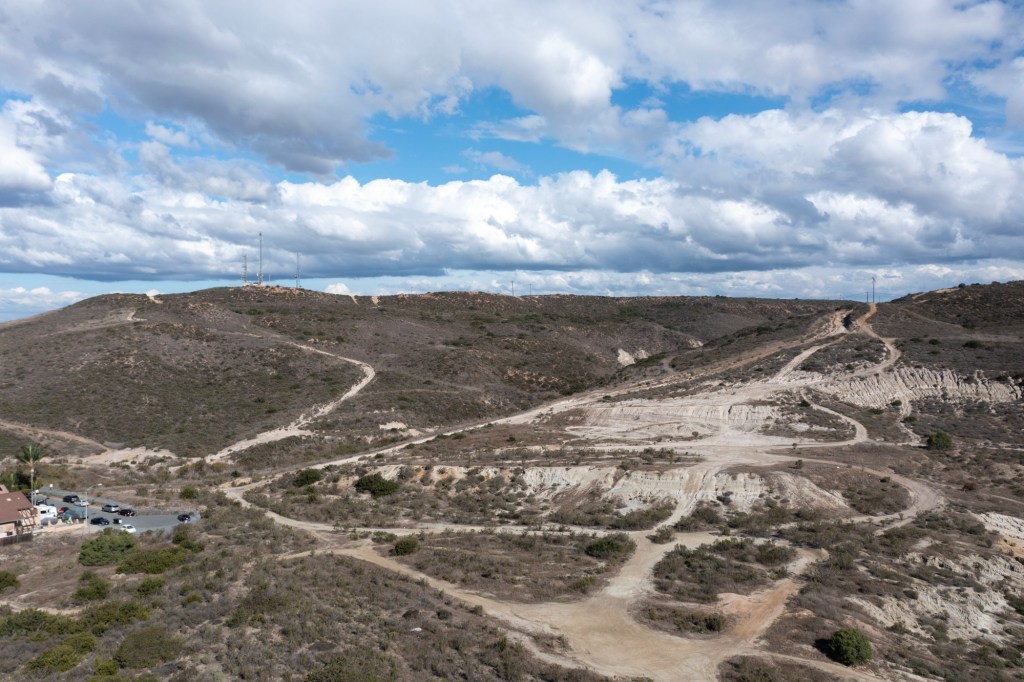
San Diego officials approved a plan for up to 5,130 homes this week near the U.S.-Mexico border that could be one of the region’s largest residential developments in years.
The Southwest Village plan stretches over a 490-acre plot of land, nearly half the size of Balboa Park, that sits between the Otay Mesa and San Ysidro neighborhoods. City officials have been eager to approve new housing on mostly vacant land near the border, including a nearly 1,000-unit housing development in mid-April.
Southwest Village would cover land owned by several developers, the city and private homeowners. It envisions a somewhat walkable area with bike lanes and bus routes, construction of new roads and infrastructure projects, 175,000 square feet of commercial space, as well as a new school and 200 acres of open space.
The San Diego City Council voted 6-2 on Monday to approve the project. Councilmember Vivian Moreno recused herself because she said she had a financial interest in a residential property in the area.
“San Diego needs more homes in every part of our city,” Mayor Todd Gloria said after the vote. “This is another important step toward building more homes, lowering housing costs and creating neighborhoods where families can live, work and thrive.”
Councilmembers Marni von Wilpert and Joe LaCava voted against the plan. LaCava said he wanted more time to review the proposal because, even though it has been planned for a decade, it was the first time the council saw it. Von Wilpert was concerned a new fire station would only be built after 700 homes were constructed and wanted it to be done at the beginning. She also wanted more guarantees in writing that the developer would build amenities it promised, like a public park.
The overall Southwest Village Specific Plan, roughly 1,800 feet at its southern point from the border, was led by Irvine-based Tri Pointe Homes, which plans to build about 1,500 to 2,100 homes on the site. Initial plans call for 778 multifamily units, such as townhouses and apartments, as well as 142 single-family homes. About 92 apartments would be set aside for low-income renters. Other developers could build homes on a smattering of private and public parcels on the rest of the land.
It’s common for developers to get entire master plans approved, in this case, Tri Pointe, even if they don’t plan on building the whole project themselves. There is no guarantee that other developers already building nearby will jump at the opportunity to start construction on areas that aren’t Tri Pointe’s. But the council’s action zones the land for the possibility of up to 5,130 homes.

A map of the San Diego’s new Southwest Village near the U.S.-Mexico border (City of San Diego).

Rendering of proposed improvements to Beyer Boulevard near San Ysidro to make way for new home development (City of San Diego).

A map of San Diego’s new Southwest Village near the U.S.-Mexico border (City of San Diego).
Show Caption
1 of 3
A map of the San Diego’s new Southwest Village near the U.S.-Mexico border (City of San Diego).
Allen Kashani, director of land entitlements for Tri Pointe, said it began work on the project in 2016 and has spent years talking with homeowners in the area, meeting with environmental groups and compromising on open space and infrastructure requirements. There are already homeowners in the area, and not everyone was thrilled with becoming part of the new district.
Antonio Blas said his family has owned land zoned only for single-family homes inside the new village for roughly 40 years. He argued that the change to denser development essentially devalues his land.
“This sudden rezoning amounts to a regulatory taking,” he read from a prepared letter, “that severely diminishes the utility, purpose and financial value of our land.”
Other homeowners and some businesses objected to the approval because they said road and infrastructure improvements were not enough or would not be prepared in time for construction. Some said they felt cut out of the planning process.
Rob Hixson, chair of the Otay Mesa Planning Group for 16 years, said he disagreed with people upset about the project. The planning group had previously approved the site plan, as did the city’s planning commission.
“We’ve asked a lot of Tri Pointe Homes, and they’ve delivered,” Hixson said. “No one has ever been excluded.”
Environmental objections to the project were another factor. Michael King, a conservation organizer with the Sierra Club, argued the project was in a location largely cut off from public transportation, and there was no significant plan to fix it. The planning of future transit, from the trolley to bus lines, would fall to the San Diego Association of Governments, not the council.
San Diego housing analyst Gary London, of London Group Realty Advisors, said the day after the vote that the development was a good step for the region’s housing needs because it will mean home prices will likely be lower than the rest of the county. New townhouses in the area typically run $530,000 to $650,000, less expensive than other parts of San Diego.
“It’s virtually the only place we can add a large increase of new housing” in the city, London said. “It’s hugely important.”
He said a possible negative of the new zoning, as touched on by the Sierra Club, is that it will mean everyone who lives there will need to get in a car to go to work. He said any new residential developments would ideally be near a job center, and he could think of areas in the eastern and northern parts of the county that would be better suited. However, the city of San Diego is often more aggressive in new home approvals than neighboring cities, so London said it was still overall a good move.
There is a bus line in the area, Route 905, but it would need to be rerouted for a southern stop once Southwest Village is built, or county planners could add another bus line. Its closest trolley stops would be in San Ysidro or Beyer Boulevard, but it’s hard to estimate a drive time without roads being built.