
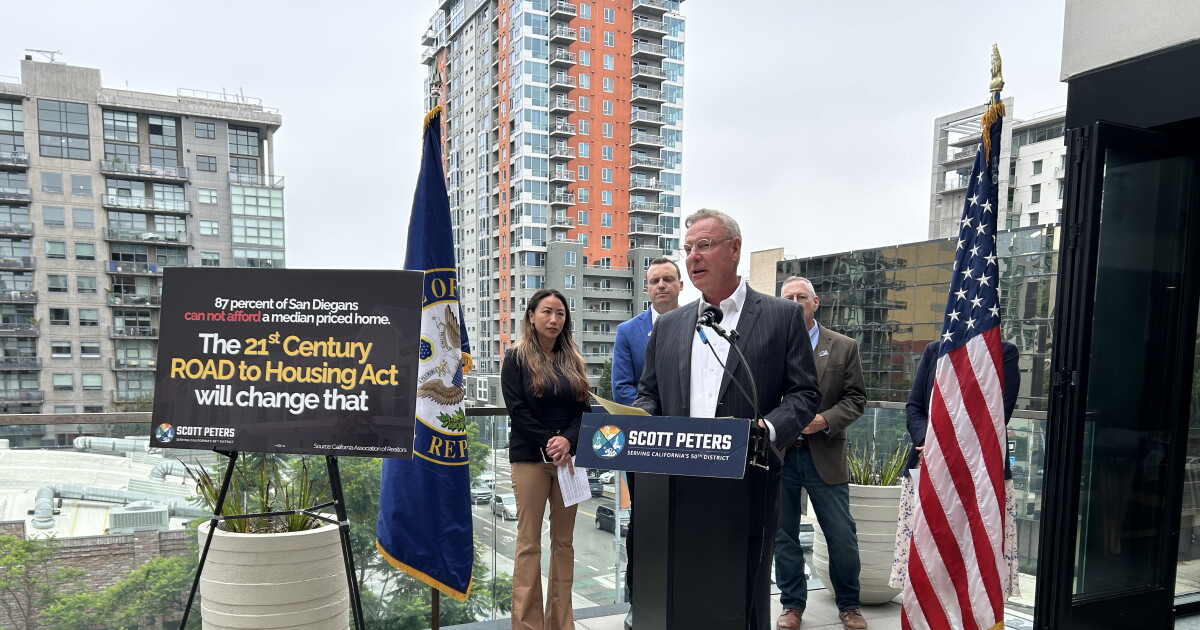
Congress passed the 21st Century ROAD to Housing Act in June to increase housing production as the nation grapples with a housing affordability crisis.
On Thursday, local housing leaders joined Rep. Scott Peters, D-San Diego, at a news conference in downtown to highlight the importance of the bill.
“The most effective way to lower housing costs is to increase housing supply,” Peters said. “The 21st Century ROAD to Housing Act is landmark federal legislation to increase housing supply and make housing more affordable for everyone.”
San Diego was the nation’s 10th most expensive rental market in June, according to the national rent report from Zumper, a nationwide rental listing platform. And the county is among the least affordable for homeownership in California, according to the California Association of Realtors.
Experts say the housing crisis in California and across the country is a result of a shortage of homes. That’s why the 21st Century ROAD to Housing Act looks to help boost production with several provisions that could be impactful in San Diego.
One is a major expansion of the availability of Low Income Housing Tax Credits. These tax credits are a major way affordable housing developments get financed when they’re bought from developers by banks. The bill raises the cap on how many banks can hold, giving them more freedom to fund affordable housing.
Another is prioritizing more development in “Opportunity Zones” or “economically distressed communities” with grants from the Department of Housing and Urban Development (HUD); another is providing more funds to local governments that demonstrate innovative ways to increase affordable housing production.
The bill would also create a program to help cities identify preapproved housing designs for certain types of housing, like Accessory Dwelling Units, or ADUs, which could speed up the approval of building permits. And it would make Federal Housing Administration (FHA) loans available for ADU construction.
And it would create a dedicated funding source aimed at helping cities convert vacant commercial and industrial buildings into housing.
“It’s the first major housing bill Congress has done, I think in 36 years,” Peters told KPBS. “And it comes in response to concern in San Diego and in California and across the country about the cost of housing, and with a recognition that the federal government has gotten in the way … in many ways, of making housing more affordable.”
Adriana Heldiz
/
CalMatters
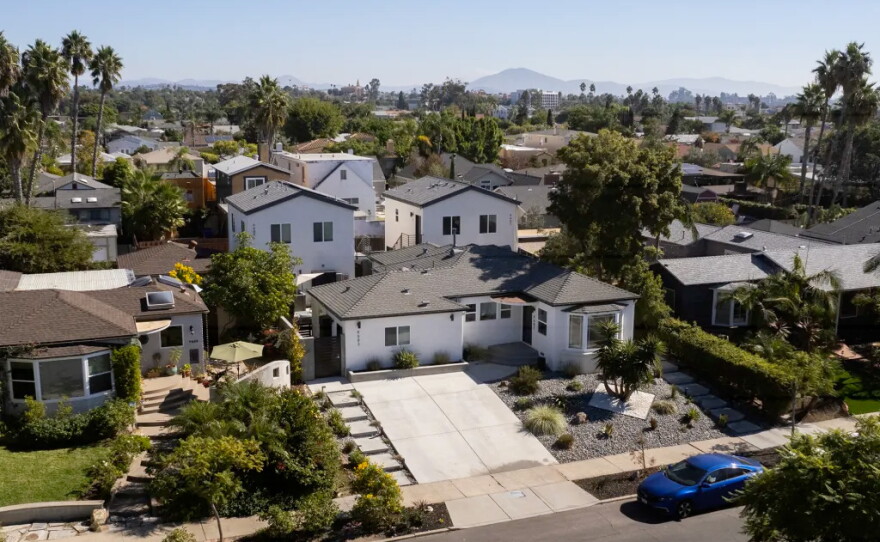
A single-family home with an ADU complex in the backyard area in the Talmadge neighborhood of San Diego on Nov. 5, 2023. The ADUs were the first constructed under San Diego’s density bonus program.
Peters and Rep. Robert Garcia, D-Long Beach, are co-chairs of the pro-housing “YIMBY” (Yes In My Backyard) caucus in Congress, a group of legislators focused on addressing housing affordability and homelessness.
The bill was approved by a large majority in both chambers of Congress and would be a bipartisan success at a time when bipartisan legislation is increasingly rare.
“The most important thing though, is just that something happened and that the Congress is like, waking up to the idea that housing is expensive, not just in California, not just in San Diego, but everywhere,” said Colin Parent, CEO of Circulate Planning and Policy.
Another major provision of the bill addresses corporate ownership of single-family homes. The bill would restrict large institutional investors from buying more than 350 single-family homes, with some exceptions designed to encourage housing production.
These large institutional investors can get an exemption if they are building new single-family homes specifically for the rental market, with a requirement to sell to an individual within seven years.
In 2024, the county looked into the issue of corporations buying single-family homes, but it’s unclear at this time how much impact such a ban will have in San Diego. Only 3.6% of single-family homes in San Diego County are owned by large investors, according to the California State Library’s California Research Bureau.
“It’s a very, very, very, very, very small share,” Parent said. “And it’s even smaller in the San Diego region. So, I don’t think that is going to make a big difference to … anybody locally. But that being said, I think it’s a perfectly good rule to institute. I think it’s a small thing. It’s not a big problem, but we certainly don’t want it to become a big problem.”
Peters applauded the bipartisan nature of the legislation, something he recognized isn’t common in Washington, D.C.
“I hope my colleagues see that doing this kind of thing is good politics, too,” Peters said. “And maybe … we can figure out a way to keep working together.”
San Diego Mayor Todd Gloria, in his capacity as President of the U.S. Conference of Mayors, applauded the passage of the bill.
“We thank Congressional leaders for proving that housing affordability is not a partisan issue — it’s an American priority,” Gloria said a statement on a U.S. Conference of Mayors Instagram post. “We urge the President to sign it without delay — American families can’t afford to wait.”
Carlynne Yu, CFO of the Regional Task Force on Homelessness, said the bill is an important piece of the struggle to get people into homes.
“The reality is simple: homelessness cannot be solved without housing,” Yu said at Thursday’s news conference. “One of our greatest challenges isn’t a lack of collaboration. It’s the shortage of housing people can actually afford. The Road to Housing Act helps address that challenge in meaningful ways.”
And Stephen Russel, President and CEO of the San Diego Housing Federation, said San Diego is already ahead of the game on incentivizing affordable housing construction.
“The City of San Diego is a beacon here in the state of California and in the nation in terms of how it has addressed this housing crisis, and so incentivizing other municipalities in this county and throughout the nation to do the same will make a big difference in the affordable housing horizon,” Russel said.
President Donald Trump abruptly canceled the signing ceremony in June, telling lawmakers he wouldn’t sign the bill because he wants Congress to focus on the SAVE America Act which would require proof of citizenship for all voters. Sen. Thom Tillis, a Republican from North Carolina, said such a bill “will never pass in this Congress,” after a “tense” meeting with the President, according to The Associated Press.
Even without Trump’s signature, the bill is set to become law on Friday after the deadline to sign or veto the bill has passed. The bill was approved by far more than two-thirds, with the House voting 358-32 and the Senate voting 85-5 in favor of the bill.
According to Parent, the bill is a great step forward, but it doesn’t mean this problem of housing affordability is solved.
“It’s great that Congress is doing this, but, boy oh boy, that’s not enough,” Parent said. “And that we’re still going to need state officials to pass good laws in California. We’re going to need local officials, city council members, mayors to say yes to more homes.”
A full analysis of the bill’s many provisions is available here from the Bipartisan Policy Center, a D.C.-based think tank that promotes bipartisan policy solutions.
Low Income Housing Tax Credits
The bill would raise a cap on the percentage of a bank’s public investments that can be Low Income Housing Tax Credits, or LIHTCs. This would unlock billions of dollars for affordable housing projects nationwide.
LIHTCs are bought by banks from developers who build affordable housing. This gives the developers up-front capital to build, and banks are able to better utilize the tax credits in the long run. Those affordable developments are then offered at below-market prices, tied to a certain percentage of area median income. There are thousands of affordable housing units in San Diego County that took advantage of LIHTCs that you can find online at the Novogradac Affordable Housing Resource Center’s LIHTC mapping tool.
Opportunity zones
The bill directs HUD to prioritize projects in Opportunity Zones for federal grants. There are Opportunity Zones in Southeast San Diego, Chula Vista, Lemon Grove, El Cajon, Santee and Escondido.
Parent said this has successfully gotten more money to flow to areas that previously had difficulty getting investment.
“It really meaningfully moved capital into places that otherwise it wouldn’t happen,” Parent said, “And it was disproportionately being used to create more homes…which is really good.”
The bill ties Community Development Block Grants (CDBGs) to housing production levels and allows this money to go directly to building affordable homes. CDBGs are federal funds used for infrastructure, economic development, public facilities, and more, according to HUD. Previously, CDBGs were not allowed to be directly used for construction of homes, only associated infrastructure.
There’s also a provision for bonuses for cities that demonstrate accelerated building, and includes small penalties for those lagging in production. You can learn more about how the city of San Diego utilizes CDBGs, and how to get involved in the process, on the city’s website.
Environmental review
The sweeping housing affordability bill also simplifies compliance with the National Environmental Policy Act (NEPA) for HUD projects and expands HUD’s authority to delegate environmental review to states, local governments, and tribes. It also exempts infill housing, small-scale construction, and housing rehabilitation from NEPA review.
In July 2025, California made major changes to the California Environmental Quality Act (CEQA) to streamline environmental reviews for housing developments. The federal housing bill would make similar changes for projects receiving HUD funding.
Innovation fund
The bill creates a $200 million annual grant program for local governments and tribes that “demonstrate measurable increases in housing supply.” San Diego has led the state of California in housing “innovations” like the Complete Communities Housing Solutions program that lets builders build more units if they include affordable homes.
The Bipartisan Policy Center recently highlighted San Diego’s success as one of four cities, “taking bold, practical action to meet their residents’ housing needs,” citing the Complete Communities program.
Grants for pre-approved housing designs
The bill gives money to local governments and tribes to choose pre-approved housing designs that help streamline production. ADUs, duplexes and townhomes are among the pre-approved designs in the bill. By selecting pre-approved design plans, builders and homeowners who choose to add an ADU can bypass the design review process that adds time and costs to a project.
Since at least 2019, San Diego County has offered pre-approved ADU designs and waived permit and development fees for projects in unincorporated San Diego County.
“Being able to create a product in a factory, purchase it … out of a catalog or online, and then… have it shipped and installed, that’s going to make a lot of sense for a lot of people,” Parent said. “It used to be that you could buy a house from the Sears catalog, and they would deliver it to you … and … you could assemble it. There’s some very handsome homes in North Park and South Park that are from that … era.”
Commercial conversions
The bill would provide funding for cities looking to convert vacant commercial and industrial properties into affordable housing, with a focus on Opportunity Zones. Grant and loan money from the HOME Investment Partnerships Program would go to local governments and developers looking to create affordable housing in these buildings.
In April, CBRE Group reported that roughly 25% of downtown San Diego’s office space was vacant.
Manufactured and modular housing
A provision from Rep. Peters’ Housing Supply Expansion Act is included in the bill to remove regulations on manufactured homes, which Peters called an important source of affordable housing.
The bill would eliminate chassis requirements for manufactured homes, or mobile homes. According to Peters, this is an important source of affordable housing, and the requirement for a vehicle chassis on the bottom of such homes adds costs to their construction.
“There’s been a requirement forever that they have a chassis on them,” Peters said, referring to the vehicle frame base that many mobile homes include. “My bill modernizes the federal definition and removes that chassis requirement. That’s going to save $5,000 to $10,000 per unit.”
It will also allow modular or pre-fabricated housing without a vehicle chassis to be considered “manufactured housing” under federal definitions. Modular or prefabricated construction can help lower construction costs, according to experts in the industry.
The bill also directs the FHA to review its financing for modular production to encourage this type of development, and it allows FHA loans for ADU construction. These low-interest federally backed loans are a boon to homeowners and could now be unlocked for those homeowners who want to build an ADU in their backyard and are looking for financing.
“A lot of people who have tried to finance an ADU have found it very difficult under the existing loan products that are available to them,” Parent said. He said the change would let more homeowners take advantage of an ADU on their property.
Homelessness spending
The bill would allow more spending on emergency shelter and street outreach over homeless prevention and system management. San Diego’s shortage of shelter space continues to make clearing encampments difficult, and currently only 60% of Emergency Solutions Grant money can be used for shelter and street outreach. The bill would allow local governments to request a waiver of this cap and invest more money into direct outreach and shelter space.
FHA multi-family loan limits
The bill would allow multi-family developers to receive more money in FHA-backed loans. The maximum amount in FHA loans a multifamily development can get is set based on housing costs in the area. The bill would raise that limit and change the formula used to set these limits from one based on the Consumer Price Index (CPI) to one based on the Price Deflator Index of Multifamily Residential Units Under Construction, which is the Census Bureau’s measure of multi-family home construction costs.
“Changing the rules for the FHA to provide loans for affordable housing developments means that the [San Diego] Housing Commission is going to be able to finance more and bigger projects, to be able to create more affordable homes for more people,” Parent said.
The Center for Public Enterprise in March reported on the lack of multi-family housing production nationwide and how FHA financing can help address the shortage.