
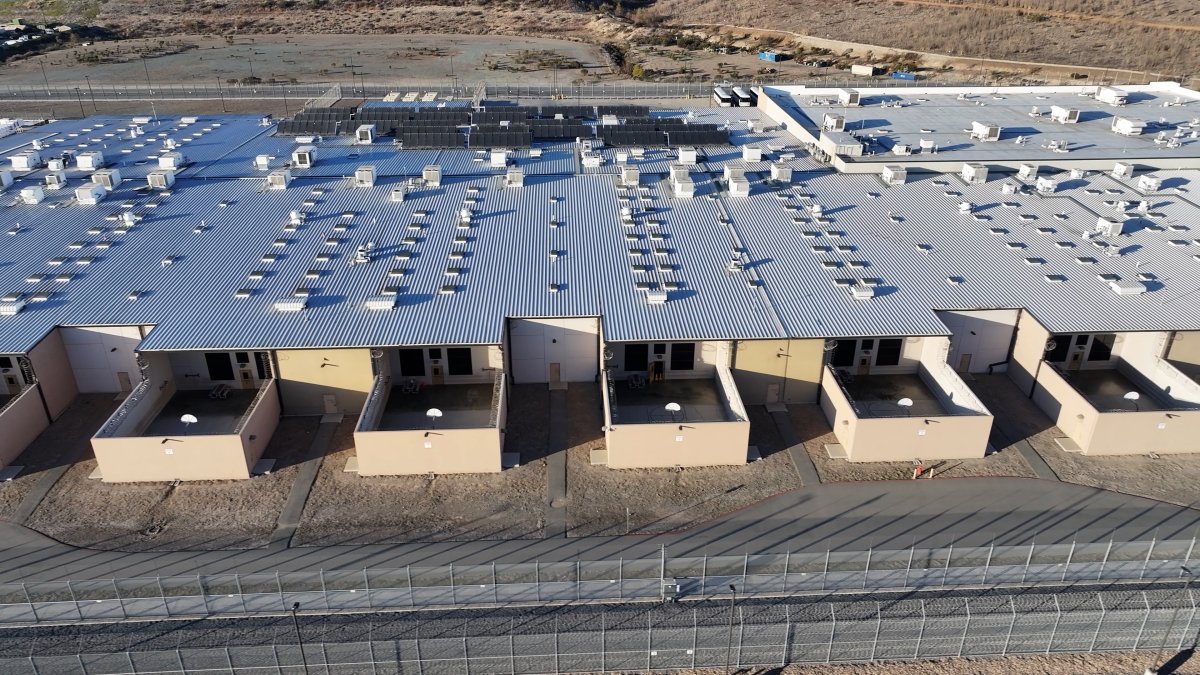
San Diego County property tax records show the Otay Mesa Detention Center was valued this year at $168 million – about a quarter of the $739 million the federal government paid to buy it last week. The county assessor said that disparity can be explained by several factors, and because of the purchase, San Diego County will lose about $2.1 million in property tax revenue each year.
Private prison company CoreCivic announced this week that the federal government had purchased two of its facilities: the Otay Mesa Detention Center, and the California City Detention Facility in Kern County, for a combined $1.5 billion.
CoreCivic said both properties were independently appraised, and the federal government will continue to pay the company to operate the facilities. The Department of Homeland Security has not responded to requests for a copy of those appraisals, but indicated in a statement that the purchase was in response to California’s effort to ban private prisons.
“The state’s sanctuary politicians continue to push legislation to outlaw or make private prisons financially infeasible,” a DHS spokesperson said in a statement. “Now, with federal ownership of these detention centers … ICE retains the detention capacity needed to arrest, detain, and remove illegal aliens.”
The Otay Mesa Detention Center’s price tag alone was $739 million. Records from the San Diego County Assessor’s office placed the value as of Jan. 1 this year at $168 million.
Assessor Jordan Marks said the property was placed on that tax rolls in 2016 at a value of $100 million, and CoreCivic put another $20 million in improvements on the property. Under Prop 13, passed in the 1970s, growth of assessed values – and subsequently, property taxes – is capped at 2%.
“There’s a couple of factors that played into this deal: One, the unique location. Two, the impact of the immigration system right now,” Marks said. “They’re in a shortage of beds, so when there’s a shortage in the market, prices go up.”
Meanwhile, the cost of construction – and the price of potentially building a new facility – has skyrocketed.
“That’s the reality of San Diego,” Marks said. “For you to build a new house, the cost of regulation, time, energy and money has made it much more expensive than buying a home and fixing it up, and I think that’s what you saw with the federal government.”
Because the federal government doesn’t pay taxes, Marks said the county will lose about $2.1 million in property taxes each year, with about $800,000 of that going to schools in the area.
“This is taking a lot of money out of the local schools, also taking money out of our local ability for water, fire districts, health care districts, everything that our community relies upon,” Marks said.
He noted that $2.1 million is a small percentage of the more than $8 billion the county collects in property taxes every year, but added, “when you’re looking at a budget deficit already in the school district, right, a budget deficit already in some of the services, like roads and other services that the county provides, every dollar counts.”
Marks’ office will do its own appraisal of the property within the next 18 months, he said.
“We have to find what’s called comps, or comparables. So in your neighborhood, where you might have a three-bedroom, two-bath every other house, it’s easy to compare,” Marks said. “We have to go and look at similar properties on a border, how many beds they have, and kind of match that up per square foot. And we’re going to do that to make sure it was done right.”
Democrats in San Diego’s congressional delegation expressed shock and suspicion at both the sale itself and the purchase price.
“All of it stinks. It all adds up to another boondoggle,” said Rep. Mike Levin, “in which I think the federal government probably overpaid for these facilities, for reasons that are unclear.”
Levin and others, including Rep. Juan Vargas, who represents the area in which the detention center is located, said they were not informed of the sale until after it was complete.
“The whole thing is quite surprising and we are not going to rest until we get to the bottom of what really happened, and whether or not taxpayers overpaid,” Levin said.
“What we’ve seen from ICE is that they have overpaid for different facilities throughout the United States,” he added, pointing to the agency’s $1 billion purchase of various warehouses it intended to turn into detention centers before looking to later offload some of those properties.
Democrats have also pointed to President Donald Trump’s financial disclosures which show he holds CoreCivic stock.
“One of the things that’s difficult is that this Trump Administration is so corrupt and has done so many things to use the federal government to help himself, his family, his friends, that it makes me really, really skeptical about this sale and what it was actually intended for,” said Rep. Sara Jacobs.
Republicans contend the purchase of the detention centers will enable the Trump Administration to better fulfill the signature campaign promise of mass deportations.
“I think it was absolutely necessary because we cannot trust California and its radical politicians to enforce the law,” said Corey Gustafson, the former chair of the San Diego County Republican Party.
“Facilities like this are critical to make sure we have the capacity to hold people who we think have come here illegally, and they will not just be dropped off because we don’t have the capacity as a government to hold them,” he continued. “So this is about deterrence in many ways.”
As complaints have surfaced about the conditions inside the detention centers, there have also been fights over access. The California Department of Justice conducted an inspection last fall, finding overcrowding and bad food at the Otay Mesa Detention Center, among other issues. And San Diego County successfully sued ICE and CoreCivic to conduct its own health inspection.
It’s not clear how that access may change now that the facility is federal property.
“It’s an extremely important thing that we have the authority and capacity to conduct these public health inspections to protect the public health at large,” said San Diego County Supervisor Paloma Aguirre, who was part of that lawsuit. “That’s the question that remains, that hopefully we’ll have more clarity from the courts in the next week or so.”