
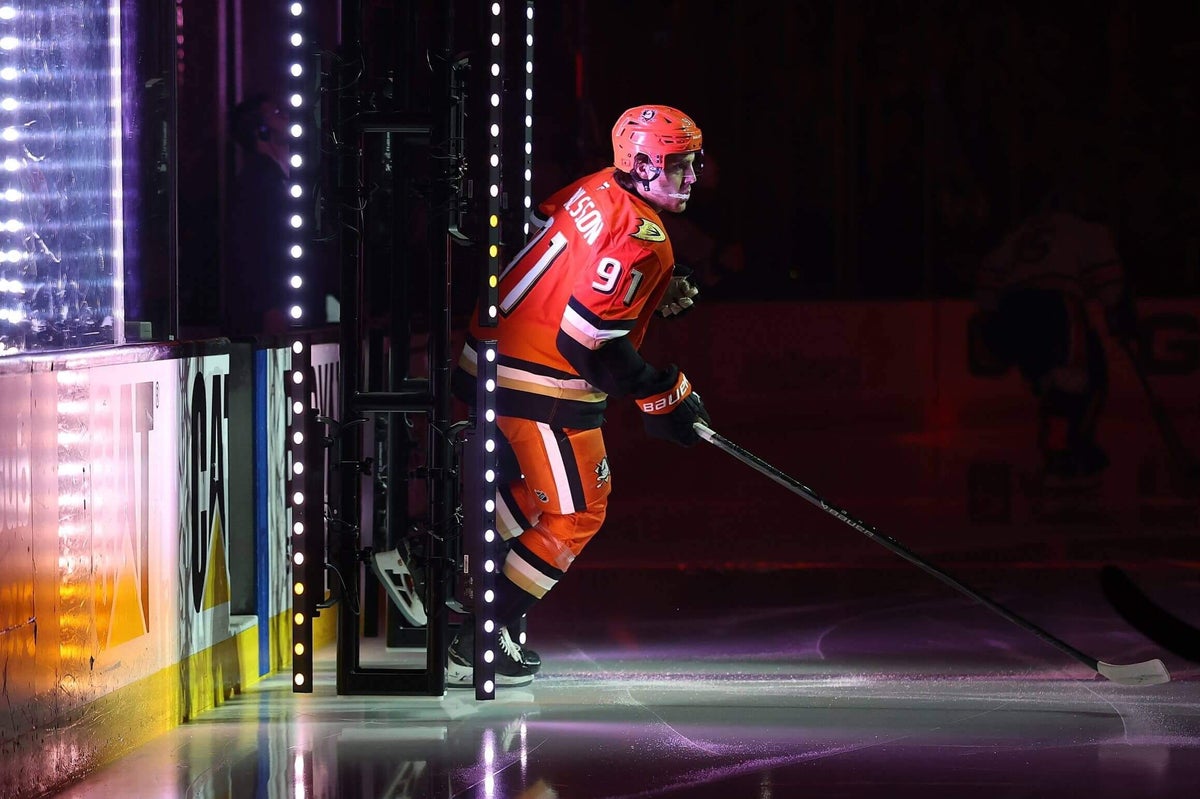
Even at a much higher number than Pat Verbeek wanted, than what Leo Carlsson’s representation pushed for, than what the blossoming center himself even dreamed of, the Anaheim Ducks did what they could have ill-afforded not to do. Signed, sealed, delivered.
The outrageous offer sheet that Carlsson signed with the Philadelphia Flyers last week was matched by the Ducks on Thursday. Five years and $90 million, with nearly an astonishing 95 percent of the contract paid out in structured signing bonuses.
The 21-year-old silky Swede will continue being the Ducks’ No. 1 center, the player the organization envisioned building around when it surprised many draft observers by taking him instead of Adam Fantilli with the second pick in 2023 after Connor Bedard came off the board.
Now that the question of whether to match the offer that rocked the hockey world has been put to bed, the Ducks have another to ponder and execute: Can they assemble a Stanley Cup-contending team with an $18 million per year player, the highest annual average in the NHL?
The Ducks will put that to the test. Conceivably, that would have been the same for the Flyers. Still, it isn’t easy to attract stars to Anaheim, and the Ducks have one on the rise. Now they’re counting on Carlsson to be just that — a true franchise-leading star, if not one of the league’s best players.
“It was surprising, to say the least,” Verbeek said of his and ownership’s reactions to the offer sheet. “I actually feel flattered, in a sense, that Philadelphia wanted such a great player. It means that we’re doing a very good job on our end, and we feel that Leo at some point — I would say next year, but I think over the course of this contract — is going to show the elite player that he is and is going to give us great reasons why we matched this offer.”
On having the backing of billionaire Ducks owner Henry Samueli, Verbeek noted, “This has kind of been something that has been more forced on us than how we like to do contracts, but knowing our owner, he wants to win just like I do. And so, we’re going to do what needs to be done to win.”
Can that be done? Is it even possible now that Carlsson’s $18 million AAV eats up 17.30 percent of the $104 million cap for the 2026-27 season? Can any NHL team win the Stanley Cup with one player taking up that much cap space?
There haven’t been many eight-figure AAV players. Only a few (Jack Eichel, Sergei Bobrovsky, Aleksander Barkov) have won a Cup in the salary cap era with a $10 million cap number. The cap, which was a paltry $39 million following the 2004-05 lockout, has spiked in the last two seasons after flattening at $81.5 million and rising only modestly over five years.
In this new landscape, the possibility of a player making $10 million or more annually hoisting the Cup should increase. Still, it hasn’t been easy for teams to win it all with a lot of cap space tied up in one player.
Nathan MacKinnon was a champion in 2022, but that was before he negotiated his $13.5 million AAV extension with Colorado, as Mikko Rantanen ($9.25 million) and Cale Makar ($9 million) were the cap charge leaders for the Avalanche. Alex Ovechkin won in 2018, but his monstrous 14-year contract with the Washington Capitals averages out to $9.538 million. Nikita Kucherov and Andrei Vasilevskiy captured back-to-back Cups with the Tampa Bay Lightning in 2020 and 2021, but both carried cap hits of $9.5 million.
More pertinent may be the cap percentage that Cup-winning stars have had. Over the last decade, Evgeni Malkin’s $9.5 million for the Pittsburgh Penguins in 2016 and 2017 ate up 13.31 percent and 13.01 percent, respectively. It’s the highest relative to the cap in championship seasons. Ovechkin’s was 12.72 percent, Rantanen’s was 11.35 percent, Eichel’s was 12.12 percent, while Bobrovsky’s and Barkov’s were 11.98 percent and 11.36 percent.
The Carolina Hurricanes, the current champions, had Sebastian Aho leading the way with a $9.75 million AAV, which was only 10.21 percent. Meanwhile, the Edmonton Oilers got close to the mountaintop with the eight-figure Connor McDavid and Leon Draisaitl, but they couldn’t finish the deal with those two AAVs combining for 25.14 percent in 2023-24 and 23.86 percent in 2024-25. With Draisaitl’s $14 million AAV kicking in last season, the Oilers fell to the salary-balanced Ducks in the first round.
Now the Ducks will try to ice a winner with a top-heavy financial structure in the same vein that the Minnesota Wild will proceed with Kirill Kaprizov and his eight-year, $136 million ($17 million AAV) contract taking effect in the coming season.
Verbeek could chuckle at the thought of Carlsson holding the highest-paid crown for a short time (“I don’t anticipate it lasts very long,” he said), but building a team that’s only just entering its contention window won’t be a laughing matter.
The next task is an extension for Cutter Gauthier, who’s coming off a 41-goal season that was the most by a Ducks player in 12 years. The 22-year-old sniper isn’t eligible for an offer sheet, but that shouldn’t stop him from getting his own eight-figure AAV contract. With just over $9 million available, per PuckPedia, Verbeek will be forced to dump salary through a trade.
“The intention is to get Cutter signed,” Verbeek said. “I think that, obviously, wherever Cutter comes in, I’m going to have some work to do to make sure that we can fit everyone in. I’ve got two and a half months to figure that out, and we’ll go through that process for the rest of the summer.”
One result of the looming cap crunch that the Flyers amplified in their offer sheet is that the Ducks had made only minimal additions while saving most of their cap room for the contracts to Carlsson, Gauthier and defenseman Pavel Mintyukov, whom they signed to a five-year, $7.2 million AAV deal. On defense, Nick Jensen has been the only replacement to fill holes left by John Carlson, Jacob Trouba and Radko Gudas leaving in free agency.
The blue line could be made up mostly of youngsters, with the 25-year-old Jackson LaCombe leading the way. Verbeek pointed to the experience that they gained in this year’s playoffs. As it stands now, though, the Ducks’ blue line will have LaCombe, Mintyukov, Ian Moore, Tyson Hinds and Tristan Luneau, whom Verbeek is expecting to make the full-time jump from the American Hockey League. They’ve also got top defense prospect Stian Solberg in development.
“The older guys provided a lot of stability,” Verbeek said. “But at this point, for me, it’s important that our younger guys be allowed to spread their wings as well and to gain more experience when this team is really ready to take on and start winning consistently in the playoffs.”
Team building won’t be a one-year issue for Verbeek as they absorb Carlsson’s contract. The Ducks could have four huge salaries once Calder Trophy finalist Beckett Sennecke comes up for his second contract. Sennecke’s entry-level deal doesn’t expire until 2028, but the Carlsson experience will motivate the Ducks to get an extension done next summer. “Certainly, we are going to have to do business in a different type of manner moving forward,” he said.
The NHL salary cap could be as much as $113.5 million in 2027-28. The Ducks will count on it rising further with the prospect of four players (Carlsson, Gauthier, LaCombe, Sennecke) eating up a large portion of their financial picture and having the flexibility to put the right pieces around them.
“The nice part is we’ve drafted well,” Verbeek said. “I feel we drafted well, and we have more support coming up underneath from the players that we have currently on our roster. Certainly, you’re going to have to look for different ways how to build the team.
“I think that I’m not really too concerned about it, because ultimately you have your core players and you have to build around them. And we will find those players that can kind of fit the contracts and the talent to go with them. So, I’m not worried about it at all.”
The most expensive contract in Ducks history now belongs to Carlsson, and with that will come massive expectations for a center who had 67 points in 70 games last season. But he wasn’t fazed by that thought Thursday.
“It’s going to be a special feeling, but I mean, I’ve been having this pressure since the draft as well,” Carlsson said. “I’m still going to be the same person. So, the only thing I can do is just go out there and play my way.”
Carlsson said he will grow as a player and that he wants to eliminate the slumps he’s run into during his three NHL seasons. Last season, he missed weeks of action after surgery to treat a Morel-Lavallée lesion on his thigh, which kept him from playing for Sweden at the Olympics. “It’s going to be hard, but that’s my goal too,” he said.
The Ducks firmly believe the best version of Carlsson is coming. They’ve put $90 million behind that belief.
“Players like Leo don’t come along very often,” Verbeek said. “He has elite skill, elite vision. His speed is also. … He’s able to go east-west just as fast as he can north-south. I think the size has played a lot into it. I think Leo is very smart. He’s a 200-foot player, and I just think with his ability, he makes players around him much better.
“You just don’t come across these types of players, and I think at some point — maybe not next year but in the near future — that it’s going to prove true.”