
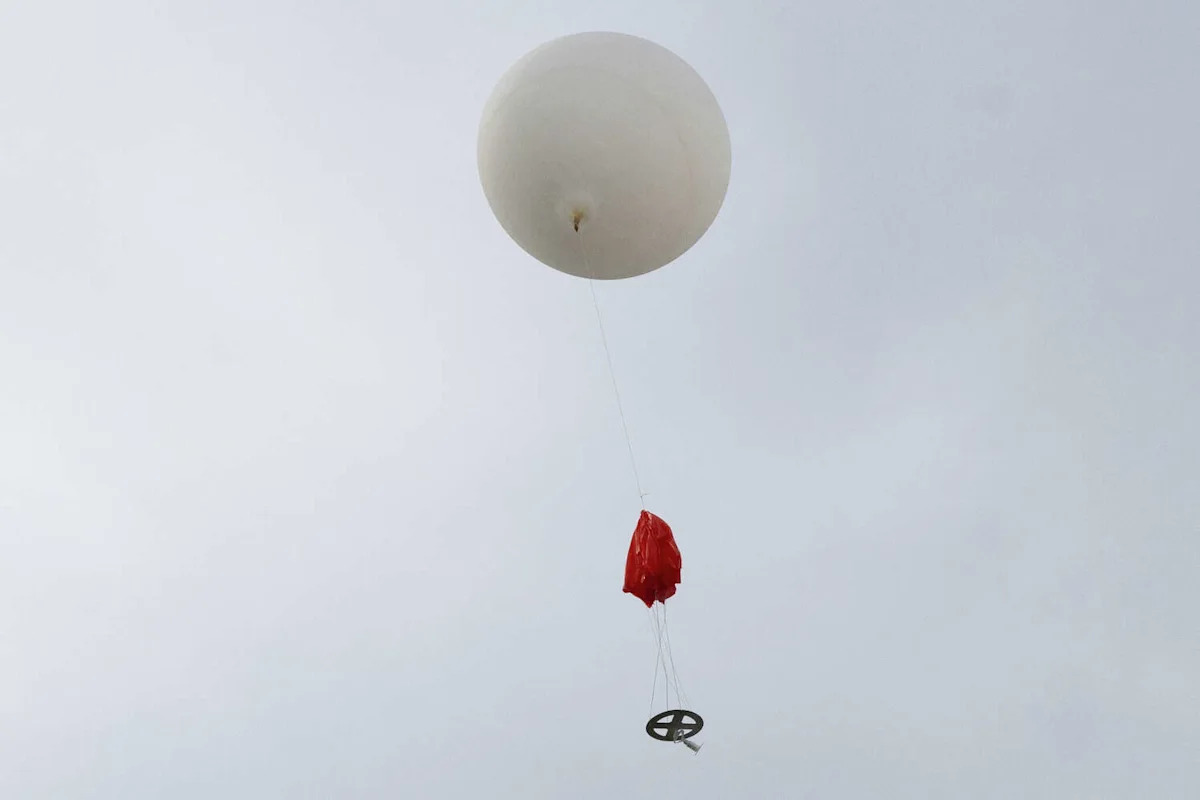
A crucial device that measures temperature, wind, pressure and wind miles above Earth’s surface has been out of service for an unprecedented spell, leaving Bay Area meteorologists without critical forecast data.
Typically, two weather balloons per day are remotely launched from Oakland San Francisco Bay Airport. But the site – the only launch site in Northern California – has been out of commission since June 29 due to a hydrogen shortage, according to the National Weather Service. It’s the longest consecutive stretch without weather balloon data in the location’s 78-year history, according to Daryl Herzmann, a meteorologist who analyzes environmental data for the Iowa Environmental Mesonet.
A weather service spokesperson said it “awaits the delivery of lifting gas” so it can restore the weather balloon launches. Brian Garcia, a warning coordination meteorologist at the local weather service, clarified the lifting gas is hydrogen and said the agency is “working tirelessly” to restore the data, but there is no known time for return to service.
Some balloons use helium as the lifting gas, but Garcia said the system in Oakland was “designed for hydrogen only. Accepting helium would require a major overhaul, and helium is expensive.”
The weather service said the hydrogen shortage is not related to a Feb. 24 explosion of a hydrogen truck in Colton (San Bernardino County) that disrupted California’s supply of hydrogen fuel.
Weather balloons carry an instrument called a radiosonde, which measures temperature, pressure, humidity and wind up to 15 miles above the ground. Data is transmitted remotely and is available publicly. It gives meteorologists high-quality observations of the upper atmosphere, which is critical for forecasting fog, air quality, thunderstorms and other short-term weather phenomena.
Critically, radiosonde data is also ingested into weather models, which simulate weather conditions around the world and have greatly improved forecast quality in recent decades.
There are alternative sources of upper-atmosphere observations, including satellites and aircrafts, but radiosondes’ vertical reach and high-resolution data makes them one of the two most valuable inputs to weather models.
The Vandenberg Space Force Base (Santa Barbara County) and Marine Corps Air Station Miramar (San Diego County) are the other radiosonde locations in California; the balloons at those locations are still being launched daily.
In April 2025, the weather service announced it was reducing or suspending the radiosonde program at select sites nationwide due to staffing shortages and operational priorities.
A large swath of the Western U.S. is now without morning radiosonde observations, which is inconsistent with the World Meteorological Organization’s guidance for launches every 12 hours. Being launched at exactly the same time as other balloons around the world is critical for weather models, which make predictions twice per day and use high-quality global observations as a starting point.

A National Weather Service map of upper-air observations around 18,000 feet Friday morning shows a big gap in weather balloon data throughout the West, including over Oakland. (National Weather Service)
In normal operations, the weather service supports 69 upper-air observations throughout the contiguous U.S., but more than two dozen locations did not release weather balloons in sync Friday morning. Some get launched later in the day, but that is not ideal due to the need for worldwide consistency.
“While it’s difficult to pinpoint exactly how much effect the widespread lack of vertical atmospheric profiles in recent months have played on actual (weather prediction) accuracy, it’s probably not zero given how broad and persistent a data void has been present much of the time,” said Daniel Swain, a climate scientist at UC Agriculture and Natural Resources.
Aside from the Oakland disruption, two locations near California have been hit with cutbacks. In Medford, Ore., weather balloons typically launched in the early morning are delayed until midday. The most recent balloon data in Tucson, Ariz. came in January.
“Currently, there are no weather balloon launches happening in Tucson; it’s a real shame that we don’t have any observations here anymore,” wrote Patrick Bunn, a University of Arizona meteorologist, in a forecast last month. “They are a critical piece in understanding current conditions, particularly through monsoon season, and enable models and us to make better predictions.
The weather service contracts with other sources for radiosonde data, including Bay Area company, Windborne. There is also a seasonal program coordinated by UC San Diego to collect data during atmospheric rivers, with a local site in Bodega Bay. But those observations won’t return until the storm season.
“I want to stress that this program is not meant to be a replacement for (weather service) launches,” program coordinator Anna Wilson said. “We want to advocate for the (weather service) launches to continue in all places they have been launched for many years, at least twice a day. It is an extremely valuable part of the global observing system.”
The Trump administration fired many early-career meteorologists early last year, and some veteran employees took early retirement to avoid potential layoffs. A lack of senior meteorologists reduced local weather knowledge and has strained the weather service’s connections with emergency managers and other partners.
The weather service announced in May it was hiring early-career meteorologists at most offices throughout the country. But as of July 10, a significant number of vacancies remained, according to the federal job hiring website.
Subscribe
There’s more to San Francisco with the Chronicle. Subscribe today for just 25¢.
This article originally published at California forecasters lose ‘extremely valuable’ weather data during historic outage.