
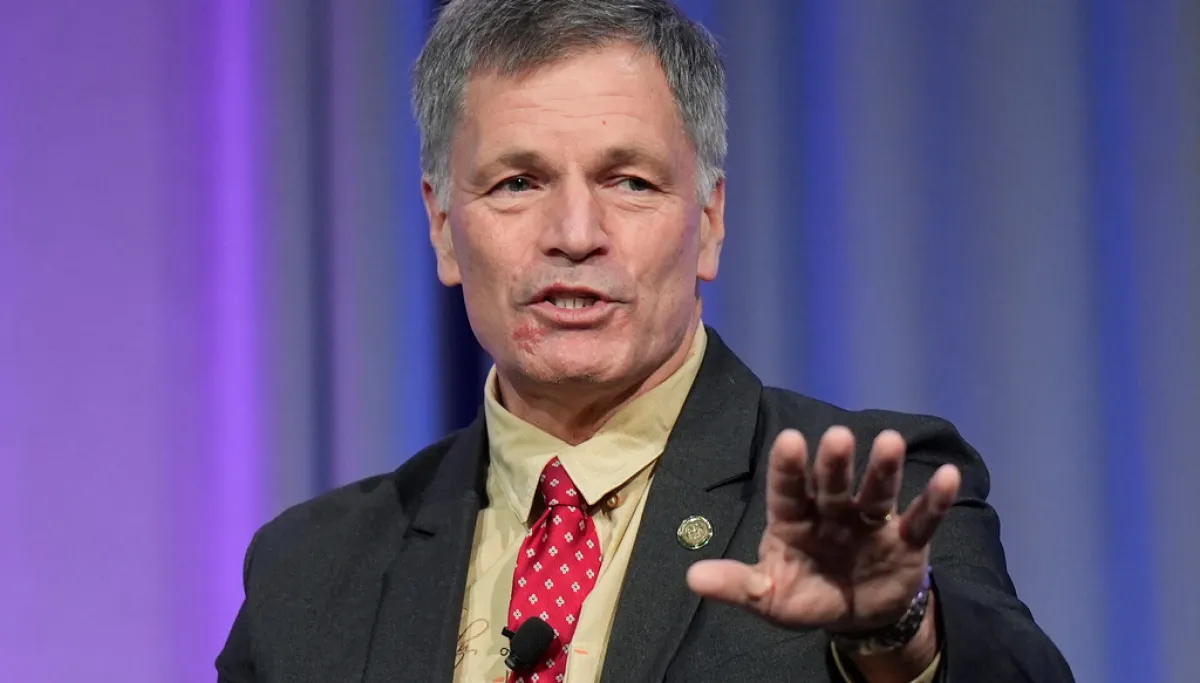
Wyoming Republican Gov. Mark Gordon said he was planning legal action against any efforts by California environmentalists to block an Oakland coal export terminal, arguing the project is essential to Wyoming‘s coal sector.
The planned export terminal is part of the pro-coal efforts announced by President Donald Trump last month. He invoked a Cold War-era law, the Defense Production Act, to provide hundreds of millions of dollars in funding to support the industry. As part of the funding, the administration provided $75 million for the construction of the export terminal, known as the West Gateway Terminal, in Oakland, California.
Gordon told the Washington Examiner that the port is “absolutely essential” to getting Wyoming’s coal shipped from the West Coast to allied countries like Japan, South Korea, and Taiwan.
However, the port has been met with strong opposition from California lawmakers, who recently introduced a bill that would place environmental review hurdles on the project.
Soon after Trump announced the DPA funding for the terminal, California Democratic Assemblywoman Mia Bonta introduced a bill that would require any local agency approving a new or expanded coal terminal with a capacity exceeding 5 million short tons per year to conduct a full environmental impact review. It would also require a new environmental review when the type or quantity of coal changes or when the report is 10 or more years old.
“Donald Trump used a Cold War emergency law to try to override all of that. He will not succeed,” Bonta said in a press release. “As a mother, a legislator, and Chair of the Assembly Health Committee, I am fighting to protect our community.”
Bonta’s bill passed out of the California Senate Environmental Quality Committee last week.
Gordon argued that any action by California to block the terminal would interfere with interstate and foreign commerce.
“We would certainly go basically to the courts to enforce the commerce clause,” he said. “It’s important not only for the coal industry. It’s important for every industry.”
The commerce clause of the Constitution gives Congress the power to regulate interstate commerce and restrict states from discriminating against interstate commerce. If California attempts to block the project, Wyoming could argue the state is violating the commerce clause by interfering in interstate and foreign commerce. A state, though, does have the right to deny permits on the grounds of environmental protection or public health.
Gordon said exporting coal, as well as oil and gas, to Asian countries is much easier to facilitate from the West Coast, instead of going through the Panama Canal or other routes.
“We would not have been a country, we would not have had a constitution, if there wasn’t some understanding that if you were landlocked, if that is you didn’t have access to the coast, that you couldn’t get your products out of, and so that commerce clause that’s in our Constitution is really critical,” Gordon said.
The Oakland export terminal would be located on the former Oakland Army Base near the Port of Oakland. The Department of Energy said the terminal could handle more than 10 million tons of bulk commodities annually.
The coal industry for years has pushed for export terminals in the West Coast in states like Washington and California, arguing that the facilities would provide easier access to Asian markets. But those plans have been met with opposition from environmental groups and state officials.
Gordon noted that Wyoming in 2020 sued the state of Washington as it attempted to block permits for the Millennium Bulk Terminal in Longview, Washington. The Supreme Court in 2021 dismissed the case.
The DPA funding announced by the president last month also provided $425 million to support 13 coal plants across the country.
ZELDIN PROPOSES ROLLING BACK BIDEN-ERA TRUCK EMISSIONS RULES
Coal plants have been on the decline for many years as utilities have retired plants or converted them into natural gas. Still, the Trump administration has taken steps to boost coal production and keep aging coal plants from retiring through emergency orders by the Energy Department.
Gordon noted that most of the coal fleet is at the end of life or fully depreciated. The governor said he was “encouraged” by the administration’s DPA funding to support new coal plants and modernize existing ones.