
June 22, 1926
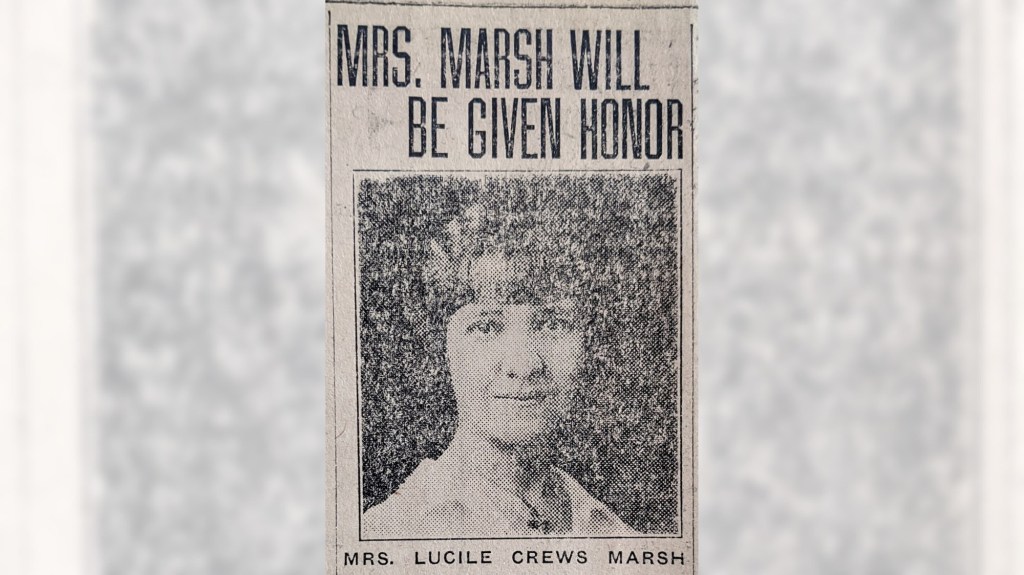
Marsh prize composition will be presented
Signal honors will be paid Lucile Crews Marsh and, through her to the city of Redlands, on July 16, when her prize-winning symphonic poem, “The Unknown Soldier,” will be presented at the Hollywood Bowl by the Los Angeles Symphony Orchestra. Emil Oberhoffer, former conductor of the Minneapolis Symphony, will direct the production.
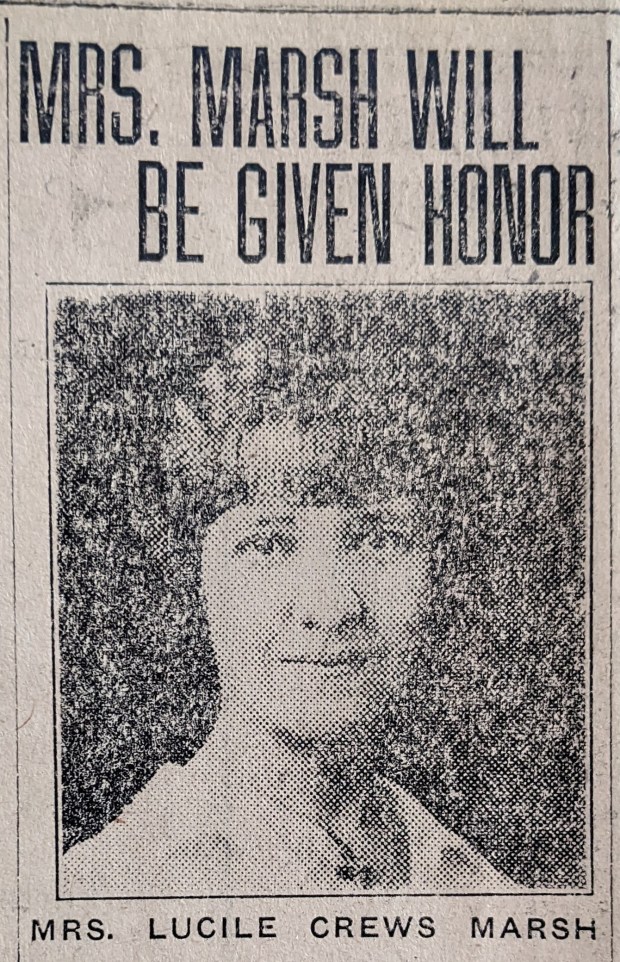 This photo of Lucile Crews Marsh ran in the Redlands Daily Facts July 10, 1926, six days before her prize-winning symphonic poem was performed at the Hollywood Bowl. (Redlands Daily Facts)
“The Unknown Soldier” is the musical composition which won for Mrs. Marsh the $1500 Pulitzer prize, offered by Columbia University “to the most talented and deserving composer in America,” and which won for Mrs. Marsh the distinction of being the first woman to whom the prize has been granted.
The character of the work, which is for full orchestra, is best described in the composer’s own words: “I have called my poem a symphonic elegy, because it seems to suggest an apotheosis and, although there are shades of the military here and there, the preponderant impression is that of quiet ecstasy.” The following poem, printed on the title page, helps to give the tone of the composition:
“He is known to the sun-white majesties,
Who stand at the gates of dawn;
He is known to the cloud-borne company
Whose souls but late have gone.
Like wind-flung stars through lattice bars
They throng to greet their own,
With voice of flame they sound his name
Who died to us unknown.”
A regrettable fact is attached to the composition of this work, because it was while working on this poem that Mrs. Marsh contracted an occupational neuritis in her right forearm, which has prevented her from playing the piano since. The talented composer once said to a friend, “When the great public hears a work they seldom know what price has been paid to put it before them.” …
Too little is known of Lucile Crews Marsh, even in her home city and by those who live under the unconscious influence of her genius. As a composer of music in its larger forms she stands in the first rank, having written, besides this notable work for full orchestra, a sonata for viola, a fantasy for organ, a cantata for chorus and soli, and two one-act grand operas, one of which received the Frankel prize this spring. Besides these, there are many beautiful songs, some of which have been sung by such artists as Helen Stanley, Cecil Fanning, Olive Kline and Louis Graveure.
Years of painstaking effort and study have been required to bring this talented woman who now makes her home in Redlands, to the place she now holds in the hearts of music lovers throughout the United States. She had one year’s study each in the New England Conservatory and the Northwestern School of Music, four years of music study in Berlin and one summer’s work in the American Conservatory of Music at Fontainebleau, and among her teachers have been Alexander von Fielitz in Berlin, Fulgenzio Guerrieri, the opera conductor, and Henry Schoenfeld, the orchestra conductor and composer.
July 10, 1926
Mrs. Marsh will be given honor
Lucile Crews Marsh, winner of the Pulitzer prize for her symphonic poem “To the Unknown Soldier,” which will be played by the Hollywood Bowl orchestra under the baton of Emil Oberhoffer on Friday evening, July 16, composed music perfectly and according to form before she had a music lesson.
Latin and mathematics were two barriers to Miss Crews’ ambition to attend college after she had finished her preparatory work at Dana Hall School, Wellesley, Massachusetts. She therefore decided to continue in music, spending a year at the New England Conservatory of Music, Boston, Massachusetts, and a year at Northwestern University School of Music, Evanston, Illinois. Miss Crews then went abroad, studying voice and musical composition four years in Berlin.
On her return from Europe, Miss Crews met a young pianist, Charles Howard Marsh, who accompanied her in a song recital. “We met, we practiced, and in six months we were engaged,” says Mrs. Marsh. After ten years of married life, she says, “We are still absolutely happy because our interests are identical.” Mr. and Mrs. Marsh lived in Los Angeles four years, moving to Redlands where Mr. Marsh has been head of the piano department of the University of Redlands for the past five years.
July 17, 1926
Mrs. Marsh’s composition receives high praise
Redlands night at the Hollywood Bowl proved to be a remarkable gathering, an ovation for Mrs. Lucile Crews Marsh, whose prize winning symphonic poem “To the Unknown Soldier” was played for the first time, and a spontaneous tribute from a great movement in a great city to a similar movement in a smaller city.
There were over 100 Redlands people in attendance and they had special boxes for the affair. Mrs. Marsh was in one of the boxes and after her composition was played, and it was applauded and applauded, she was led onto the stage by Emil Oberhoffer, former Minneapolis Symphony conductor, who this year opened the bowl and directed the orchestra last evening in the playing of the composition.
The composition won the Pulitzer prize for the best composition by an American composer during the past year. It was beautifully played by the great Philharmonic orchestra under the direction of Mr. Oberhoffer and the great crowd enjoyed it immensely. Mrs. Marsh was presented with two immense baskets of flowers.
Editor’s note: In addition to writing music, Lucile Crews Marsh (1888-1972) wrote plays that are in the University of Redlands’ Lucile Crews Marsh Collection. According to the university’s website, the plays in that collection date from 1930 to 1968, after Marsh received a degree from the university in 1920.
At least some of those plays were performed by the Redlands Footlighters, the community theater group Marsh and three other women founded in 1945.
Her musical activities did not end with the performance of her 1926 symphonic poem. The 1931 Redlands Bowl Summer Music Festival season opened with “The Romance of the Rose,” with words by Bruce McDaniel and music by Lucile Crews Marsh, according to Lawrence Emerson Nelson in his 1963 book “Only One Redlands,” and Marsh is listed in the 1933 Redlands city directory as a musician.
There may be “Only One Redlands,” but the Daily Facts came up with more than one version of the title of Marsh’s 1926 symphonic poem — “The Unknown Soldier,” “To the Unknown Soldier” and, in a story not quoted here, “To an Unknown Soldier.”
Articles are from the Redlands Daily Facts archive and are presented as they were written at the time.