
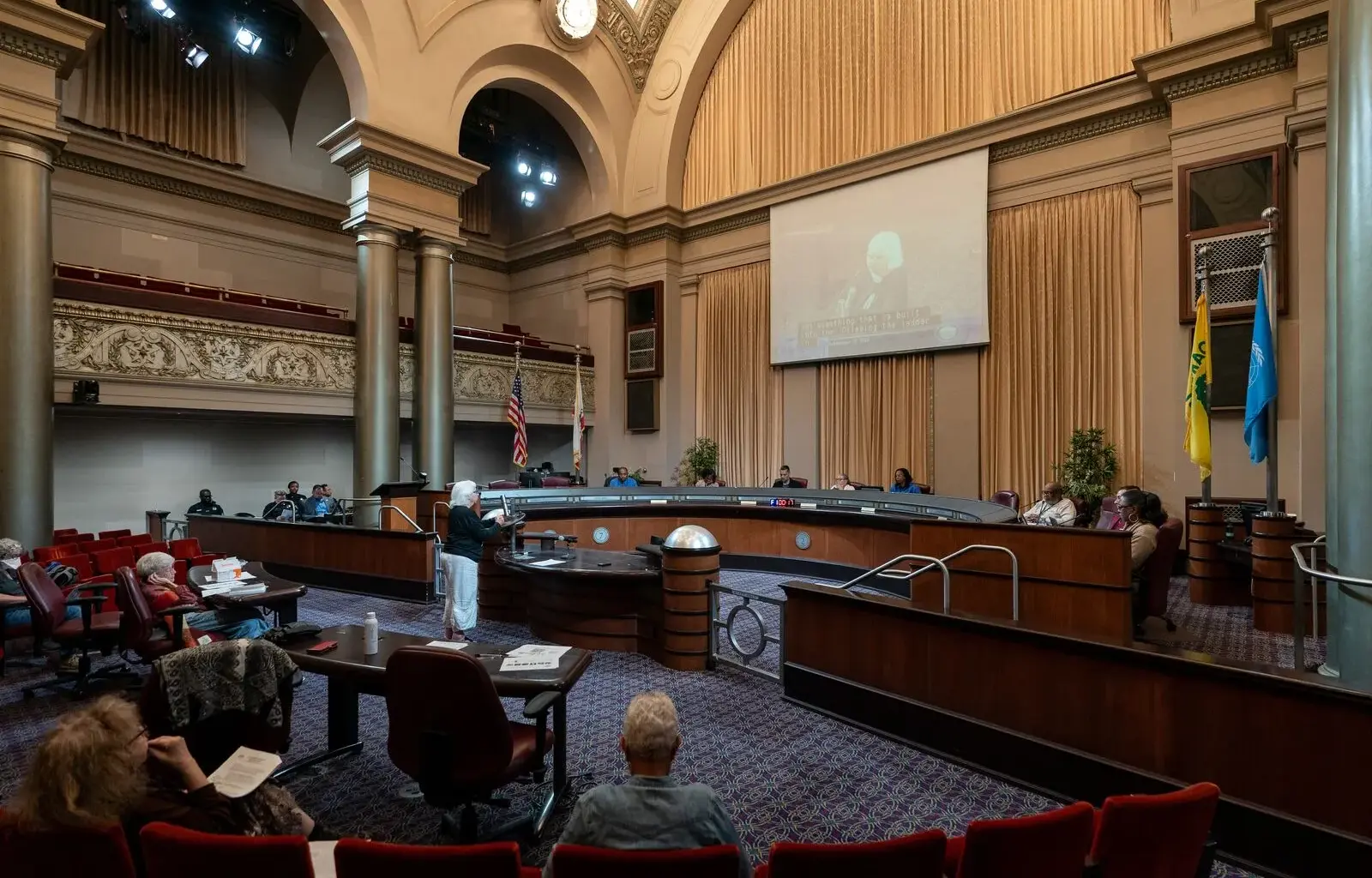
Oakland was one of the first cities in the nation to establish a police oversight board roughly 45 years ago. And in 2016, voters overwhelmingly approved the creation of an even stronger oversight panel called the Police Commission.
Considered one of the nation’s most powerful civilian police watchdog groups, the Oakland Police Commission has the power to fire the police chief and propose changes to the police department’s policies. Its commissioners oversee the work of a civilian agency that investigates allegations of police misconduct. And they supervise the Office of the Inspector General, which audits OPD’s policies, practices, and procedures.
Because the commission’s work is complex, there are many questions about its role and responsibilities within the city’s broader public safety system.
Below, we’ve compiled answers to frequently asked questions about the commission. If you have other questions we didn’t answer here, please email us, and we’ll consider updating this post.
What is the Police Commission?
The Oakland Police Commission is a volunteer, civilian-run city board that oversees OPD. Its primary role is to ensure OPD’s policies and practices abide by national standards of constitutional policing. Many people consider it one of the nation’s most powerful civilian police commissions.
The Police Commission oversees the Community Police Review Agency, or CPRA (pronounced SIP-ruh), which investigates complaints of officer misconduct and recommends discipline. The Office of the Inspector General, or OIG, an independent civilian oversight body that audits OPD’s policies and practices, is also under the Police Commission.
Put simply, CPRA handles individual allegations of misconduct, whereas the OIG examines patterns and procedures that may give rise to those accusations or other issues that need to be fixed to make OPD a more effective police department.
What is the difference between the Police Commission and the Oakland Police Department?
The commission is completely independent of the police department. In fact, the city charter states that current and former police officers and representatives of law enforcement groups, such as the Oakland Police Officers’ Association, are not eligible to serve on the commission.
Commissioners may be appointed based on their experience or expertise in a particular subject, such as human resources, policy development, law, and civil rights.
How was the Police Commission created?
Oakland has a long history of residents demanding police reform and greater oversight in response to controversial police shootings, civil rights abuses, and management failures at the highest levels of OPD.
The city’s first oversight board was created in 1980, the year after a 15-year-old boy named Melvin Black was shot to death by two officers in West Oakland. The City Council set up the Citizens’ Police Review Board, or CPRB, in response to massive protests about Black’s killing. However, the CPRB’s powers were weak. It could only consider complaints of police misconduct and provide nonbinding recommendations that the city administrator often ignored.
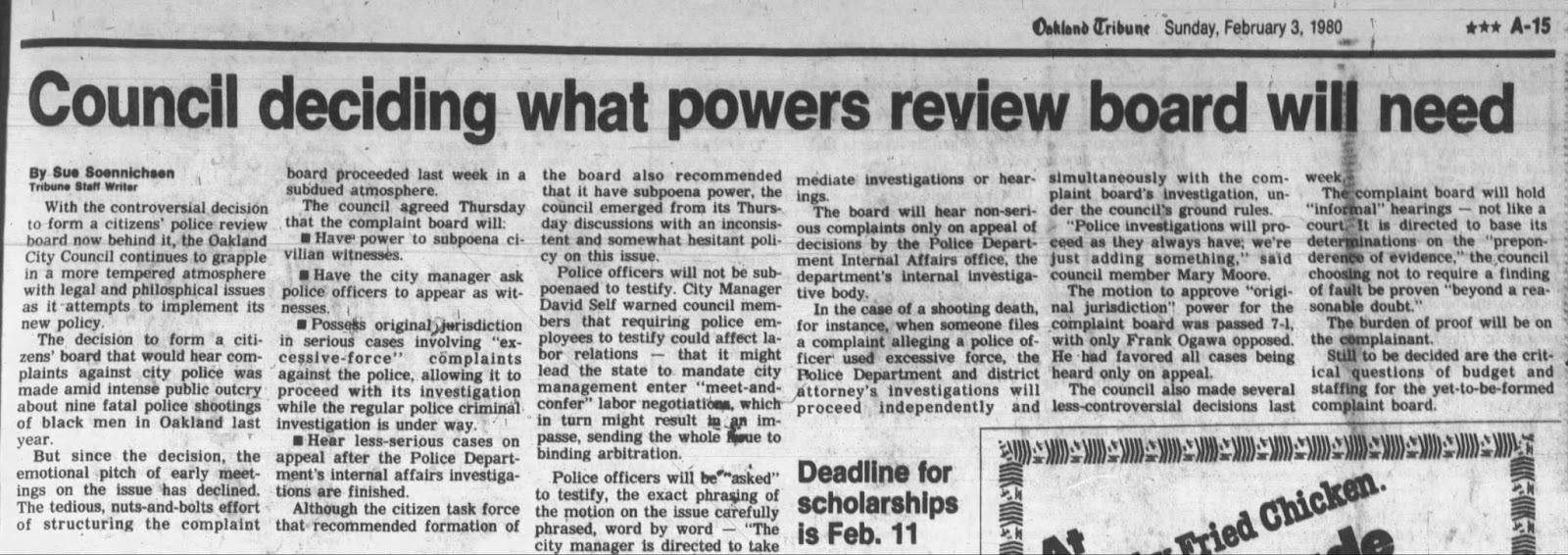 A Feb. 3, 1980, article in the Oakland Tribune mentions the creation of the Citizens’ Police Review Board “amid intense public outcry about nine fatal police shootings of black men in Oakland.” Credit: Newspapers.com
The CPRB remained in place for three more decades with some changes. Meanwhile, OPD was placed under federal court oversight in 2003 as a result of the “Riders” case. The Riders were a squad of officers who beat up suspects, planted drugs on people, falsified reports, and committed other violations.
By 2015, it appeared that OPD was on track to finally complete its federal court oversight program. This meant that the federal monitor keeping a close watch on OPD to prevent police abuses of power and track the department’s reforms would soon be leaving. Anticipating this, city leaders began to consider ways of ensuring long-term civilian oversight of OPD to prevent future problems from cropping up.
The Coalition for Police Accountability, an activist group, envisioned a police commission as a long-term accountability structure that could do the same work of monitoring OPD and helping the department improve. They worked closely with Councilmembers Dan Kalb and Noel Gallo to write Measure LL, a ballot measure to establish a police commission.
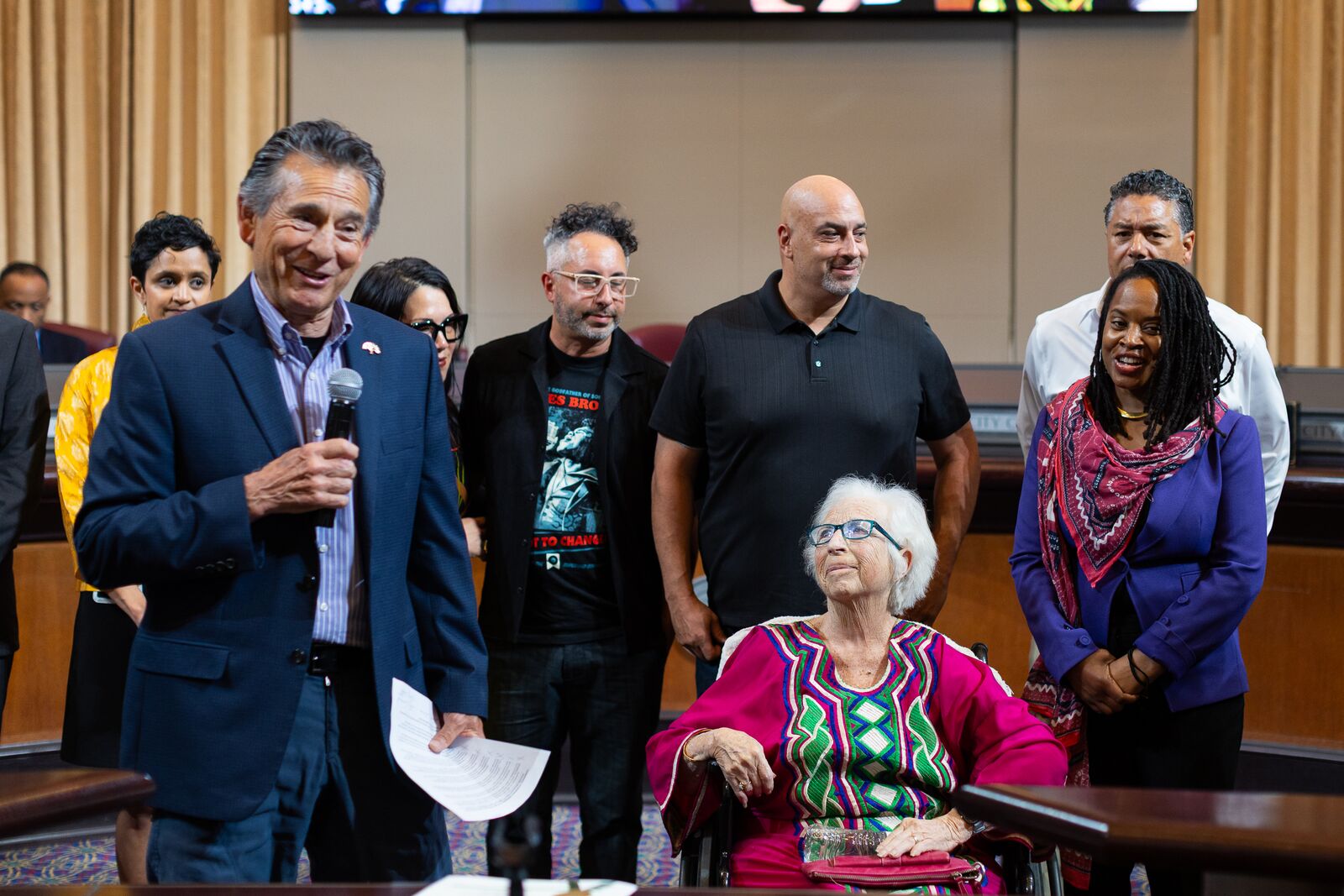 District 5 Councilmember Noel Gallo, left, honors longtime activist Rashidah Grinage, a founding member of the Coalition for Police Accountability, as the City Council passes a resolution recognizing her contributions to police accountability and civilian oversight in Oakland on Tuesday, May 6, 2025. Credit: Estefany Gonzalez for The Oaklandside
Then, in early 2016, news broke that the police department had covered up a scandal involving multiple OPD officers who sexually abused a teenage girl. The case caused three OPD chiefs to lose their jobs in a week.
When the election rolled around in November, Oakland voters overwhelmingly approved Measure LL, which amended the city charter to establish the Police Commission. The measure passed with over 83% of the vote.
The commission was given more autonomy through Measure S1, which Oakland voters approved by 81% in 2020. This created the Office of the Inspector General under the Police Commission and strengthened the commission and CPRA’s independence from the city administrator.
Who is on the Police Commission?
The commission has seven regular members and two alternate members. Alternates step in whenever a regular member’s spot on the board becomes vacant. Commissioners are Oakland residents and are not paid for their service.
The commission also has a chief of staff, whose job is to coordinate the commission’s regular and ad hoc committee meetings and conduct policy research, among other duties.
How are commissioners appointed?
The mayor appoints three commissioners and one alternate commissioner, subject to the City Council’s approval. The remaining four commissioners and one alternate commissioner are appointed by the city’s Police Commission Selection Panel. The selection panel is comprised of nine Oakland residents, appointed by each City Council member and the mayor.
When one of the commissioners nominated by the selection panel leaves the commission and there is a vacancy, the selection panel collects applications from people interested in serving on the commission and interviews candidates. After vetting applicants, the selection panel, by a two-thirds vote, recommends a slate of commissioners to the City Council. From there, the City Council must approve or reject the slate. If the council fails to approve or reject the selection panel’s slate within 60 days of the panel submitting the slate and completing background checks, then all the names on the slate are appointed.
When one of the mayor’s appointees leaves the commission, the mayor picks a new commissioner to fill that seat, pending City Council approval. If the council doesn’t take action on the mayor’s nomination within 60 days, then the nominee is appointed.
Commissioners serve for three years. They’re limited to two consecutive terms, except for commissioners who served less than one year, who may serve two additional consecutive terms.
What can the Police Commission do?
According to the city charter, the Police Commission has the authority to do the following:
The commission can review, comment on, and propose changes to OPD policies; however, most policy changes — like those governing vehicle pursuits — are ultimately up to OPD and the City Council.
The commission can approve or reject OPD’s proposed changes to policies related to use of force, profiling based on protected characteristics like race or gender, and protests or other First Amendment assemblies.
The commission can review funding allocations to OPD in the mayor’s proposed budget and provide feedback.
The commission can require the police chief to submit annual reports about OPD’s activities.
The commission is in charge of the process of recruiting applicants for the job of police chief. They submit a list of three finalists to the mayor, who makes the final decision about which of the three to appoint.
On its own, for cause, the commission can fire the police chief.
What is the commission’s role in disciplining officers for misconduct?
The Community Police Review Agency was established under the Police Commission to allow Oakland residents to file complaints of police misconduct. CPRA is required to investigate complaints involving use of force, in-custody deaths, racial and other forms of profiling, dishonesty, and policing of public assemblies like protests.
For investigations, CPRA and the commission have the power to do the following:
The commission can issue subpoenas when CPRA staff are investigating police misconduct and want to obtain records.
CPRA can access OPD’s personnel and disciplinary files and records, including records from OPD’s Internal Affairs Bureau, which conducts internal investigations into allegations of misconduct.
CPRA investigators can interview officers, witnesses, and other people when looking into a complaint.
CPRA’s investigations run parallel to OPD’s investigations of officer misconduct through its Internal Affairs Bureau.
When CPRA and OPD come to the same conclusions about a complaint, the police chief will notify the officer being investigated whether they’ve been cleared or “sustained” for wrongdoing and will face discipline.
If CPRA and OPD disagree on a case, then the Police Commission steps in. Three commissioners form a discipline committee to consider OPD’s and CPRA’s conclusions, and then make a final decision about whether or not an officer should face discipline.
Do other cities in the U.S. have a police commission or a similar civilian oversight body?
Oakland isn’t the first or only U.S. city to have a civilian-run police oversight board. Over the past several decades, many cities have established civilian commissions to oversee their police departments, including Chicago, Philadelphia, Seattle, Atlanta, Denver, and Washington D.C.
In 1973, Berkeley created its Police Review Commission, which was reportedly the first of its kind in the nation to have the power to investigate complaints against officers. Berkeley voters approved a ballot measure in 2020 to replace the Police Review Commission with the current Police Accountability Board and strengthen its independence and investigatory powers.
Nationally, professionals who work for police oversight boards share best practices through the National Association for Civilian Oversight of Law Enforcement.
What are some criticisms of the Police Commission?
Some critics say the Police Commission and Community Police Review Agency obstruct officers from doing their jobs by imposing discipline they believe is too harsh, or by creating an atmosphere in which officers are afraid to do their jobs because they’ll be subjected to unwarranted complaints that lead to investigations.
Outgoing OPD Chief Floyd Mitchell has echoed this sentiment at City Council and Police Commission meetings. During a Jan. 10 special meeting of the Police Commission, Mitchell told commissioners: “There is a culture problem here, from the police officers’ standpoint, that they fear doing their job. In my view, there has been the weaponization of the disciplinary process.”
Since the commission and CPRA can investigate community complaints of police misconduct and recommend discipline, and because commissioners cannot be current or former police officers, some residents believe the Police Commission is biased against OPD.
Other criticisms of the commission emerged during the first few years of its existence. The commission struggled to launch itself and organize its work. Commissioners fought amongst themselves. Powerful city officials like the city administrator and city attorney also clashed with the commission.
Infighting erupted again in 2023 when the commissioners split into two opposing blocs. One group accused the other of abusing its power and marginalizing some of the commissioners.
The Police Commission has also had difficulty recruiting new commissioners due to the heavy workload and no pay involved. And it has churned through several directors for the Community Police Review Agency — some who were fired, others who quit.
When does the Police Commission meet?
The Police Commission meets on the second and fourth Thursdays of each month inside the council chambers at Oakland City Hall. Meetings start in closed session at 5:30 p.m., and open session begins around 6:30 p.m.
Meeting agendas, minutes, and recordings, as well as instructions for signing up for public comment, are available on the commission’s website.
“*” indicates required fields