
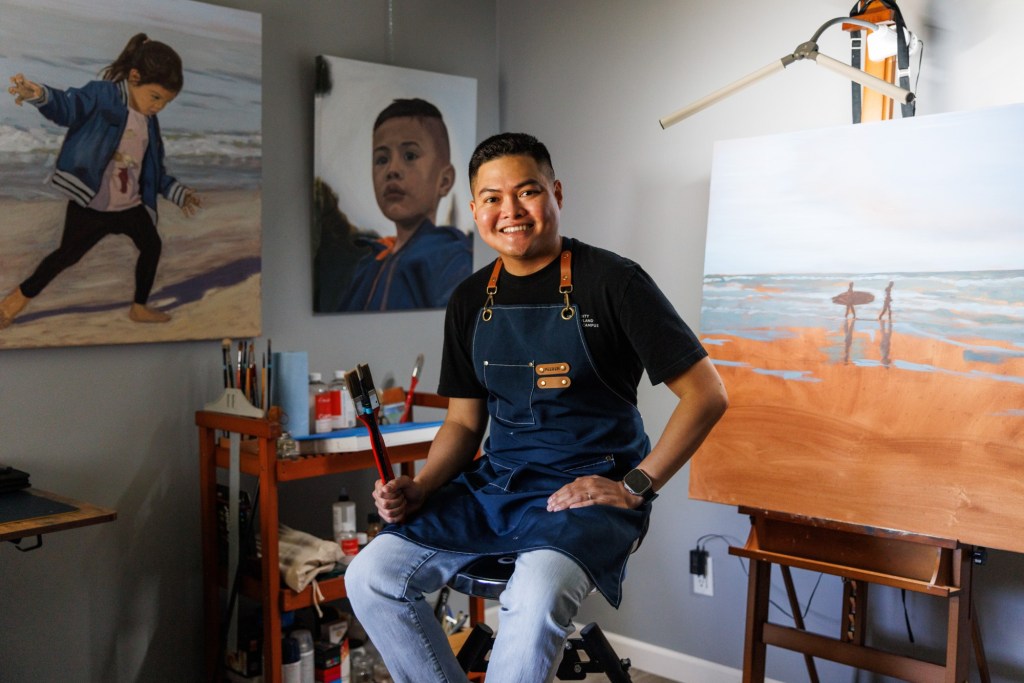
As a member of the LGBTQ+ community, Filipino American artist Joshua Orozco knows the importance of being seen and the value of finding that rare feeling of belonging. That’s why when it comes to his artwork, he’s not afraid to broach LGBTQ+ themes, even if not overtly, as part of his artistic exploration of identity, an often complex journey that’s influenced by factors both societal and cultural.
“Being part of the LGBTQ+ community informs my art through its attention to vulnerability, visibility and belonging,” he said. “My work is not always explicitly about sexuality, but my identity shapes the way I approach tenderness, isolation, connection and the idea of home.”
“I am drawn to quieter expressions of identity and to the emotional complexity of being seen. For me, that can show up through atmosphere, gesture, memory and the relationships between people and places.”
Orozco is one of the many local and national artists featured in the latest iteration of “PROUD+,” the long-running annual exhibition at The Studio Door that is now in its ninth year. The Chula Vista-based Orozco is one of three artists who received Best in Show honors, sharing the prize with Los Angeles-based pop artist Ethan Kotch and Muncie, Ind., painter and animator Kaden Sebastian.
Orozco put his brush down long enough recently to answer questions about his art.
 Filipino American artist Joshua Orozco at his home studio in Chula Vista. (Kristian Carreon / The San Diego Union-Tribune)
Q: Tell us about your artistic journey — when and where did it all begin?
A: The earliest memory I have of making art goes back to third grade in Goa, Camarines Sur, a small town in the Philippines. We were reading a book called “Tales of Robin Hood,” and I found myself more fascinated by the illustrations than by the story. I tried to re-create one of the landscapes and felt incredibly proud of what I made.
A few years later, I won first prize in an interschool poster-making contest about climate change. I brought home a few hundred pesos, but my father, who was struggling with a gambling addiction, asked to borrow the money and never returned it. I did not realize at the time how much that experience affected me, but I slowly stopped making art.
In 2010, my mother petitioned for my siblings and me to immigrate to the United States, and we settled in Los Angeles. I joined the U.S. Navy in 2012 and was stationed in Sasebo, Japan, the following year. While serving aboard a ship, I was looking for a creative outlet beyond photography. I bought a sketchbook and some pencils and started drawing after work, often at a Starbucks off base. Eventually, I bought Posca markers and small canvases, since storage on a ship was limited. I also painted murals on a couple of doors aboard the ship.
Life became busy again with transfers, deployments and moves between Japan and San Diego. But in early 2025, I decided that if I did not pursue art seriously, I would regret it later. I signed up for an oil-painting class at Art on 30th in North Park as a birthday gift and kept taking classes. It gave me not only a place to learn but also a deeply supportive art community. The people I met there encouraged me to apply for exhibitions, which led to opportunities at Art on 30th, The Studio Door, Art Scene West and other venues. I also recently completed the Keys to the Art World mentorship, and our cohort will have a year-end exhibition this December.
 “Light Is the Head That Wears a Paper Crown,” a painting by Chula Vista artist Joshua Orozco, is one of the Best in Show winners in this year’s “PROUD+” exhibition at The Studio Door in Hillcrest. (Joshua Orozco)
Q: You’re a part of the PROUD+ exhibition at The Studio Door. Take us behind the scenes of the piece you have in the exhibition. Where did you get the inspiration for it?
A: My painting, “Light Is the Head That Wears a Paper Crown,” grew out of a commissioned portrait I made for a family friend. The original reference showed a young person wearing a birthday paper crown, and I kept returning to the tenderness, vulnerability and innocence in that image.
I was thinking about the way children can still inhabit imagination before they are fully burdened by responsibility, expectation or the harsher realities of the world. The paper crown became symbolic for me. It suggests imagination, dignity and the small ways we protect or empower ourselves.
I wanted the painting to feel gentle but still carry emotional weight beneath the surface. For me, it is about being seen with empathy and allowing softness to be a form of strength.
 Filipino American artist Joshua Orozco’s home studio in Chula Vista. (Kristian Carreon / The San Diego Union-Tribune)
Q: How would you describe your artwork to a stranger?
A: I would describe my work as atmospheric and reflective. I paint landscapes, wildlife, portraits and figures, often using cinematic light, softened edges and scenes that feel quiet or suspended in time.
Many of my paintings begin with places I have been, photographs I have taken or memories that stay with me. My work explores identity, belonging and the emotional weight that can exist in ordinary moments.
Q: What has been the most challenging part of your artistic journey?
A: The most challenging part has been giving myself permission to take my art seriously while balancing military service and the responsibilities of everyday life. For a long time, art felt like something I loved but could not fully claim.
Building confidence, making time and allowing my work to become more personal have all been ongoing challenges.
Q: The most rewarding?
A: The most rewarding part has been reconnecting with a part of myself that I thought I had lost. Art has also introduced me to an incredibly supportive community of artists, mentors, viewers and collectors. It means a lot when someone recognizes themselves, a memory or a feeling in a painting I created.
Once a painting is finished, it no longer belongs only to me. It becomes something I can share, and in a way, it allows me to set down some of the emotional weight I carried while making it. That is rewarding, too.
Q: If you were to use just one word to describe your journey as an artist, what would that word be?
A: Resilience. My journey has taught me to keep returning to what matters, especially my dream of making art, even after setbacks, uncertainty or long periods away from it.
Q: Artists are often inspired by or influenced by their surroundings and other artists. What do you think has been the most powerful influence on you as an artist?
A: One of my earliest artistic influences was Richard Schmid. While I was stationed overseas, I bought his book “Alla Prima II” and was struck by how alive and effortless his paintings felt. I still own that book and return to it whenever I need inspiration.
I have also been deeply influenced by the communities that have supported my growth, especially Art on 30th and The Studio Door. Art on 30th gave me a place to learn, take risks and connect with other artists, while The Studio Door has created meaningful visibility and space for LGBTQ+ artists. I’m especially grateful to Patric Stillman and Kate Ashton for helping create those spaces.
But the most powerful influence on my current work is memory. The places I have lived, traveled to with my husband and experienced through military service have shaped the way I see atmosphere, distance and belonging. My current body of work is rooted in remembered people and places, especially moments that may have felt ordinary at the time but stayed with me afterward.
 One of Joshua Orozco’s pieces on display in his home studio in Chula Vista. (Kristian Carreon / The San Diego Union-Tribune)
The Studio Door presents “PROUD+”
When: Through July 31. 11 a.m. to 6 p.m. Tuesdays through Saturday or by appointment.
Where: The Studio Door, 3867 Fourth Ave., San Diego
Admission: Free
Phone: 619-255-2867
Online: thestudiodoor.com