
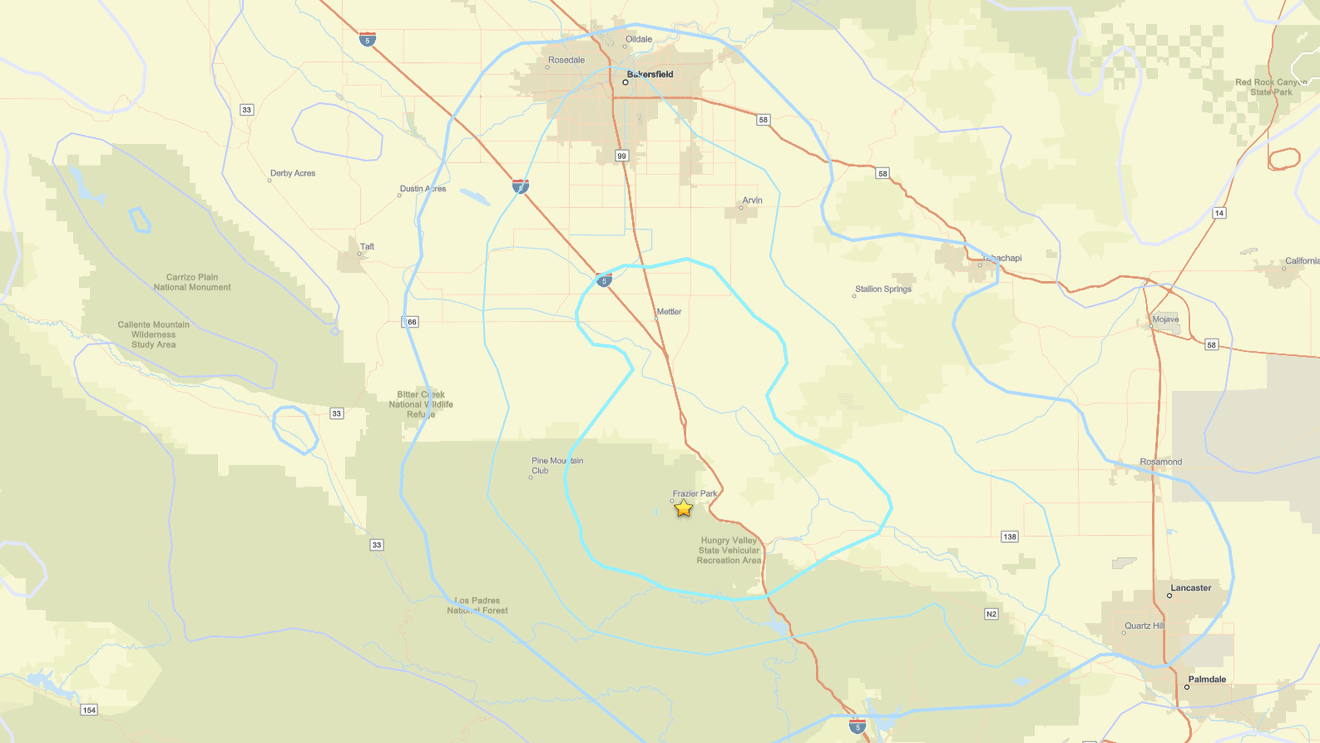
BAKERSFIELD, Calif.(KBAK/KBFX) — The magnitude 4.1 earthquake that struck near Frazier Park early Sunday morning did not appear to have occurred on the San Andreas Fault or the Garlock Fault, seismologists say.
RELATED: Early morning earthquake wakes residents near Frazier Park, felt in Kern County and beyond
The Southern California Seismic Network said preliminary analysis indicates the earthquake was likely associated with the Pleito Fault, a smaller fault in the Frazier Park area that is part of Southern California’s complex network of fault systems.
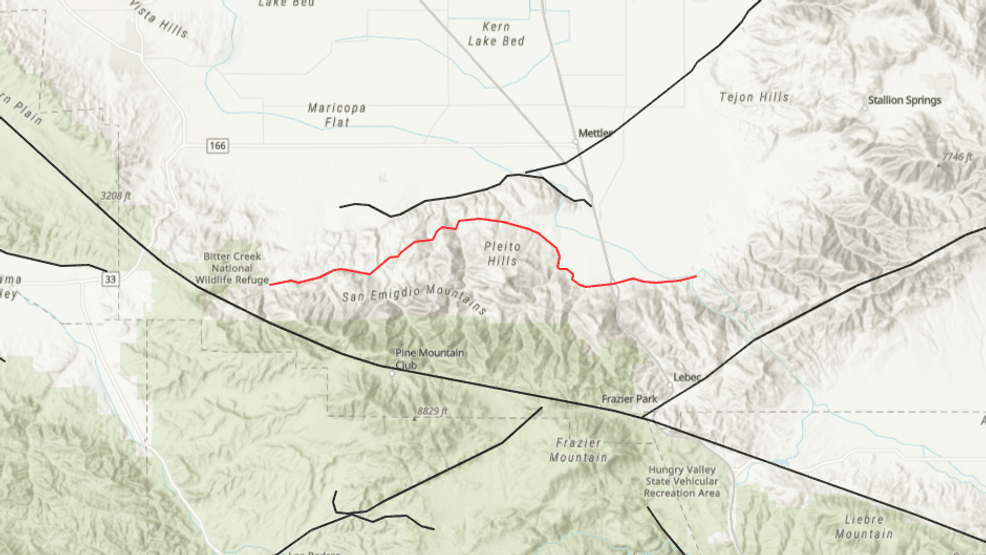
An image from the Southern California Seismic Network highlights the location of the Pleito Fault, which is mostly west of Interstate 5 near Frazier Park. Experts say the Pleito Fault is likely associated with the 4.1 quake that struck the area on July 12, 2026. (Photo: Southern California Seismic Network)
The quake struck at 3:38 a.m. about 1 mile east-southeast of Frazier Park at a depth of approximately 8 miles, according to the U.S. Geological Survey. The earthquake was followed by several aftershocks, including a magnitude 3.2 quake later Sunday morning.
Because the epicenter was located near several major fault systems, speculation quickly spread online that the earthquake occurred at a critical junction between the San Andreas and Garlock faults and could signal larger seismic activity to come.
However, the report from the Southern California Seismic Network shows the earthquake does not appear to have impacted either of the nearby major faults.
Instead, scientists say the event was likely linked to movement along the Pleito Fault, a lesser-known fault that runs through the region west of Interstate 5 near Frazier Park.
The Frazier Park area sits within one of California’s most geologically complex regions, where the San Andreas Fault, Garlock Fault and numerous smaller faults intersect and interact. The San Andreas passes just southwest of Frazier Park and the Garlock Fault lies farther to the east.
Seismologists say earthquakes of this size are relatively common in Southern California and do not necessarily indicate a larger earthquake is imminent.
Smaller aftershocks following a magnitude 4 earthquake are also considered normal and can continue for days or even weeks after the initial event, with chances decreasing over time, experts say.