
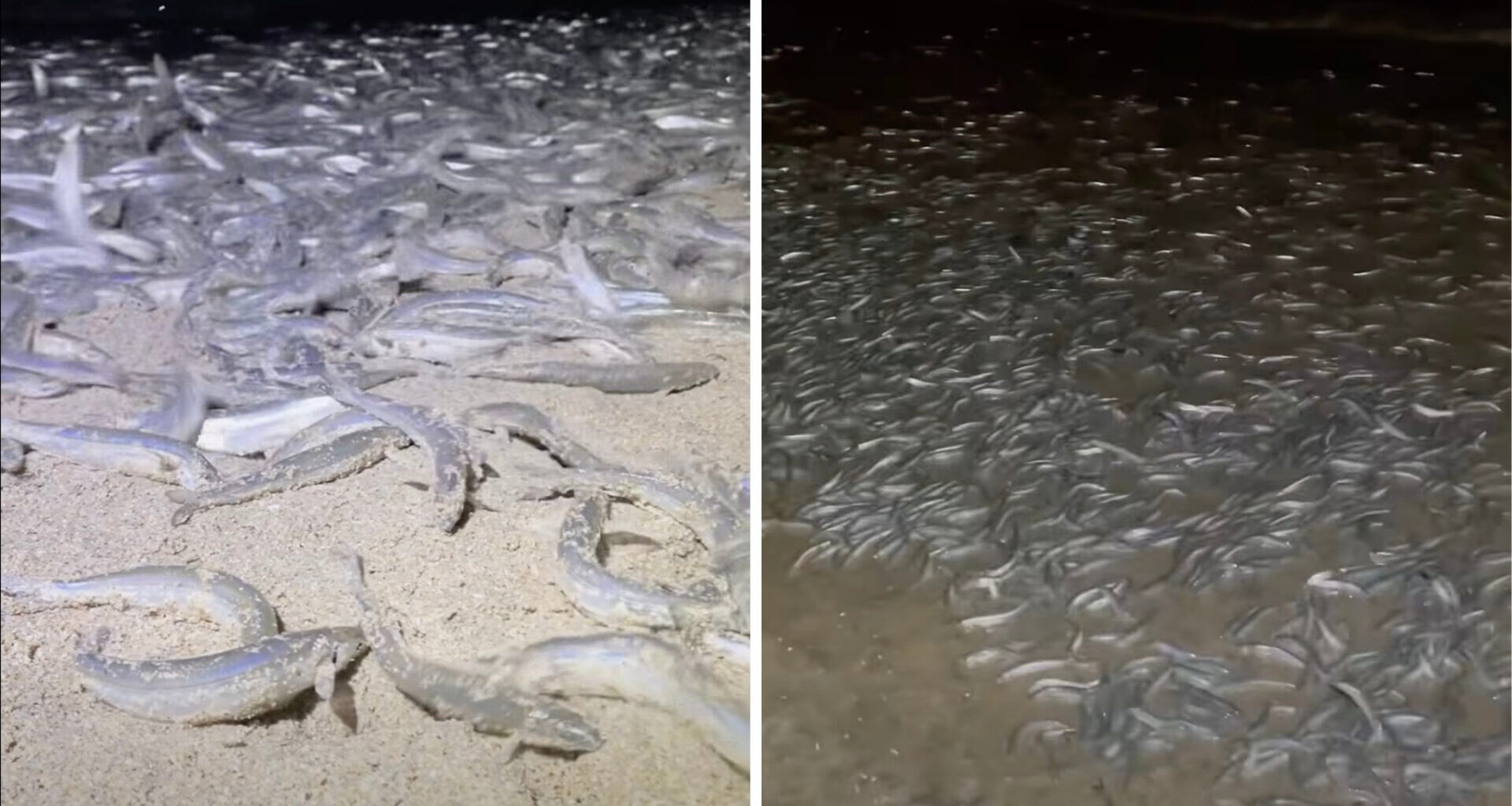
SOUTHERN CALIFORNIA, Calif. (VVNG.com) — One of California’s most remarkable natural spectacles is set to unfold once again this week as thousands of California grunion are expected to emerge from the Pacific Ocean and spawn on sandy beaches during evening high tides between July 14 and July 17, according to the California Department of Fish and Wildlife (CDFW).
The annual grunion runs attract wildlife enthusiasts, photographers and families eager to witness the unique phenomenon, where the small silvery fish leave the ocean completely to reproduce. The event occurs only during specific nights following the full and new moons when tides are high enough to carry the fish onto the beach.
Unlike most fish, California grunion spawn entirely out of the water. Females ride the waves ashore, arch their bodies into the sand and use their tails to burrow until only their heads remain above the surface. They then deposit their eggs while one or more males wrap around the female to release milt, fertilizing the eggs before the fish quickly return to the ocean with the receding waves.
According to CDFW, a single female may lay between 1,600 and 3,600 eggs during one spawning event and may spawn up to six times during a season. The fertilized eggs remain buried in moist sand for about 10 days before the next series of high tides and wave action trigger them to hatch and wash into the ocean.
The department said grunion runs are never guaranteed at any specific beach.
“Beaches are scouted by grunion in advance so every run there is no guarantee your favorite beach will be visited,” according to information provided by CDFW.
“Once a run begins, and in a true test of fishy strength, grunion storm the beach to lay their eggs away onshore during the high tide. This rare and special event is timed with the moon and tidal cycles.”
Expected July Grunion Runs
CDFW’s 2026 schedule lists the following probable spawning periods for this week’s run:
Tuesday, July 14: 9:45 p.m. to 11:45 p.m.
Wednesday, July 15: 10:35 p.m. to 12:35 a.m.
Thursday, July 16: 11:20 p.m. to 1:20 a.m.
Friday, July 17: 12:10 a.m. to 2:10 a.m. (run begins after midnight).
The department notes these times represent the probable two-hour period when spawning may occur, with the second and third nights of each four-night run generally producing the best viewing opportunities.
No Guaranteed Beach Locations
Although grunion spawn on numerous beaches throughout Southern California, CDFW does not recommend any specific beach because of changing ocean conditions, local curfews and safety concerns.
Instead, officials encourage visitors to attend organized grunion educational events when available. Those planning to search on their own are advised to contact local state or county beach lifeguards, who can often report whether spawning activity has recently occurred.
Fishing Season Is Open
California’s grunion fishing season is currently open and runs from July 1 through March 31. During the open season, anyone 16 years of age or older must possess a valid California fishing license to collect grunion. An Ocean Enhancement Validation is also required when fishing in ocean waters south of Point Arguello in Santa Barbara County.
State regulations require that:
Grunion may only be taken by hand.
Nets, buckets with traps or other equipment may not be used.
Digging holes in the sand to trap grunion is prohibited.
The daily bag and possession limit is 30 fish per person.
From April through June, grunion are protected during their peak spawning season, when observation is allowed but harvesting is prohibited.
A California Wildlife Tradition
California grunion (Leuresthes tenuis) are members of the silversides family and are found primarily along the Pacific coastline from central California to Baja California. Most adults measure between 5 and 6 inches long, although some grow to nearly 7 inches.
Unlike many marine fish, tagging studies have shown grunion do not migrate long distances. Instead, they remain close to the shoreline in waters generally less than 60 feet deep, returning year after year to continue one of California’s most fascinating wildlife traditions.
Copyright 2026 Victor Valley News Inc. All rights reserved. This material may not be published, broadcast, rewritten, or redistributed.
📢 Stay connected with the High Desert’s largest news community!
🔗 For more local news, visit VVNG.com.
Note to readers: If you value our reporting and want to see it continue, consider becoming a monthly supporter. Your contribution helps keep independent, local news accessible to everyone. Support local news today!
(CLICK PLAY TO WATCH VIDEO – Courtesy of California Department of Fish and Wildlife)
Copyright 2026 Victor Valley News Inc. All rights reserved. This material may not be published, broadcast, rewritten, or redistributed.
📢 Stay connected with the High Desert’s largest news community!
🔗 For more local news, visit VVNG.com.
Note to readers: If you value our reporting and want to see it continue, consider becoming a monthly supporter. Your contribution helps keep independent, local news accessible to everyone. Support local news today!