
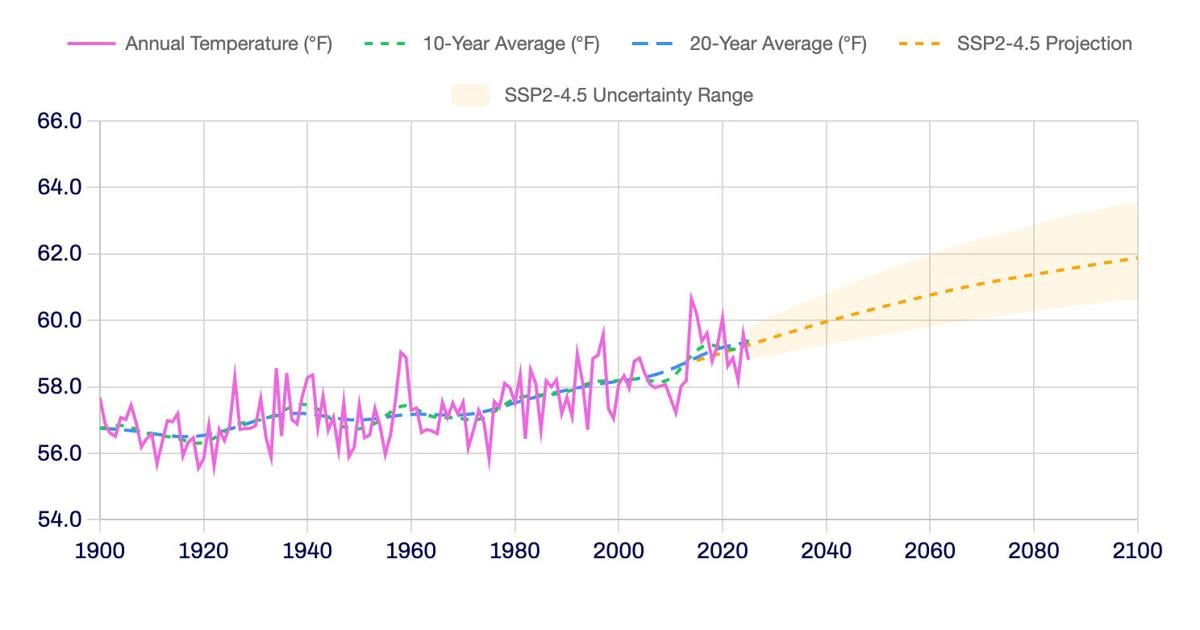
While countries across the world reach near-record highs this summer, a Berkeley nonprofit has released a new platform for people to view climate projections unique to their specific locations and cities.
Berkeley Earth released Synthesis, earlier this month as an open-access platform combining historical observations with climate projections for cities and regions, rather than the entire globe. The model includes weather data for more than 40,000 sites across all countries around the world and projections analyzed from more than 40 climate models.
“What we like to say internally is that no one lives at the global average,” said Kristen Sissener, executive director of Berkeley Earth. “We hear a lot about 1.5 (degrees Celsius) … but in the meantime, what’s happening (in) different places in the world looks very different.”

Berkeley Earth | Courtesy
Sissener, an alumna of UC Berkeley, got involved with Berkeley Earth to make the data more applicable for policy and business decisions at the local level. The organization is also largely focused on communicating climate data to the public.
Berkeley Earth was founded in 2010 by UC Berkeley professor Richard Muller and his daughter Elizabeth Muller “with the goal of addressing the major concerns of climate change skeptics.”
In partnership with C40 Cities — an international organization consisting of city mayors across the world looking into climate action — Berkeley Earth is also looking at how electricity demand will change for cooling buildings and the public health outcomes of climate change in different areas around the world.
“We really wanted to move the conversation forward from … ‘it’s going to be warmer,’ Sissener said. “Public infrastructure has a lot of impacts on public health. When you can … start speaking in specifics, you can really start getting to the level of applications and direct decision-making.”
In their report with C40 Cities, Berkeley Earth estimates that emissions from city energy systems can double from 2020 to 2050 as cooling demand increases.
While the projected demand is a 20%-30% increase on average, C40 Cities expects that cities in Europe and Africa can anticipate a 50%-100% increase in the same time period.
“The global average is really just a mathematical abstract, which again is very important, and we don’t want to take away from that,” Sissener said. “But when you’re able to see what’s happening close to you, it carries a different weight.”