
For many Americans, opera is seen as a dated art form with centuries-old stories they can’t relate to. But nothing could be more timely or relatable than “Fellow Travelers,” which San Diego Opera presented in a powerful three-show run this past weekend at San Diego’s Balboa Theatre.
Composed by Gregory Spears with a libretto by Greg Pierce, the 2016 opera is now on a 10th anniversary created by Up Until Now Collective and produced by a consortium of opera companies that includes San Diego Opera. The opera is based on Thomas Mallon’s 2007 novel about the “Lavender Scare,” the real-life purge of LGBTQ federal workers that began during the McCarthy era in the early 1950s.
Because of President Eisenhower’s Executive Order 10450, as many as 10,000 federal workers lost their jobs during the next quarter-century. But today, a new purge is under way. A few seats to my right at Friday’s opening-night performance of “Fellow Travelers” was former U.S. Space Force Col. Bree Fram, who was forced to retire last year because of the Pentagon’s new Executive Order 14183, which bans transgender service members.
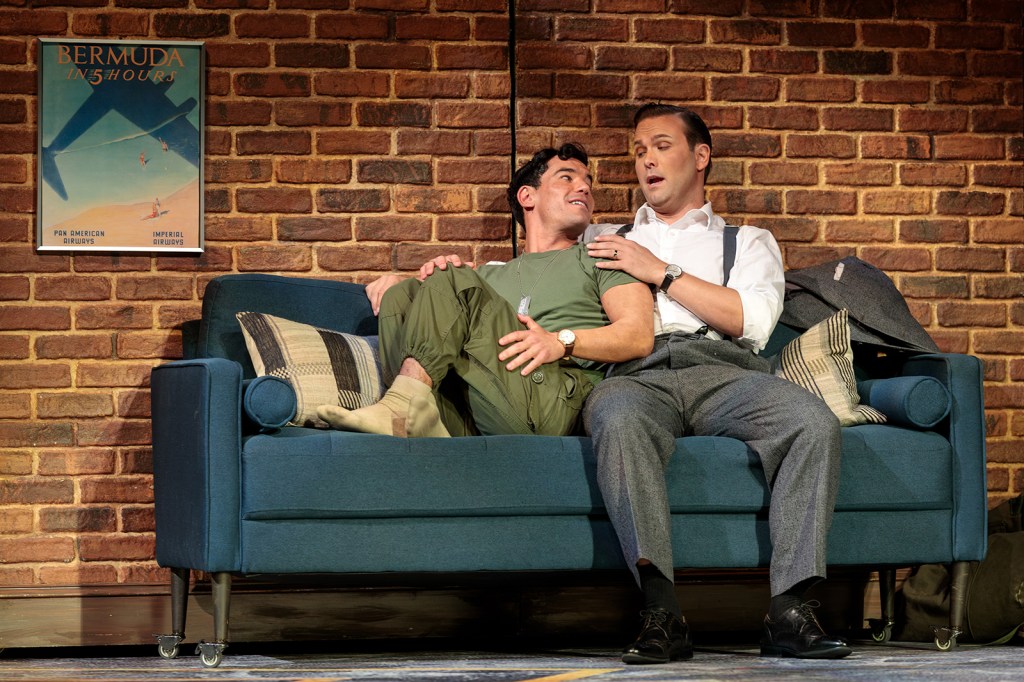
 Tenor Andy Acosta as Timothy Laughlin in the San Diego Opera’s presentation of Up Until Now’s touring production of the opera “Fellow Travelers,” which played July 10-12 at the Balboa Theatre in San Diego. (Karli Cadel)
There was an excited buzz in the audience before Friday’s show among audience members, who saw this staging as a milestone cultural event. But during the fast-paced two-hour, 15-minute production, directed with power and grace by Kevin Newbury, there was a potent air of solemnity. Bruce Stasyna conducted the live orchestra.
San Diego-based tenor Andy Acosta led the “Fellow Travelers” cast as Timothy Laughlin, an eager, idealistic and conservative young Irish Catholic who arrives in Washington, D.C., with big dreams. But when he falls in love with the promiscuous State Department officer Hawkins “Hawk” Fuller, Timothy finds himself torn between his passion, his faith and his career.
Acosta delivered a standout acting and singing performance that transitioned from the stuttering vocal delivery of the nervous young newcomer to the confident, multi-octave vocal leaps of a man deeply in love and proud of his work as an anti-communist congressional speechwriter. His soul-searching “I Died Last Night” prayer aria was particularly powerful.
Baritone Joseph Lattanzi was equally strong as Hawk, a reckless man who has grown comfortable taking risks. His final aria, a duet with Acosta, was especially moving. And soprano Amber R. Monroe brought richness and warmth to the opera, both with her singing and her maternalistic performance as the conflicted Mary, a closeted lesbian who works as Hawk’s secretary.
Unlike the music in many contemporary operas, Spears’ “Fellow Travelers” score is beautifully melodic, with rolling swells of strings and woodwinds instrumentation. Pierce’s libretto, which is sung through, doesn’t spare the darkness from this real period of history, but he created moments of joy, levity and romance.
Newbury’s staging features some office desks, filing cabinets and apartment furniture. But the most potent visual element of his production were the cast’s nine singers, who often lined up behind a semitransparent scrim to watch the characters onstage, representing the ominous atmosphere of government surveillance.
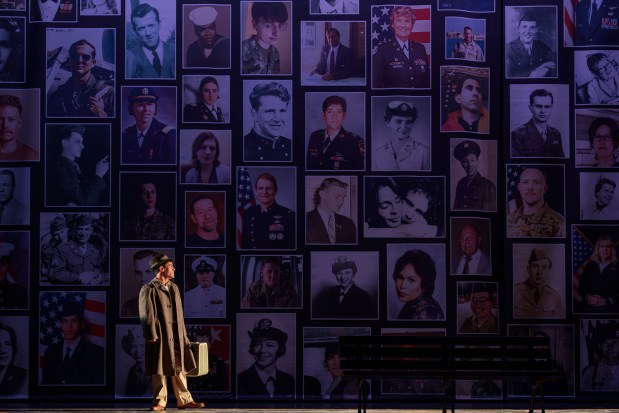
At the end of “Fellow Travelers,” Timothy decides to leave Washington and its ever-growing web of investigations. In that powerful final scene, Acosta stood silently before a wall of photographs from the past 70 years of real-life LGBTQ workers who lost their federal jobs under these laws. At the very center of the photo collage was a portrait of Friday-night attendee Bree Fram in her dress uniform next to an American flag.