
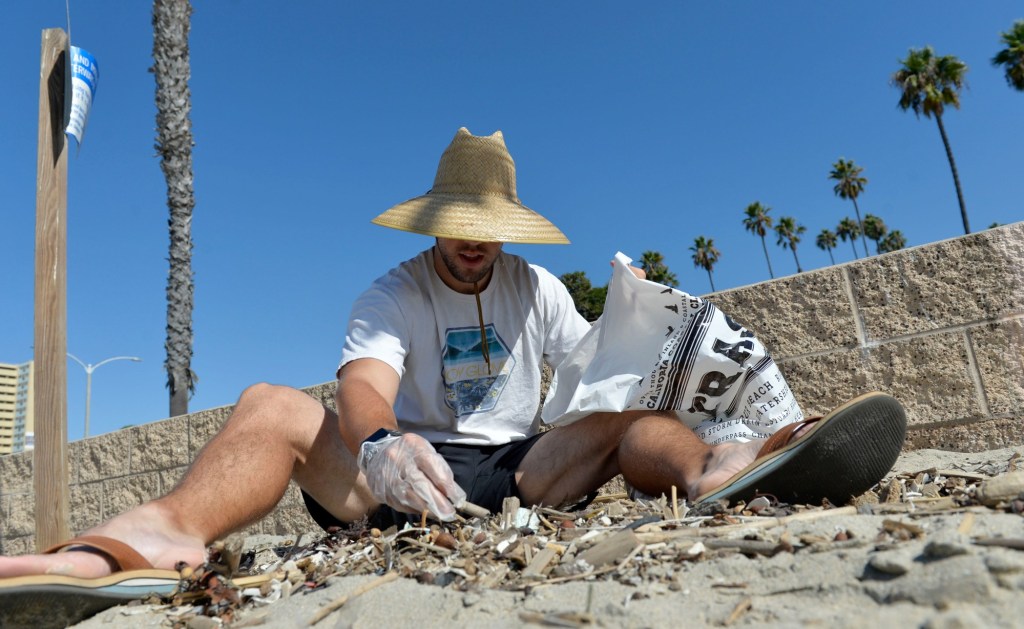
California is a global leader in environmental stewardship, investing heavily in our pristine coastlines, bays and wetlands. Yet walk along almost any street or beach, look down, and you will see a grim reality: thousands of cigarette butts wedged in sidewalk cracks, huddled against curbs, half-buried in sand and washed into storm drains.
They’re so common that most of us don’t notice them. That is precisely the problem. The tobacco industry has so normalized this pollution that California’s cities have become outdoor ashtrays.
This didn’t happen by accident. The cigarette filter — that orange or white tip — was never meant to protect anyone’s health. Decades of research, including that based on internal tobacco industry documents, shows filters provide no net public health benefit. Popularized in the 1950s, they suggested reduced harm from cigarettes and thus kept people smoking. The industry remained highly profitable through these efforts and, in the process, created the world’s most littered item. Made of cellulose acetate, a poorly degradable plastic, each discarded filter leaches nicotine, heavy metals, carcinogens and microplastics into soil and water. Globally, trillions of butts are dumped into the environment every year.
Our team at San Diego State University surveyed 60 census blocks across the county’s eight largest cities. Two rounds of fieldwork turned up nearly 55,000 cigarette butts. Extrapolated countywide, roughly 8.6 million butts sit on public surfaces at any time, and more than 200 million are discarded annually. Mixed-use, walkable neighborhoods had four to six times as many butts as residential blocks. Butt receptacles made no difference.
A second study near storm drains feeding the Kendall-Frost Mission Bay Marsh Reserve, one of San Diego’s last protected wetlands, shows why cleanups alone aren’t the solution. After a full cleanup, half the butts reaccumulated within two weeks; by seven weeks, they were back to baseline. Holding litter to 10% of current levels would require a cleanup every other day. Cleanups won’t make butts go away. We also found nicotine concentrations in water and sediment samples near the stormwater outlets to be 25 times higher than the level known to harm aquatic life.
Here’s a fact: The tobacco industry reaps profits while taxpayers bear the environmental costs of tobacco use. Cities across California absorb the cleanup costs of a product engineered, marketed and sold without regard for its waste products. The industry’s “corporate responsibility” playbook is familiar: sponsor cleanups, provide pocket ashtrays, promote ineffective butt-recycling programs — anything that keeps the blame on people who smoke and the financial burden on taxpayers.
California cities should stop treating cigarette filters as regular trash and instead treat them for what they are: toxic, single-use plastics. San Francisco pioneered a Cigarette Litter Abatement Fee in 2009 to cover the city’s mitigation costs — a model other cities could adopt. Santa Cruz, Capitola and Santa Cruz County have banned the sale of filtered cigarettes starting in 2027. State lawmakers have proposed statewide filter bans several times over the past decade, but none have passed. Extended producer responsibility legislation — regulatory standards that California already applies to producers of batteries, motor oil and electronics — should apply to tobacco companies. And California cities should watch closely as the first-ever lawsuit against the tobacco industry to recover environmental damages from tobacco product waste progresses in Baltimore.
The Golden State takes pride in its coastline and natural resources, and we invest heavily to protect them. But pride is not policy, and industry greenwashing does not substitute for accountability. More than 200 million cigarette butts litter San Diego County’s streets, parks and beaches each year — a level no cleanup can ever overcome. This source of plastic and chemical pollution is now known, as is the industry that causes it. California cities don’t choose to be ashtrays, but they will remain so until lawmakers decide that the industry — not the public — should be held accountable for tobacco product waste.
Matt is a psychology professor. Novotny is a public health professor emeritus. Greiner is an adjunct psychology professor. They all teach at San Diego State University and are co-directors of SDSU’s Center for Tobacco and the Environment.