
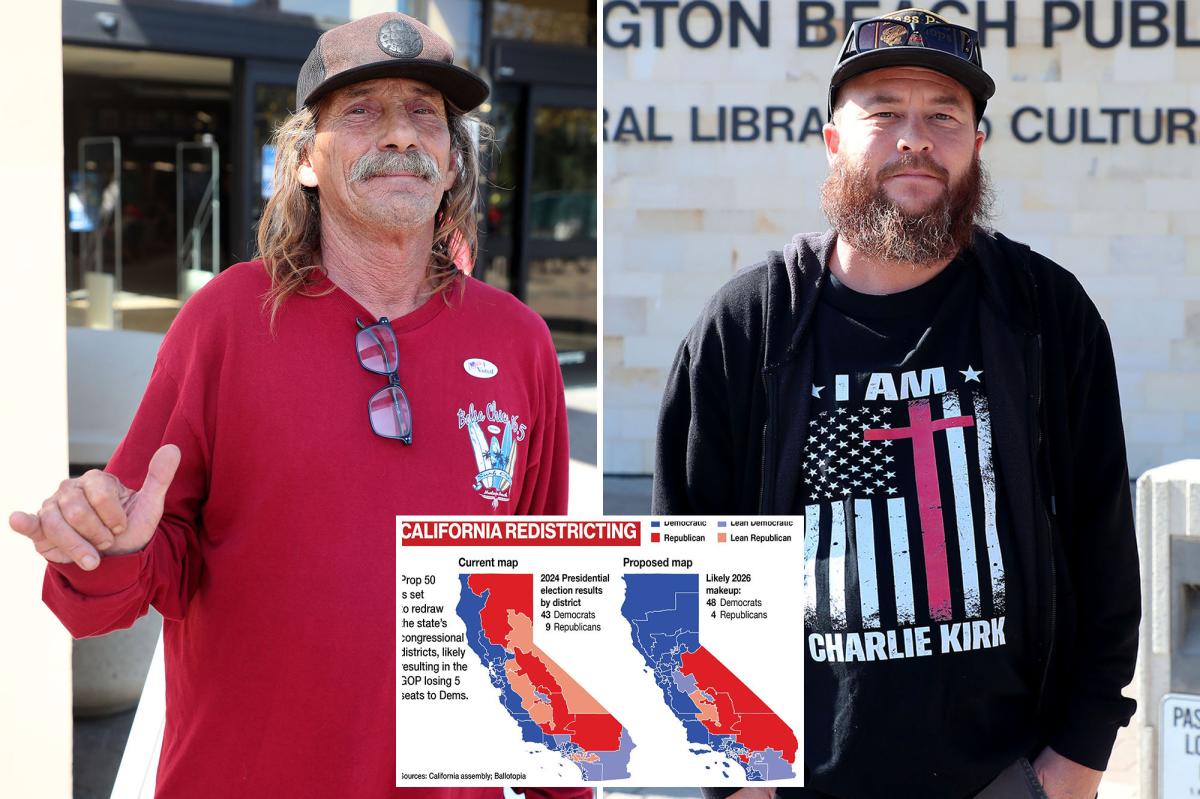
Voters in former Republican strongholds are seeing red as their districts turn blue after Gov. Gavin Newsom and California’s voters passed Prop 50, paving the way to flip five House seats to the Democrats.
The proposition — which passed overwhelmingly with 63% of the vote — was a feat of calculated gerrymandering meant to offset a similar, Trump-backed scheme in Texas, theoretically balancing the scales in Washington.
Prop 50 eliminates five of the state’s Republican congressional districts by swapping the existing map — drawn by an independent commission — with one from Democratic state lawmakers until 2030.
Jennifer York, Zac Britton, and George Reed encourage passing motorists to vote Yes on Prop 50 along Bicentennial Way in Santa Rosa, Calif. AP
But 2,000 miles away from the Capitol, conservative Californians feel their voice is being stripped away in the name of political gamesmanship.
“This is just Newsom reacting to Texas. He says, ‘They can do it, and we can do it too.’ It’s like a child throwing a tantrum,” said Silvia Garcia, 73, who cast a “no” vote in her hometown of Lakeside, CA, near San Diego.
Lakeside, a Republican enclave, will now be part of a majority-Democrat district for the next five years.
Map showing California’s congressional districts before and after the passage of Prop 50. NY Post Design
Texas recently took on a gerrymandering plan of its own, hatched at the request of President Trump, who browbeat state lawmakers into drumming up five more seats for the Republicans ahead of the midterms.
Ligia Carle, 64, who moved to the U.S. from Mexico City more than 30 years ago, doesn’t mind fighting chicanery with chicanery.
“It’s not unfair. They started this. [Trump] is the one who requested an extra five seats,” she said.
California Gov. Gavin Newsom speaks during a campaign event on Proposition 50 in San Francisco. AP
“It is very disappointing that things can be so crooked. I never expected something like this,” Carle admitted, but said she hopes Prop 50 will help stymie “everything that is happening right now, the bad things happening around the country. ICE taking down citizens. I hope it will stop.”
But Amy Liebland, 65, a conservative in the town of Huntington Beach, near Los Angeles, believes “two wrongs don’t make a right.”
“I’m against it on principle,” she told The Post.
Diane Adams, 73, from the same town, laments the suspension of the Citizens Redistricting Commission (CRC), an independent body established in 2010 tasked with drawing more equitable district maps.
“The independent decision-making group we already have should stay in place,” Adams told The Post.
Doug Scott, 55, votes NO on proposition 50.
Voters arrive/leave Huntington Beach Central Library, on Election Day. David Buchan for New York Post
Larry Shriver, a retiree in the tiny, apple-growing town of Julian, put it more bluntly:
“Those motherf—s! I voted not only ‘no’ but ‘hell no!’” he told The Post.
Republican assembly member David Tangipa, center, speaks to reporters during a press conference announcing a federal lawsuit challenging Proposition 50. AP
Robin Kelly, a tax consultant in Riverside, doesn’t trust the politicians behind Prop 50 to set things right after 2030.
“If people think they’re are going to allow us to have [the old map] back, they’re not…Once we allow gerrymandering, they will never give that up again. They’ll always find a way,” she said.
That Prop 50 was an act of gerrymandering was never in question.
Patrick Willis, 38, stands outside Huntington Beach Central Library, where he voted “NO” on Proposition 50. David Buchan for New York Post
The text of the ballot itself described Prop 50 as “temporary changes to congressional district maps in response to Texas’ partisan redistricting.”
Governor Newsom even called it “the most transparent and democratic redistricting that’s ever been done in the United States of America.”
State Republicans disagree, and they are already taking Prop 50 to court.
The California Republican Party filed a federal lawsuit Tuesday challenging the state’s new congressional district maps, alleging Democrats illegally used race as the primary factor in redrawing boundaries to favor Latino voters.
The complaint, filed in U.S. District Court for the Central District of California, seeks to invalidate the new map.