
Wildfire threatened Berkeley a century ago as high temperatures and low humidity blanketed the Bay Area.
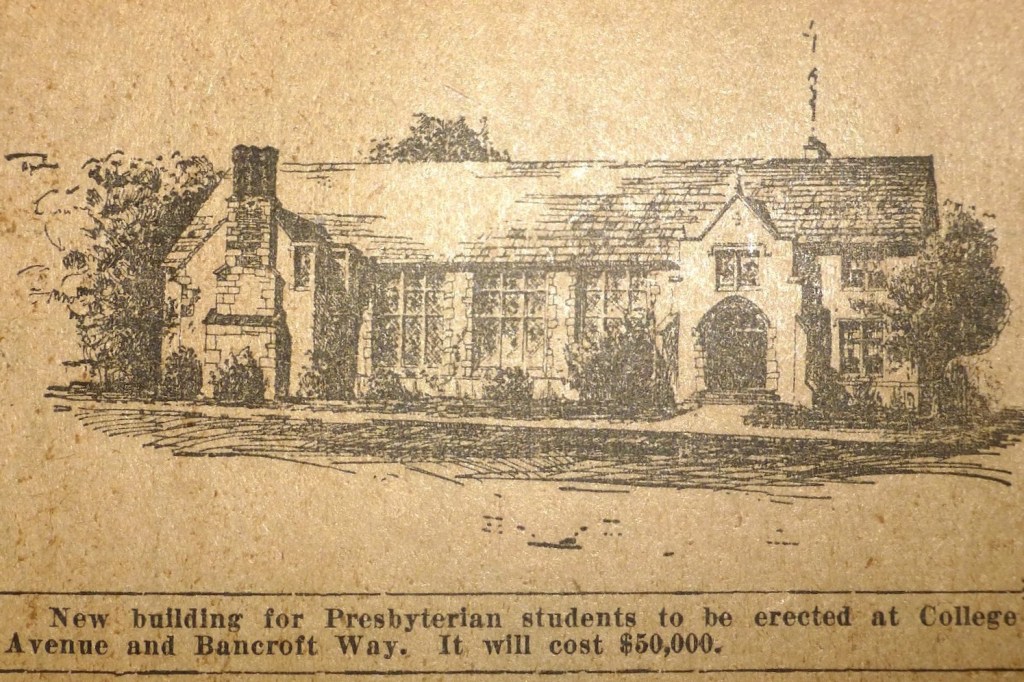
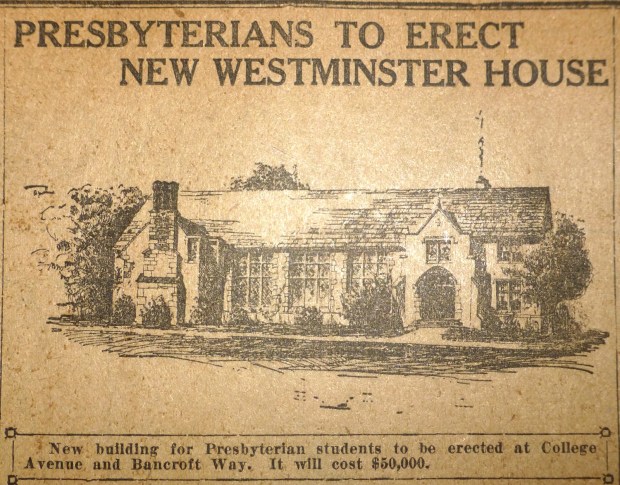 Plans were announced in July 1926 to build a Presbyterian student center adjacent to the UC Berkeley campus. The Tudor-style building, Westminster House, still stands but houses a gastropub today. (courtesy of the Berkeley History Society and Museum)

A brush fire started during the night of July 15-16, 1926, “burned nearly 25 aces of land in Strawberry Canyon, threatening a conflagration,” the Berkeley Daily Gazette reported. “Berkeley was aroused to a high pitch of excitement … two Fire Department companies and several hundred student volunteers and park department employees fought the flames for several hours before they were extinguished.
“The flames came dangerously near university buildings, residences in the vicinity and the California Memorial Stadium. For a time the flames threatened to leap a small hill into the main part of the campus. The siren calling out student volunteers at the university … was sounded for the first time since its installation a year ago. The botanical gardens of the university located near the stadium were seriously threatened by the blaze.”
In addition to firefighting volunteers, a crowd estimated at 3,000 gathered on campus and nearby to watch the flames. At almost the same time the Berkeley fire started, a blaze erupted near Mount Tamalpais in Marin County, threatening a radio station near Bolinas. Three hundred men were fighting it the next day, and towering smoke “was plainly visible from the Berkeley hills.”
The fires occurred during a heat wave that “brought increased forest fire hazard.” San Francisco temperatures reached nearly 87 degrees, and that was considered a cool spot statewide. Berkeley reached 83 degrees, and inland temperatures were 100 to 116 degrees. One Berkeley resident, M.R. Dallas, age 36, of 1433 Adeline St., died at Berkeley General Hospital, apparently from heat prostration.
New student center: The July 20, 1926, Gazette heralded plans by local Presbyterians to build Westminster House, a center for students of that Christian denomination at Bancroft Way and College Avenue. More than 1,000 UC Berkeley students at the time were Presbyterian, and the building would cost $50,000. The Tudor-style building still stands today and is home to local gastropub Freehouse.
Double shooting: Berkeley saw a rare double shooting on July 21, 1926, when an Emeryville man appeared in the Sing Lung Laundry at 2031 Blake St. in the middle of the night, asked for a resident by name, then shot him, shot another resident in the stomach and fled in a taxi.
The 70-year-old man who was shot first died, “and Frank Gee, the other victim, is believed dying,” the Gazette reported.
Gee was a cook at the Theta Delta Chi fraternity. Berkeley police said they thought the shooting could be related to opium sales and a “tong war” (gang war) between two groups of Chinese-American rivals. The dead man was found to have “a small quality of opium … as well as some cartridges” and a gun.
Traffic campaign: On July 19, 1926, Berkeley police began “an intensive campaign against violators of the boulevard stop ordinance. Police today issued a warning that motorists must come to a complete stop at all boulevards. Those who merely slow down and shift gears will receive treatment as harsh as those who speed past the signs,” the Gazette warned readers.
Along with the campaign, the city had raised the fine for violating a stop sign from $2 to $5. The paper reported that Berkeley’s traffic safely campaign was now seeing results, with just 30 arrests for traffic violations over a two-day period.
Car ferries: On July 20, 1926, the Gazette reported that, perhaps in response to the recent approval of a rival company’s proposal to build a pier for a car ferry from San Francisco to Berkeley, the Key System was filing for permits to operate car ferry service from Emeryville to San Francisco.
Bay Area native and Berkeley community historian Steven Finacom holds this column’s copyright.