
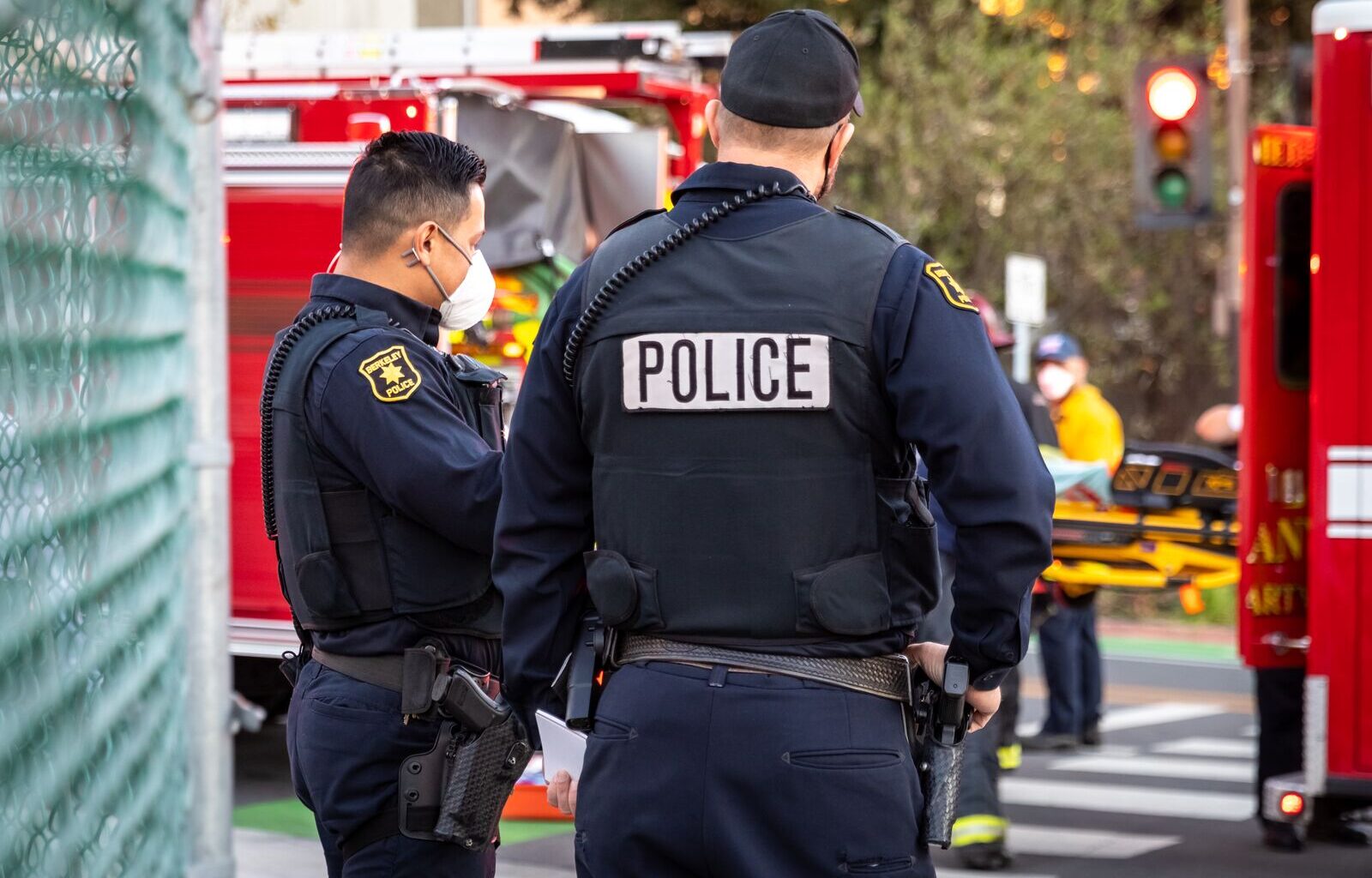
 Berkeley police officers, on the job in 2022. The city’s police officers union has been among those negotiating with the Police Accountability Board for years over the rules determining the board’s powers. Credit: Kelly Sullivan
The system of civilian oversight over Berkeley police, created with support of 85% of voters five years ago, is navigating one conflict after another these days.
Several times in the last year, the city’s police department refused to turn over records to the Police Accountability Board (PAB) and police accountability director unless subpoenaed. The City Attorney’s Office typically represents the PAB and the Director of Police Accountability in legal matters, despite complaints that it presents at least the appearance of a conflict — the same lawyers also represent the police department, with which the PAB occasionally wrangles.
Accountability board members spent years reviewing racist, anti-homeless text messages between members of a Berkeley police unit, only to have their final recommendations for policy changes within the Berkeley Police Department (BPD) largely brushed aside earlier this year, with the city arguing BPD had undertaken enough reform already.
Meanwhile, the accountability board has been trying for more than two years to negotiate its own working rules with the city police officers union. Without them the board has been working under interim regulations since 2021. And now the City Council, which several PAB members have accused of ignoring their oversight work and recommendations, has waded into the negotiations to tell everyone involved to hurry up and get the regulations done.
Currently at stake is when people accusing officers of misconduct should have access to their body-worn camera footage.
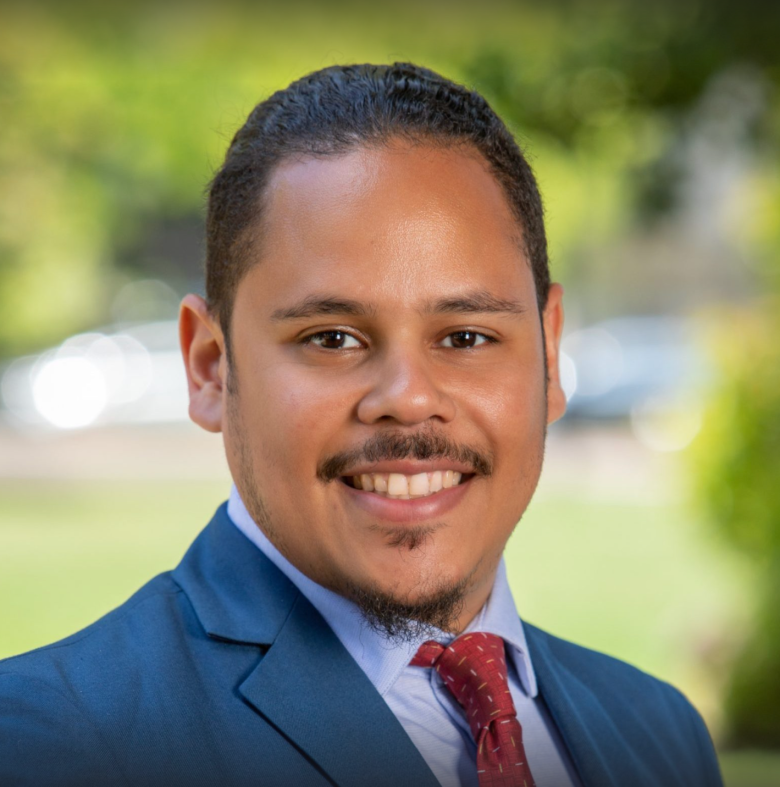 Hansel Aguilar, Berkeley’s Director of Police Accountability. Courtesy of Aguilar
In September Director of Police Accountability Hansel Aguilar took an unusual public scolding from the City Council after he forced two items onto their agenda, aimed in part at increasing his office’s autonomy. Among other criticisms, several council members admonished Aguilar to focus his energies in other directions, such as the PAB’s still-pending final regulations. Aguilar — whom the council hired, and can also fire — said the proceeding felt “punitive.”
PAB chairman Joshua Cayetano said the council members’ meaning was clear: Stay in your lane.
“The City Council is interested in police accountability as they understand it, and as they want to see it in Berkeley, and would like the PAB to reflect that understanding as well,” Cayetano said in a phone interview. “And we don’t always see eye-to-eye on that.”
Police are reluctant to turn over officer disciplinary records, Aguilar says
Aguilar and the PAB’s dealings with the city administration and the council are not universally adversarial. Cayetano and police Chief Jen Louis wrapped up work just three months ago on an initiative that aimed to reduce racial disparities in police stops. Council members have high praise for Aguilar’s and the PAB’s reviews of BPD requests for new surveillance technology.
Nevertheless, Aguilar, who was hired in 2022 as the Director of Police Accountability, said the police department’s reluctance to turn over officers’ prior discipline records during investigations “has been the source of a lot of tension since I’ve been here.”
Aguilar — who previously ran a law enforcement oversight agency in Charlottesville, Virginia — has the authority to recommend “corrective action” in response to complaints, though he can’t compel the police department to follow his recommendation. He said he tries to consider the totality of an officer’s disciplinary record when investigating an allegation.
“Let’s say discrimination — is there a pattern of this type of behavior, or is it a one-off? I think that’s going to impact our recommendations,” Aguilar said.
 Joshua Cayetano, chair of the Police Accountability Board. Courtesy: City of Berkeley
“I think there’s a discomfort — and it’s not just a Berkeley one — but I see police unions, and police in general, not wanting to give more of that sensitive information to anybody outside the department. This is the tension of why civilian oversight exists,” Aguilar told Berkeleyside. “But I also think there’s a sentiment of generalized distrust there — once that information is out, what will be done with it?”
Nobody within the accountability apparatus who spoke with Berkeleyside criticized Berkeley’s police union. Union officials did not respond to questions for this story, other than to say the negotiations were proceeding amicably.
The police department, City Manager’s Office and City Attorney’s Office did not respond to Berkeleyside’s questions.
Berkeley officials disagree over body cam footage
It’s been more than three years of negotiations over the rules by which the PAB operates. At one point, the city terminated its contract with a negotiator after the process stalled for around six months. The negotiations have involved not just the PAB and the police union, but also the City Attorney’s Office, the City Manager’s office and the city’s Human Resources Department. The accountability board — which succeeded Berkeley’s prior police oversight body, the Police Review Commission, in 2021 — has been operating under interim regulations since its creation.
Now, accountability board members and Berkeley’s administrative departments have found common ground on most items, but on at least one — body-worn camera footage — they seem to be at loggerheads, which means the City Council will likely have to decide the matter for them.
The PAB has proposed that those who accuse officers of misconduct should have access to their body-worn camera footage, the same as the officers in question or the panel members who would conduct the hearing. The city administration does not want accusers to have access to the footage before hearings, but it is not clear why.
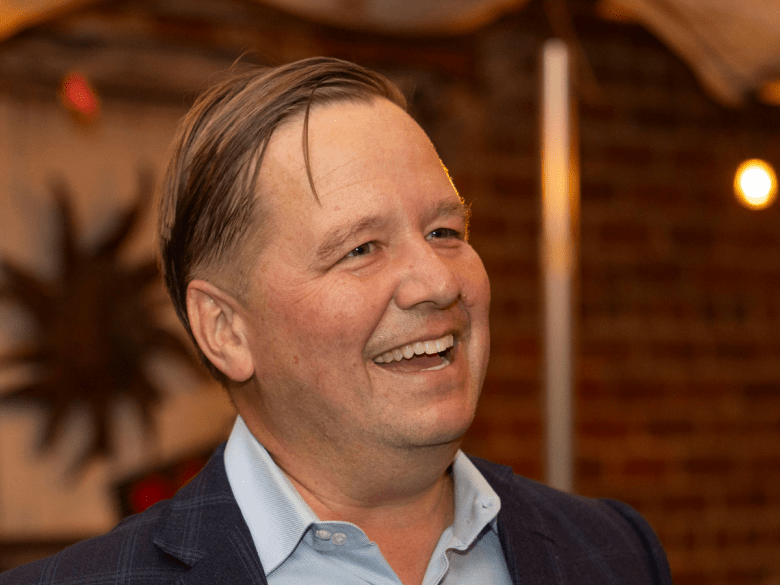 Councilmember Brent Blackaby. Credit: Colin Peck, Berkeleyside
“Our goal is to oversee a fair hearing, and one of the elements of a fair hearing is those parties being able to have access to the records that are being relied upon to make conclusions as to whether an officer conducted misconduct or didn’t,” Josh Cayetano, the PAB chair, told Berkeleyside in an interview.
If that stakeholder caucus — comprising the administrative departments, Aguilar and the board — cannot hammer out an agreement on its own, the City Council will have to step in.
Councilmember Brent Blackaby, who served on the Police Accountability Board member before being elected to the council, is the main author of the resolution urging the different sides to finish negotiating over the board’s regulations. The process has been going on since he served on the PAB and he’s frustrated by how long it is taking.
Blackaby told Berkeleyside his prodding is not directed at one group or another, but that he hoped the council could help move things along.
“This is like, ‘Come to us, let us know what are the last remaining issues that are outstanding,’” Blackaby told Berkeleyside. “If it’s a policy question, where the people are wondering where we are going to come out, we can give that assurance.”
Experts in policing frustrated their ‘advice is not taken’
Aguilar’s office, the board, the police department, city human resources, city attorneys, the City Manager’s Office and the City Council are all parts of the same city government. But just because each is a cog in the same machine, does not mean they always mesh.
City police, attorneys and human resources officials are part of a public bureaucracy. The City Council, which sets policy for that bureaucracy, is a political body. And due to the nature of their work, Aguilar and the PAB — the members of which are appointed by the council — frequently find themselves in disagreement with different parts of the bureaucracy.
Because the board can only recommend policy changes, which the City Council must vote to adopt, members said the board’s effectiveness in the future would lie in its ability to persuade the council on the PAB’s positions.
“Honestly, we need to be better at persuading the council members individually,” Cayetano said. “There’s an opportunity there for more communication and more effort on our part.”
Council members, PAB members and Aguilar have found common ground on at least one matter: Each wants more, and better, communication with each other, outside official meetings where they may find themselves at cross purposes.
“I just think we can build more trust by building better relationships,” Blackaby said.
But the current dynamic with the council has left board members feeling ignored.
“It’s sometimes frustrating that our recommendations are not accepted, sometimes feel dismissed, but we are an advisory board, so they can take our advice or leave it,” Kitty Calavita, who has been on the board since its inception, told Berkeleyside in a phone interview.
Nevertheless, Calavita said, that advice comes from board members with lifetimes of experience in policing and oversight.
“We have attorneys on our board, we have Ph.D.s on our board, we have people with a lot of relevant experience, so it is often frustrating that our advice is not taken.”
“*” indicates required fields