
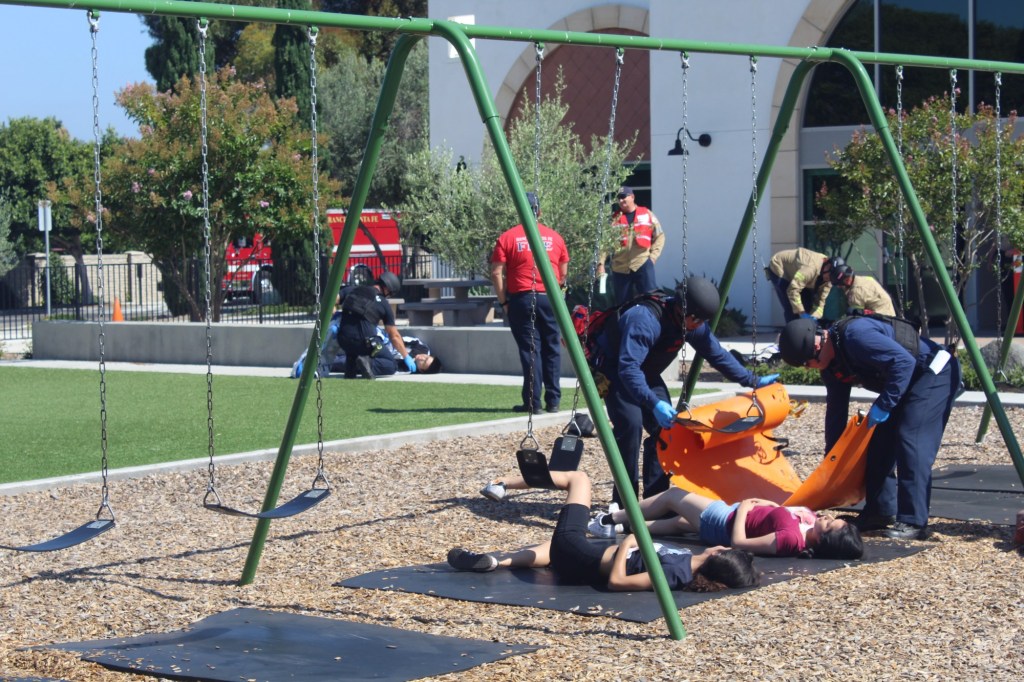
Local first responders recently went through a realistic, multi-agency training exercise to be prepared to save as many lives as possible when the worst imaginable occurs.
The Rancho Santa Fe Fire Protection District hosted the intentional mass casualty incident drill over the course of three days on the Horizon Prep campus, inviting collaboration from the Del Mar, Solana Beach and Encinitas Fire Departments, officers from the Rancho Santa Fe Patrol, local ambulance crews, Reach Air helicopter services and Palomar Medical Center.
Across six sessions, crews of firefighters were drilled on new terminology, tactics and strategies in the event of an intentional mass casualty incident (MCI), the new standard operating guidelines coming out of a study completed by Sacramento metro fire departments.
The drill incorporated dummy victims and live victims played by Palomar College emergency medical technician students.

Firefighters are briefed ahead of the RSF Fire Protection District’s training drill at Horizon Prep campus. (Karen Billing)

Firefighters work to quickly evacuate victims during an intentional mass casualty incident training at Horizon Prep campus. (Karen Billing)

Firefighters work to quickly evacuate victims during an intentional mass casualty incident training at Horizon Prep campus. (Karen Billing)

Firefighters get a wounded “victim” to safety during a recent intentional mass casualty incident training. (Karen Billing)

Firefighters work to quickly evacuate victims during an intentional mass casualty incident training at Horizon Prep campus. (Karen Billing)

Firefighters work to quickly evacuate victims during an intentional mass casualty incident training at Horizon Prep campus. (Karen Billing)
Show Caption
1 of 6
Firefighters are briefed ahead of the RSF Fire Protection District’s training drill at Horizon Prep campus. (Karen Billing)
“We’re changing our tactics on how we respond to these incidents because the threat and the danger are different,” said RSF Fire Protection District Battalion Chief Luke Bennett at the July 9 session. “Hopefully none of us will have to use these skills in our careers, but the reality is we have to be prepared.”
According to Bennett, statistically, over 50% of intentional mass casualty incidents end within five to 10 minutes. Firefighters are not expected to go into an area with active gunfire—per their operations guidelines, a safety corridor is created by law enforcement and the firefighters can then enter and get patients and victims to an evacuation zone.
In the drill, the firefighters received a mock dispatch call and entered the campus to find the live victims as well as dummies with status notes attached to them throughout classrooms and on the open quad and playground.
“The number one thing we’re working against is time,” Bennett said, noting firefighters’ main goals are hemorrhage control and rapid extrication to safety.
Firefighters on the litter team used rescue stretchers and a useful new device called a fox trot to carry out victims to the evacuation zone. The dummies, representing victims that were unable to be saved, were assessed and marked with purple glow sticks.
Firefighters escorted walking wounded victims to the evacuation zone and routinely checked up on all victims as they waited to be loaded into arriving ambulances.
The firefighters had already been taught this new mindset for intentional mass casualty incidents but the drill provided an opportunity to put their learning into action.
As individual crews did the training over the three days, they were encouraged to go back and share what they learned and experienced with their stations.
“Every day we’re getting victims out more quickly,” said RSF Fire Training Captain Kyle Carranza.
On the third session on July 9, 45 fire personnel from across North County San Diego worked together swiftly and efficiently to get 19 victims out to safely.