
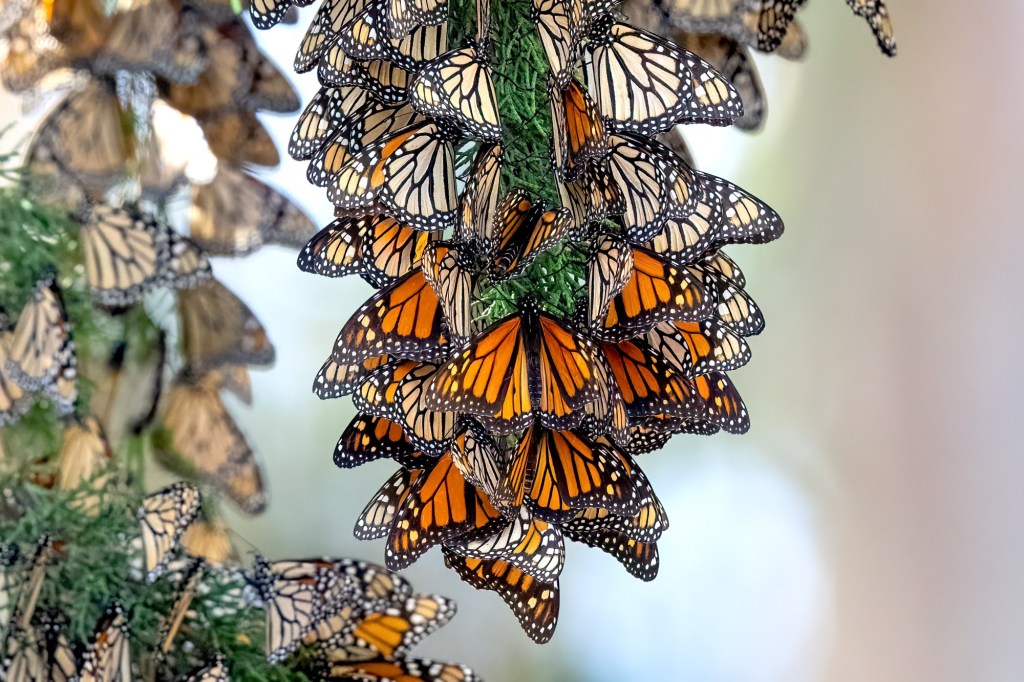
In a previous column, I mentioned last fall’s annual count of California monarch butterflies was only 12,260. This contrasts with a population in the 1990’s of 3.5 million. Each year, counters scour groves of trees along the coast from Baja California to Mendocino County to take stock of the monarch population. Al Basiulis, who gardens in San Pedro, wrote to express his surprise at such a small number of monarchs, especially since he sees them flitting around his garden.
I have seen monarchs in my garden, too, and echo the surprise of Bsiulis. With such a tiny number in the state, how could I have been so lucky to be blessed with their visits? With this riddle in mind, I turned to Ron Vanderhoff, coordinator of Orange County’s annual monarch count. Vanderhoff is also general manager of Roger’s Gardens, the ultimate destination nursery, in Corona Del Mar.
Each fall near Thanksgiving, Vanderhoff searches for the presence of monarchs in groves of coast-adjacent eucalyptus trees in Seal Beach, Huntington Beach, and San Clemente. The lifespan of monarchs you typically see in the garden is 4-6 weeks. However, the last generation of the season, known as the “super generation,” migrates to the coast where it lives for 3-4 months through late fall and winter. Only after native milkweeds — which die back in the winter — begin to grow again in late February or early March, do the monarchs depart from their resting place to lay eggs on the dormant emerging milkweeds.
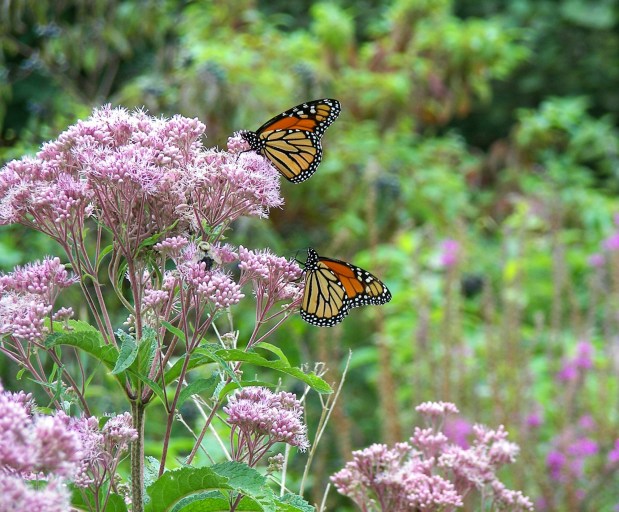 Monarch butterflies on pink milkweed flowers. (Getty Images/iStockphoto)
As to the monarchs we currently see in our gardens, some of them could be descendants of the butterflies that migrated from the coast last spring, considering that each female monarch lays 300-500 eggs. Another possibility concerns the recent development of a resident monarch population. Resident monarchs have evolved over the last 20-30 years and do not migrate to the coast. Instead, they live on a tropical evergreen milkweed species (Asclepias curassavica), which is widely available in the nursery trade.
The problem with resident monarchs is that they are infected with a protozoan parasite whose spores are deposited together with their eggs. The larvae that hatch are infected with the parasite and carry it throughout their lives. It is estimated that 95-100% of resident monarchs are infected with this parasite, which has spread among the migratory monarch population as well. Vanderhoff is so determined to plant only the right kind of milkweed that he offers one free native milkweed plant per household in exchange for the tropical milkweed specimen you dig up and bring in for elimination.
Vanderhoff educated me about how atmospheric conditions can affect the level of cardenolides in milkweed and ultimately in monarchs. Cardenolides are the cardiac glycosides, which, when ingested by monarchs, render them toxic to most birds and many other predators. The monarch’s orange color then serves as a warning sign to any animal that may have tasted a monarch previously and vomited it out, but now knows how to recognize this lepidopteran nemesis. When temperatures rise, the concentration of cardenolides in a milkweed can increase to such a level that monarch larvae themselves, upon consuming such a heat-stressed plant, will die. By the same token, when the concentration of carbon dioxide in the air rises, the level of cardenolides can drop to a level that monarch larvae ingesting it lose their toxicity to predators.
I asked Vanderhoff about his monarch counting experience and he says it’s not at all glamorous. You have to count them in late November’s early-morning chill and the routine starts around 6 a.m. By 8 a.m., the counting ends since as soon as the temperature begins to warm, the monarchs will fly away. Although they are reproductively dormant during the winter, they fly around during the day, sipping water and imbibing nectar. If you should wish to participate in counting monarchs, register to volunteer at westernmonarchcount.org.
As to whether gardeners can make a difference in boosting monarch populations, Vanderhoff confessed that “time will tell,” but informed me that “a lot of native milkweed has been added to both gardens and wildlands over the last decade or so. At Roger’s Gardens alone, we have been averaging over 7,000 plants each year for at least the last 6-7 years. That’s a lot of native milkweed getting planted.”
Hedy Buzan, who gardens in Laguna Woods, shared her gardening practices as follows: “My gardening philosophy is pretty simple. (I think I was doing chaos gardening before it was a thing.) I improve my soil, mostly with worm compost, plant whatever, and accept the results. As an example: Last year my garden was seriously attacked by critters and so I planted extra of everything and then didn’t thin things out and it became an overgrown jungle, but I just finished harvesting a ton of Romano beans so the plants didn’t seem to mind much although other beans got crowded out especially by my squash, but I figure the beans are putting nitrogen in the soil so what is the harm?” Note: Legumes such as peas and beans have roots that live in symbiosis with root-dwelling bacteria that turn nitrogen in soil air pockets into a form that can be taken up into the plant as fertilizer.
Buzan also singled out kale for special praise. “Kale is so easy to grow year-round in Southern California that I call it free food,” she wrote. Kale can stand up to our heat waves, on the one hand, but has grown successfully in snow on the other; cold weather actually sweetens its taste. You can plant kale any time of the year as long as you tend to its water needs. It sprouts from seed in 5-10 days and may be planted now if situated in some shade, since too much heat will cause it to bolt, meaning that a flower stalk will bolt straight up into the air, upon which leaves will turn bitter and inedible. Kale does need its fair share of water, and the lack of it will also make leaves bitter, but you can minimize irrigation through maintaining a 2-3 inch layer of mulch around your kale planting.
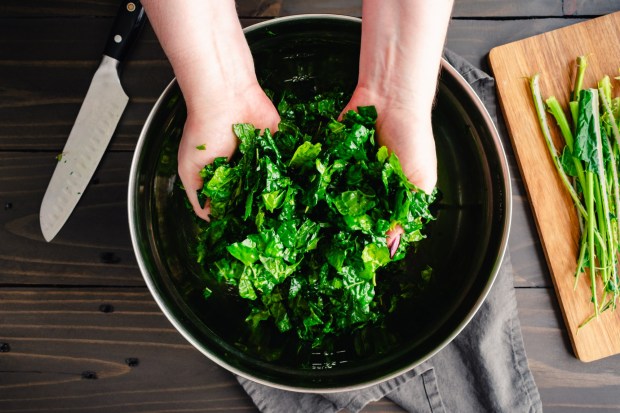 Kale leaves. (Getty Images)
Although a cabbage cousin, kale does not form a dense head but has eminently pluckable outer leaves that may be removed as needed. It also grows upright, so minimal space is required in its cultivation, and it is therefore suitable for growing in containers too.
As for eating, Buzan shared that “kale is more palatable when combined with other leafy greens. I add kale to spinach and chard for better flavor than either spinach or chard alone. Kale is delicious added to potatoes for ‘green mash’ that is flavored with sautéed garlic and olive oil; when made with sweet potatoes, this mash is a nutritional powerhouse. Adding minced kale to finely sliced cabbage, scallions, and grated carrot with an olive oil and vinegar dressing is a really tasty coleslaw. My favorite straight-up kale (shred it fine) salad includes something sweet like fresh grapes or raisins and sunflower seeds and/or pecans.”
It has been said that the world is divided into two groups of people: those who like to eat kale and those who don’t. However, after reading Buzan’s recipes, I think it would be fair for the second group to give it another try.
Your questions and comments, as well as gardening conundrums and successes, are always welcome at joshua@perfectplants.com.
California native of the week: The evergreen, bush anemone (Carpenteria californica), having begun to bloom in late spring, may still be flowering now. Its large white flowers will remind you of a cross between anemone and camellia. It should be grown in full sun or light shade and, once mature, be stingily watered. It will survive temperatures of 15 degrees. Flowers are fragrant, and leaves are glossy, deep green. Cut off spent flowers to keep it tidy. Should it become unruly, you can cut it down to the ground, and it will regrow in due course. Some object to planting California natives in the summer but according to native plant icon Bert Wilson, founder of Las Pilitas Nursery in Santa Margarita, who recommends summer planting, you can plant “even when it is 110 F, but you have to water once a week or so to a depth of at least a foot, preferably 18 inches, and then let the top 1/2 inch dry between waterings.”