
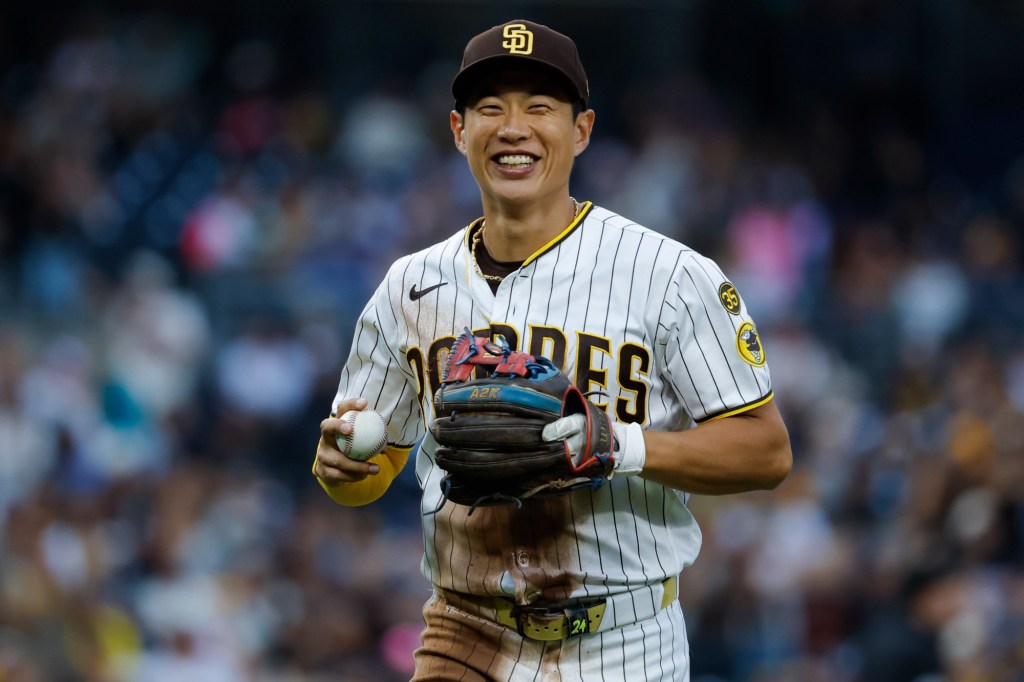
The Padres signed Sung-Mun Song to a four-year, $15 million contract in December. The South Korean star was a fifth-round pick of the KBO’s Nexen (now Kiwoom) Heroes in 2014, but appeared in just 226 games from 2015-19 before missing all of 2020 and part of 2021 while fulfilling his mandatory military service.
After returning to the Heroes, Song posted a sub-.700 OPS in both 2022 and 2023 before breaking out in 2024, when he slashed .340/.409/.518 with a .927 OPS and 19 home runs. He followed that with another standout season in 2025, earning the KBO Player of the Year Award and a Golden Glove, among other honors. The Heroes posted the left-handed hitter in November 2025, giving MLB teams one month to sign him.
The 29-year-old Song is an infielder who can play all around the diamond and is an adept baserunner. He suffered an oblique injury during Spring Training and opened the season in the minor leagues before being called up by the Padres in May.
This interview has been lightly edited for length and clarity and is translated by Song’s interpreter, Jun Yi.
What got you interested in baseball?
A: My dad was a big baseball fan. Growing up, playing catch with my dad when I was maybe four or five years old and watching the KBO — that’s how I got into baseball. … I was always good when I was young. I was hitting at the top of the lineup and playing every day.
Did you look up to any players when you were younger?
A: The one player I admired is Hyun-soo Kim. He played in the big leagues too (with the Orioles and Phillies), and a lot of coaches helped him in the KBO.
When the Heroes drafted you, did you envision yourself playing in Major League Baseball one day?
A: Not at all. I dreamed about the big leagues maybe since two or three years ago. I wasn’t drafted in the top rounds of the draft, so there’s not many examples of Korean players coming over to the big leagues from my draft (round).
From 2020 to 2021, you fulfilled your military obligation. What does that entail? Did you have to give up baseball during that time?
A: It is mandatory for Korean men to go to the military. But thanks to the rules, there are military baseball teams, so we get to practice every day. We get to focus on baseball. It is bad that you’re getting, like, two years in the minors with the military baseball team, but at least you’re playing. And it’s kind of refreshing playing with the military baseball team too.… We do mainly baseball, but also some military drills.
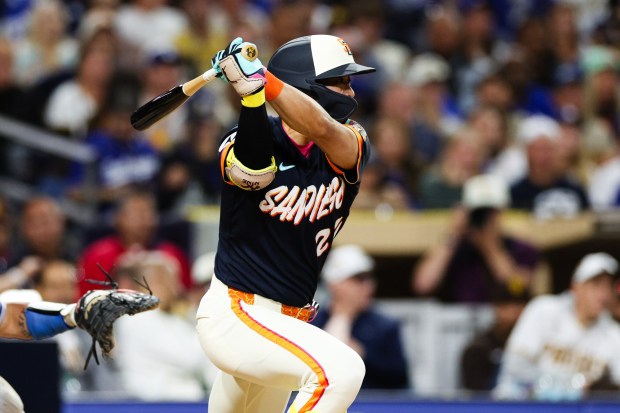 The San Diego Padres’ Sung-Mun Song hits two-run single during the eighth inning of a game against the Dodgers on Friday, June 26, 2026, in San Diego. (AP Photo/Derrick Tuskan)
When you returned to the Heroes, your performance was average for a few years. But in 2024 and ’25 you excelled, putting up numbers that you never had before in your career. What shifted for you?
A: After getting military service done, I wasn’t a young age anymore. I wasn’t a prospect anymore. So I thought, ‘I have to really focus and do something.’ I worked out more, got more lifts in. Tried to avoid junk food; tried to get away from the food that everybody likes. I was better mentally and physically, so I could play well.
There are a lot of changes between those two years because, first of all, I got married. And I need to work hard and be more professional because I’m in the prime of my career, age-wise, and there’s definitely a lot of things changing physically too.
At that point, were you thinking about eventually posting?
A: I personally didn’t think I would be able to go to the big leagues, but we had (former Heroes teammates) Ha-Seong Kim and Jung Hoo Lee (in MLB), and Hyeseong Kim was about to go to the big leagues. They were talking to me about the big leagues. So I was like, ‘Maybe I can go. Maybe.’ … I was hesitating because it was only for two years that I did good — really good — in the KBO, but Ha-Seong Kim and Hyeseong Kim gave me confidence, like, ‘You should get posted.’ They really gave me confidence, so I got posted.
You won quite a few awards in 2025. Which one meant the most to you and why?
A: The Golden Glove, because in Korea, it’s kind of different from the (USA) Gold Glove. It’s the best player at each position who wins the Golden Glove, both hitting-wise and defensively; just overall. So, the best third baseman overall. One of my dreams was to win the Golden Glove.
What stood out to you about the posting process?
A: Once you decide to get posted, there are a lot of scouts at home plate watching you play. So I definitely knew somebody’s watching me. And then whenever that timeline starts, it’s just one month to get an offer from a big-league team. That one-month window feels like a year.
Why were the Padres the right team for you?
A: I heard from Ha-Seong Kim. He said, ‘Great field, great city. We have superstars on our team.’ I definitely thought I could learn from them and have a great time in the USA.
KBO games are so electric. What do you miss about the atmosphere of those games, and do you think any part of it could be brought to America?
A: KBO, it’s amazing. Every single player has their own cheer songs. That’s amazing. But it’s kind of different. In the big leagues, the crowd is so focused on the game, so I would not necessarily bring something over from the KBO to the big leagues.
What’s been the hardest adjustment from the KBO to major league baseball?
A: When I first signed, I thought, ‘Oh, maybe hitting will be the hardest part.’ But since I got here, it’s everything. You need to be good at every single thing: fielding, baserunning, hitting. Everything is an adjustment.
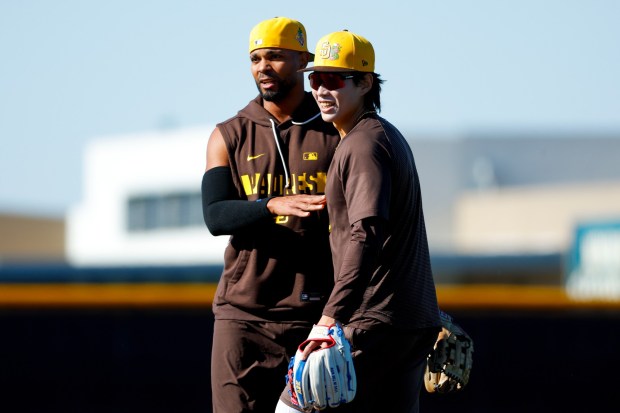 Sung-Mun Song #24 and Xander Bogaerts #2 of the San Diego Padres hug during spring training workouts at the Peoria Sports Complex on Saturday, Feb. 14, 2026 in Peoria, Ariz. (Meg McLaughlin / The San Diego Union-Tribune)
You’re not just adjusting to the major leagues; you’re also adapting to life in a completely different country. What has that experience been like?
A: Yeah, it was kind of tough to start the season in Triple-A because I was always “the guy” on our team in the KBO. It’s a lot different. I knew it was coming, but when it came, I was kind of lonely by myself. But it’s part of the process.
You were also the team captain of the Heroes. How different does your role feel now?
A: Yes, compared to Korea, I get nervous at every single play because it’s the big leagues. But I don’t get the pressure to lead the team or do anything (like that), so it’s kind of different.
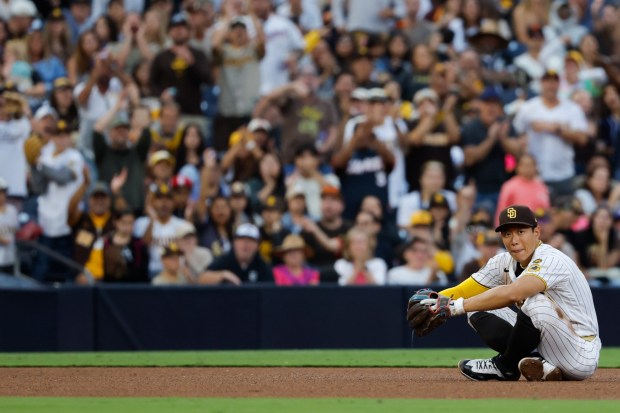 Sung-Mun Song #24 of the San Diego Padres smiles after a catch against the Toronto Blue Jays during the fourth inning at Petco Park on Saturday, July 11, 2026 in San Diego, California. (Meg McLaughlin / The San Diego Union-Tribune)
What kind of pride do you take in your defense?
A: I’m definitely confident about my defense and baserunning because I’m showing my strength on the field regularly.
You hit your first major league home run in July. What did you feel when you were rounding the bases and where will you put the ball?
A: Going around the bases, I was relieved because I haven’t hit a homer for a long time. I (had become) kind of nervous, like, ‘When am I getting my first homer?’ So getting around the bases relieved me. And the home run ball will be in the middle of the house, where everybody could see it.
You’ve shown improvement offensively. What’s made the most difference?
A: Playing every single day. And in games, working every single day. Doing the little things helps me.
When you were playing in Korea, you were in the lineup regularly. How hard is it to have more sporadic playing time here?
A: It’s definitely tough, but I knew that whenever I’m coming over, I’m not going to start every single day because there are so many talented players on our team. Mentally, it’s fine. But whenever I’m playing the game, it’s kind of hard to make (a good) performance because I’m not playing every day.
Is it hard to be away from your family or away from life in Korea?
A: Yes, it was tough. Now my family is here, but to start the season, they were not here. So being in a different country and getting stressed from baseball, and missing family, was combined. I was having a hard time because I cannot speak English. Like even the small things, I need help from my translator.
I’m not sure people realize how challenging that acclimation process can be, especially when you’re expected to perform right away.
A: Yes. In the KBO, there are foreign players. When I was in the KBO, I didn’t know if the foreign players were having a hard time or not. But if I ever go back to the KBO and play again, I’ll be more friendly to the foreign players, for sure (laughs).
Are there any former KBO players now in the major leagues that you stay in touch with? And since joining the Padres, who have you become especially close with?
A:The Korean players coming over from the KBO are, as I mentioned, Jung Hoo Lee, Ha-Seong Kim and Hyeseong Kim. We were all on the same team (in Korea). They’re very friendly and I’m really happy that we’re playing in MLB. On the Padres, everybody’s been so welcoming. They know I’m a rookie and I’m new to the country and the team, so they’re really helping me out.
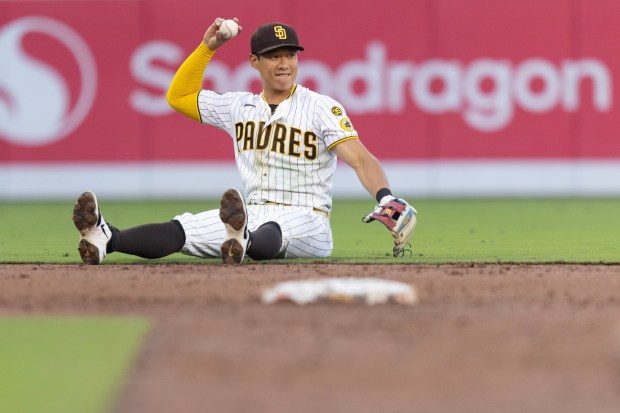 San Diego, CA – San Diego Padres shortstop Sung-Mun Song, 24, throws the ball after making a diving play during the game against the Arizona Diamondbacks Monday, July 6, 2026, at Petco Park in San Diego, CA. (Luke Johnson / The San Diego Union-Tribune)
Your path to the major leagues wasn’t a straight line. What message would you share with players who have spent years in the minor leagues or the KBO and are still chasing that same dream?
A: I hope everybody knows that there’s a timing for us to shine. There’s a timing for everybody. So hopefully they pursue their dreams and work hard.
You have a five-month-old daughter. How has fatherhood impacted you?
A: It felt like I only saw her for two weeks because I was here and she was back in Korea. But it’s really good. After the game, coming home and seeing her makes me happy. And leaving the house, even though I’m tired, I get motivation from her.
Do you have any hobbies or passions off the field?
A: I don’t have many hobbies, but I play mobile games, like phone games. And I watch some dramas, like TV shows. In the KBO, we had off days every single Monday, so you could do something like a hobby. But here, you don’t get an off day regularly.
Have you been able to tour San Diego at all?
A: I’ve been to La Jolla Beach. It was really nice. One place I would like to visit is Sea World.
What’s your favorite American food, and what’s the Korean dish you miss the most?
A: American food, maybe steak and pastas. Any kind of pasta is fine with me. And since I’m in the States, I miss some spicy Korean foods.
If you had one teammate who was going to be dropped in Korea for a week with no translator, who do you think would do the best and why?
A: That’s hard. I would say Fernando Tatis Jr. He’s a happy guy all the time and he spent time with Ha-Seong Kim too. He jokes a lot. And he knows a couple Korean words, so that will definitely help. Even though there’s a language barrier, he’ll have fun there.
On a personal note, I love Korean skincare products. Are you surprised at how much they’ve taken off in the United States?
A: So, I knew it was popular in the States, but I felt (the popularity) because when they had the Seoul series in Korea, back in 2024, all the wives of the players came into the cosmetic shop and shopped a bunch (laughs). So that’s when I knew, ‘Oh, it’s really popular.”
You seem to have a great attitude and personality. Have you always been this way?
A: I was always a jokester. I would joke around with my teammates or even the manager or coaches. I had a great relationship (with them). But obviously, coming over to the States, I have a language barrier. So if I learn more English, I’ll joke more or have more fun. English is very hard.