
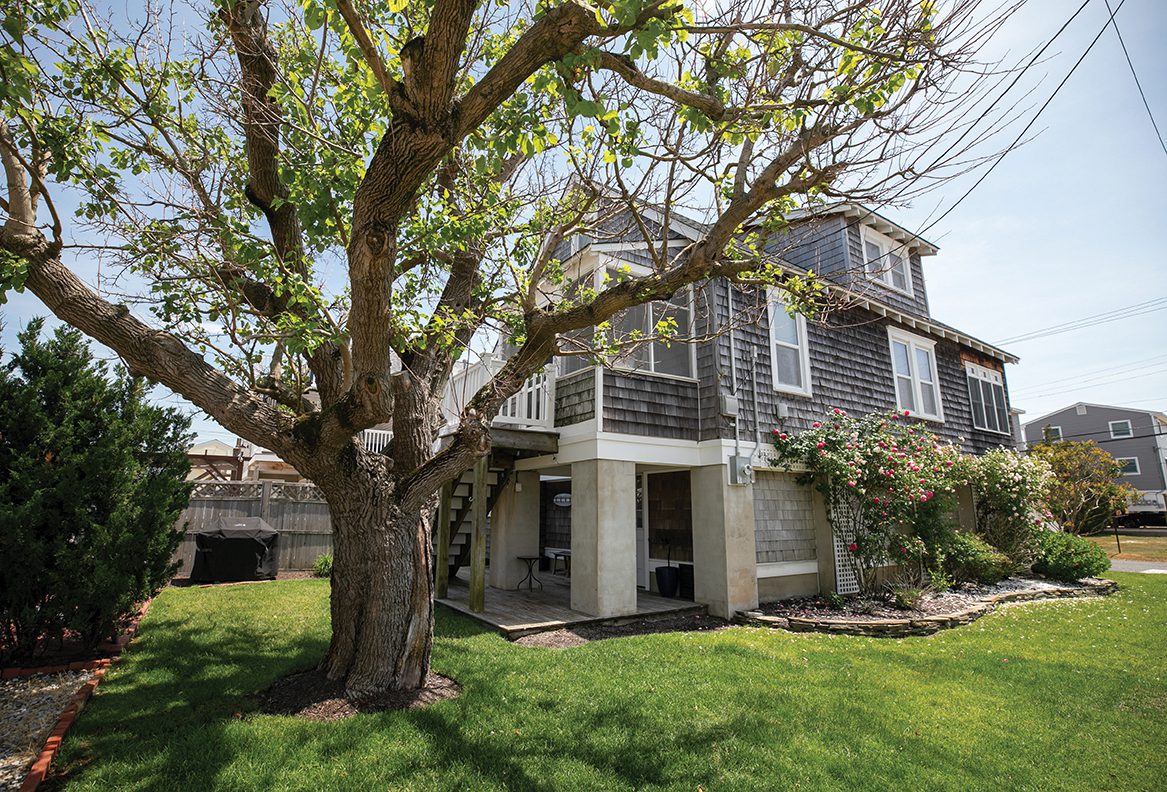
ALL AROUND THE MULBERRY TREE: A mulberry tree, said to be planted when the house was built almost a century ago, could be one of the largest on LBI. (Photos by Jack Reynolds)
Editor’s Note: This is the fifth in a series on vintage home on Long Beach Island, the people who are preserving them, and the stories that make them special.
Unlike most homes on Long Beach Island, this 1929 beach house on 27th Street in Ship Bottom was never bought or sold. Built by James Housel, it has remained within the same extended family for nearly a century, passed down from one generation to the next.
Over four generations, only the following families have lived within its walls: James and Marcy Housel, followed by Betty and Eliot Stellar, then James and Teresa Stellar, and today Devrie Stellar and Sean Lyons. Ownership came through inheritance and trust, with each generation assuming responsibility for the one that followed.

A loft-style room upstairs serves as a cozy bedroom.
Preserving What Endured
Inside, much of the original internal structure remains intact, including the loft-style top floor that has long defined the home’s layout. Some of the home’s history is written directly into the house itself. After a storm damaged the interior, the family’s contractor carefully saved a door jamb marked with decades of penciled height measurements – names and dates recording the growth of children and grandchildren over time.
Another side story lives in the backyard. A large mulberry tree grows there, and family lore says it was planted by James Housel around the time the house was built. Marcy Housel, it is said, disliked the tree and poured leftover dishwater on it after every dinner, hoping it might not survive. Instead, it thrived. Today, the family believes it may be the mulberry tree with the largest diameter on Long Beach Island.
Touching the Past
One of the home’s most distinctive features is a vintage map of Long Beach Island that hangs in the dining room, depicting the Island as it once was. The map has been part of the house since its earliest years, originally glued directly to the wall.
Family legend holds that Betty Stellar touched the spot where the house sits on the map so often that she eventually rubbed away the ink, leaving a small white mark. Years later, when the wall was slated for renovation, the contractor carefully cut the map out of the wall and moved it upstairs for safekeeping.
Tested by Water
The house has faced flooding more than once. During the storm of 1962, floodwaters reached mid-calf height and entered the house, an event that ultimately led to Betty Stellar getting a new kitchen. In 1992, water rose to knee level but stopped short of entering the home after her husband arranged to have the house jacked up and a second cinder block added to the foundation.
Then came Superstorm Sandy in 2012. With nearly 6 feet of storm surge, the first floor sustained significant damage. Everything was repaired, and afterward the house was raised to meet the town’s new requirement. It was high enough to withstand an 11-foot storm surge.
A garage door salvaged from the original garage, now gone, is mounted beneath the house at ground level. Marked with three lines, it records the flood levels of 1962, 1992 and Sandy. When the storm hit, the family took the map’s survival as a sign. The map was framed and rehung in its earlier spot, now protected behind glass.
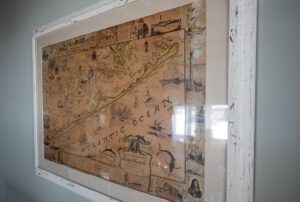
A vintage map of LBI hangs in the living room. It has been a feature of the home since its early days, once actually glued to the wall.
Maintaining a Year-Round Presence
Everyone in the family has spent summers there, and today two family members live in the house year ’round. That matters more than it may seem. Betty Stellar always believed the house had a soul, and that it was unhappy when left empty. For most of its life, the house had no heat and was closed each October, reopening in May. Betty would tear up when it was shut down for the winter.
Now, with her granddaughter and her husband living there full time, the house is never empty. The family likes to think its soul is finally content.
Carrying It Forward
The hope for the house is simple: that it continues on through future generations, cared for by those who understand its history and value. To the family, it stands as a reminder of a slower, more rooted way of life. Nearly a century after it was built, through storms, floods, elevation and generations of care, the house remains rooted in Ship Bottom – still standing.
Colleen Sullivan Trevisan, a part-time LBI resident, is a lifestyle writer specializing in home, travel, weddings and beauty, writing for outlets such as HGTV, Today.com, Better Homes & Gardens and InStyle. She’s also an adjunct professor at the Newhouse School at Syracuse University.