
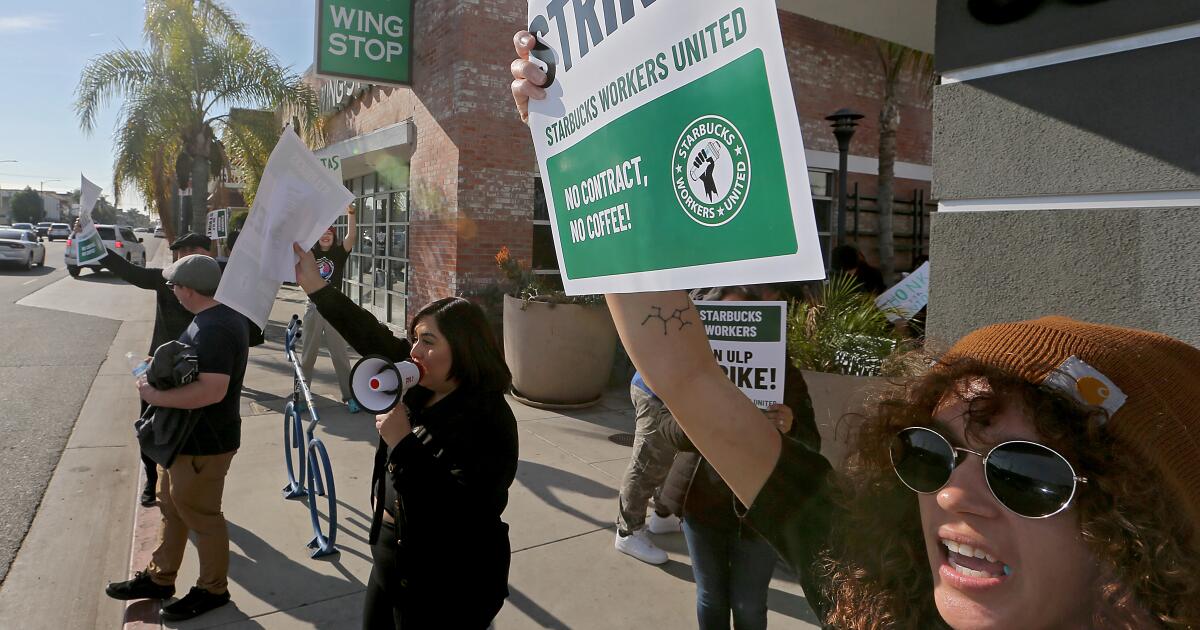
Unionized Starbucks baristas have voted overwhelmingly to authorize their leaders to call a strike as soon as next week if the coffee giant doesn’t make new proposals or they don’t see real progress in contract talks.
The authorization was approved by 92% of those who voted, Starbucks Workers United said Wednesday morning.
Michelle Eisen, a spokesperson for the union and a former Starbucks worker of 15 years, said the vote follows six months of Starbucks failing to offer new proposals to address workers’ pay and staffing concerns.
The union said baristas were prepared to strike in more than 25 cities if a contract is not finalized by Nov. 13.
“Union baristas mean business and are ready to do whatever it takes to win a fair contract,” Eisen said in a statement. “If Starbucks keeps stonewalling, they should expect to see their business grind to a halt. The ball is in Starbucks’ court.”
Starbucks, however, places the blame for failed contract talks on the union. Starbucks spokesperson Jaci Anderson said the company was “disappointed” with the union’s move to authorize a strike “instead of returning to the bargaining table.”
“When they’re ready to come back, we’re ready to come back,” Anderson said in an email. “Any agreement needs to reflect the reality that Starbucks already offers the best job in retail, including more than $30 an hour on average in pay and benefits for hourly partners.”
The company emphasized that just a fraction of its stores are unionized, and that consumers should not be overly worried about disruptions in service.
“Our customers can be assured that our partners will be ready to serve them at the vast majority of our more than 10,000 company operated coffeehouses and nearly 7,000 licensed locations throughout the holiday season, regardless of the union’s plans,” Anderson said.
Starbucks Workers United represents 12,000 workers at about 650 coffee shops. Their membership accounts for about 4% of Starbucks’ U.S. workforce, according to the company.
More than 55 unionized stores are in California.
In a Wednesday blog post on the company’s website, Starbucks’ chief partner officer, Sara Kelly, characterized the union’s proposals as unrealistic, saying it requested pay increases of 65% immediately and 77% over three years — in addition to other changes that could hinder store operations.
“These aren’t serious, evidence-based proposals,” Kelly said.
The strike authorization vote, just before the crucial holiday season, comes as the coffee giant has contended with flat or declining sales in some U.S. stores this year.
Hopes that the two sides would be able to hammer out a deal had been high since early last year, when Starbucks — which had been accused by federal regulators of unlawfully firing workers — pledged publicly to work with the union.
But contract talks broke down in December. In February, federal mediators were brought in to resolve the dispute, but little progress was made.
In April, the union voted to reject the coffee chain’s latest proposal that guaranteed annual raises would not fall below 2%.
Since then, the union has regularly asked the company to return to the bargaining table but has been met with silence for months, Eisen has said.
Unionized workers have also taken issue with recent closures that have affected dozens of California stores, and new policies such as the updated uniform and requirements for handwritten messages on coffee cups that they say create bigger workloads. They say these policies have been implemented without proper bargaining, and are among the reasons workers are gearing up for a strike.
Starbucks Workers United, which is affiliated with the powerful Service Employees International Union, has filed more than 1,000 unfair labor practice charges with the National Labor Relations Board against Starbucks since its campaign to unionize the coffee giant took off in 2021.
Although most charges predate Starbucks’ pledge to take a more peaceful approach with the union, more than 125 were filed this year, the union said.
Hundreds of the charges, including those that allege bad faith bargaining, unilateral policy changes and retaliatory discipline, remain unresolved, according to Starbucks Workers United.
The union says many of its members struggle to make ends meet with inconsistent hours, and many members are not scheduled for the 20 hours a week they need to qualify for benefits.
In a majority of states — although not in California — starting pay for Starbucks workers is $15.25 an hour, an amount the union says is too low.
Workers United President Lynne Fox wrote an opinion piece in September in the news outlet In These Times explaining baristas’ demands and describing how Starbucks Chief Executive Brian Niccol, who took the helm a little over a year ago, has made a slew of changes that conflict with his initial pledge to “engage constructively” with unionized baristas.
“The next three months will determine the future of this iconic U.S. company,” she wrote.