

Supporters say the plan would help give small business owners a break as rent prices skyrocket in San Francisco.
Jul 17, 2026
Updated 3:31 pm PT
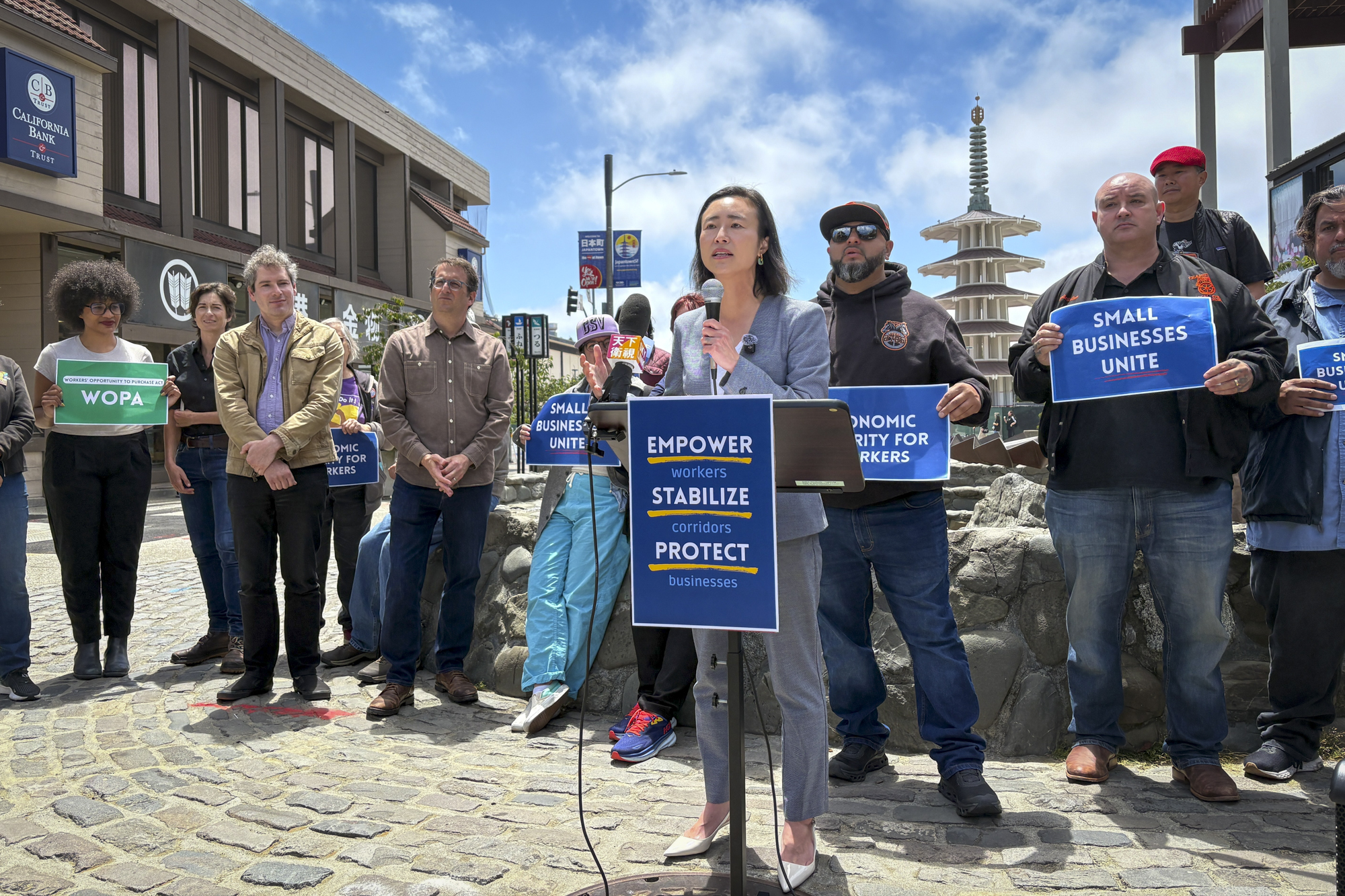
Supervisor Connie Chan unveiled a package of legislation aiming to support small business owners amid rising commercial rents and help workers more easily purchase their business if an owner decides to sell, in San Francisco, on July 17, 2026. (Sydney Johnson/KQED)
As small businesses in San Francisco face skyrocketing rents and ongoing economic troubles stemming from the pandemic, the city is looking to make it easier for owners and workers alike to keep doors open.
San Francisco Supervisor Connie Chan on Friday unveiled a package aimed at supporting small business owners and their workers through two pieces of legislation. The first would enable small businesses to unionize in order to collectively negotiate rent with commercial landlords.
For many small businesses, San Francisco’s astronomically high rent is one of the largest operating expenses. But the city’s rent control policies do not cover commercial properties, making it difficult to stay in business amid the current ballooning real estate market, largely driven by the artificial intelligence boom.
“Small businesses often face the risk of displacement, especially when their commercial rent goes up,” Chan said during a press conference on Friday in Japantown, which is home to a number of mom-and-pop shops. “We want our small businesses to stay in our corridors, because that really is the backbone of our local economy.”
 Pedestrians cross the street in front of a vacant to vibrant pop-up Dandelion Chocolate on Powell Street in San Francisco on Dec. 17, 2025. While retail vacancy in Union Square has improved after several years of store closures, San Francisco Center Mall is still struggling despite millions of dollars raised for Mayor Lurie’s Downtown Development Corporation, free lease programs for small businesses, and other Hail Marys the city is throwing at its primary commercial district.
The proposal would enable small business owners to collectively negotiate rents with their landlords and direct public resources like legal aid to commercial tenants’ unions.
In some commercial corridors, small businesses already work together to negotiate rents, but Chan’s proposal would codify that process by requiring property owners to recognize commercial tenants unions where members share the same landlords during lease negotiations.
Jon Osaki said that the model has shown success in Japantown, where several small businesses collectively bargained rent prices down with property owners during the pandemic when business was extremely slow.
“It was so disheartening in the pandemic that many of our small businesses were threatened with forced evictions, even though they were in a situation where they could not operate,” Osaki said. “Small businesses have been the lifeblood of our community.”
Christin Evans, who owns a bookstore and cocktail bar in the Haight-Ashbury neighborhood, said many small businesses she hears from have had their leases shift to month-to-month as landlords see opportunities to raise the rent during the current economic boom.