
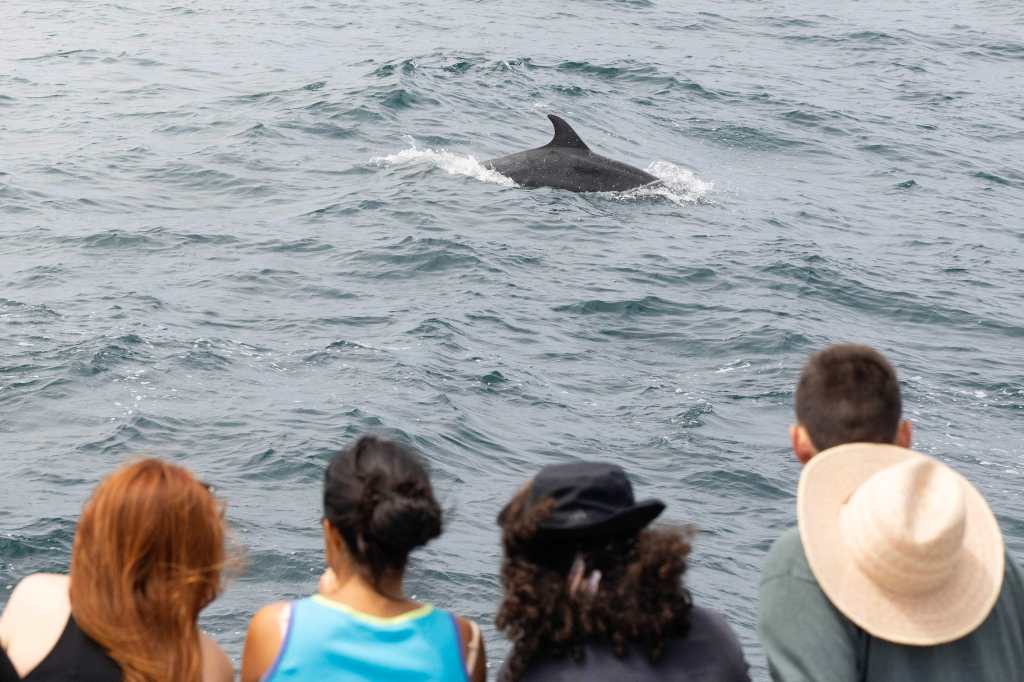
It was a cloudy morning on Friday, July 17, when dozens of families, individuals and nature enthusiasts lined up at Rainbow Harbor, in Long Beach, waiting to board a boat — in search of whales, dolphins and other marine life.
The attendees were there for a whale-watching adventure with the Aquarium of the Pacific, which offers twice-daily tours off Long Beach’s coastline to look for those wonders of the sea. And for these visitors waiting patiently in line on Friday, this kind of experience is few and far between.
But for certain Aquarium of the Pacific volunteers, these whale watching tours have become part of a routine.
These volunteers comprise the institution’s Whale Photo I.D. program, which, as the name suggests, works to identify and track whales and other related ocean animals traveling through California’s coastal waters.
Originally launched in 2010, the Whale I.D. program exists to help track and monitor whales and dolphins, their behaviors, health and other key indicators that help scientists understand the broader picture of ocean health. It’s one of many community science initiatives the aquarium of the pacific offers, akin to its citizen scientist-led program that tracks green sea turtles living in the San Gabriel River.
The aquarium offers two whale watching tours a day, one at noon and another at 3 p.m. Volunteers with the Whale I.D. program typically take part in both. They’re charged with keeping a sharp eye out for camouflaged flukes and blowhole spurts — in hopes of spotting whales hidden among the ocean’s vastness.

Common dolphins are seen off the coast of Long Beach during an event hosted by the Aquarium of the Pacific to educate members of the media on how warming ocean waters are impacting whales on Friday, July 17, 2026. (Photo by Drew A. Kelley, Press-Telegram/SCNG)

The Aquarium of the Pacific hosts an event educating members of the media on how warming ocean waters are impacting whales off the coast of Long Beach on Friday, July 17, 2026. (Photo by Drew A. Kelley, Press-Telegram/SCNG)

A California brown pelican is seen off the coast of Long Beach during an event hosted by the Aquarium of the Pacific to educate members of the media on how warming ocean waters are impacting whales on Friday, July 17, 2026. (Photo by Drew A. Kelley, Press-Telegram/SCNG)

The Aquarium of the Pacific hosts an event educating members of the media on how warming ocean waters are impacting whales off the coast of Long Beach on Friday, July 17, 2026. (Photo by Drew A. Kelley, Press-Telegram/SCNG)

Common dolphins are seen off the coast of Long Beach during an event hosted by the Aquarium of the Pacific to educate members of the media on how warming ocean waters are impacting whales on Friday, July 17, 2026. (Photo by Drew A. Kelley, Press-Telegram/SCNG)

Common dolphins are seen off the coast of Long Beach during an event hosted by the Aquarium of the Pacific to educate members of the media on how warming ocean waters are impacting whales on Friday, July 17, 2026. (Photo by Drew A. Kelley, Press-Telegram/SCNG)

Bottlenose dolphins are seen off the coast of Long Beach during an event hosted by the Aquarium of the Pacific to educate members of the media on how warming ocean waters are impacting whales on Friday, July 17, 2026. (Photo by Drew A. Kelley, Press-Telegram/SCNG)

Common dolphins are seen off the coast of Long Beach during an event hosted by the Aquarium of the Pacific to educate members of the media on how warming ocean waters are impacting whales on Friday, July 17, 2026. (Photo by Drew A. Kelley, Press-Telegram/SCNG)

The Aquarium of the Pacific hosts an event educating members of the media on how warming ocean waters are impacting whales off the coast of Long Beach on Friday, July 17, 2026. (Photo by Drew A. Kelley, Press-Telegram/SCNG)

Captain Chris Batts looks for any sign of whales during an event hosted by the Aquarium of the Pacific to educate members of the media on how warming ocean waters are impacting wildlife on Friday, July 17, 2026. (Photo by Drew A. Kelley, Press-Telegram/SCNG)
Show Caption
1 of 10
Common dolphins are seen off the coast of Long Beach during an event hosted by the Aquarium of the Pacific to educate members of the media on how warming ocean waters are impacting whales on Friday, July 17, 2026. (Photo by Drew A. Kelley, Press-Telegram/SCNG)
“We have sort of two parts to the volunteer program. There are the photographers, (who) come out on the boat and (take) pictures of whatever they see,” Sara Lesser, the aquarium’s education supervisor, said during the first Friday whale watching tour. “And then we have the volunteers who are on site, and they are processing the data, uploading it to various databases, looking to find matches, and sharing it with our partners.”
Photographers, Lesser added, typically search for markings on whales that help distinguish them. With specific species of whales, like humpbacks, photographers keep an eye out for their flukes because the undersides of their tales are unique to each individual — just like a human fingerprint.
Volunteers “also (track) the behavior, what they’re doing, and the photographers also will take notes of what they’re doing,” Lesser added. “They will get the GPS coordinates. They’ll even track what the weather is like, and that just gives us a bigger picture and a better understanding of what is happening when we’re seeing these animals, what they’re doing, and that helps us understand them more.”
Data collected by the Whale I.D. program volunteers are shared with various partners, Lesser said, including the Cascadia Research Collective. That nonprofit, based out of Washington state, conducts scientific research in the fields of marine mammal and bird biology, animal behavior, ecology, and pollution ecology, according to its website.
“We’ll share yearly, and (Cascadia Research Collective) has even a greater database beyond just California,” Lesser said, “so that just helps kind of put together a bigger picture of the animals we’re looking at.”
The aquarium’s program, thus far, has had a noticeable impact. It has, for example, helped identify a resident population of fin whales; spotted endangered blue whales off the coast in 2019; and, notably, helped prove that a marine shipping lane at the ports of Long Beach and Los Angeles were intersecting with whale populations.
“Through the photo I.D., our photographers found that there were a lot of whales swimming and feeding right in that shipping lane where the boats were coming in,” Lesser said. “We were actually able to use the GPS data and the photographic data to get them to move the shipping lane, and it reduced the number of ship strikes that we were seeing between fin whales specifically and these boats.”
The program is especially crucial now, with an ongoing marine heatwave impacting ocean life across the board — including whales. While some animals, including whales, can adapt to warmer waters, Lesser said, others cannot — such as some of the creatures whales prey on.
“Their food, the small bait fish, sardines, anchovies, tend to prefer colder water. So (whales) either move deeper in the water column, or they’re going to move farther north where the water is cooler,” Lesser said, “and so, we’ll see changes of behavior of these animals.”
The Whale I.D. program also helps monitor those changes, Lesser said, and help scientists understand the broader health of the ocean’s ecosystem.
It’s not just smaller fish that have trouble adapting to warmer water, after all, but also birds, which are more likely to experience serious population declines during marine heatwaves since they’re unable to dive deep enough into the ocean to reach their typical food sources.
Because it’s possible that Southern California may see higher instances of stranded, injured or deceased marine animals as the heatwave continues, the Aquarium of the Pacific recently launched a resource aimed at helping people know who to call if they see an animal in need of rescue.
“It has numbers to call if you see stranded animals or entangled animals,” Lesser said. “And it’s a really comprehensive list. It breaks it down by group — so, what to do if you see entangled whales, what to do if you see sea turtles, what to do if you see seals and sea lions, and then also birds as well.”
The aquarium also encourages the public to reach out to aquariumofpacific@lbaop.org if they see any marine animals that seem unusual for Southern California, since marine heatwaves can cause more exotic animals that don’t usually visit the area to appear in off the region’s coast as well.
“That’s if you see anything strange, if you have any questions, if you need to reach out for any reason,” Lesser said, “you can use that email address.”
The resource list to help sick and injured marine animals can be found at aquariumofpacific.org/conservation/rescue.