
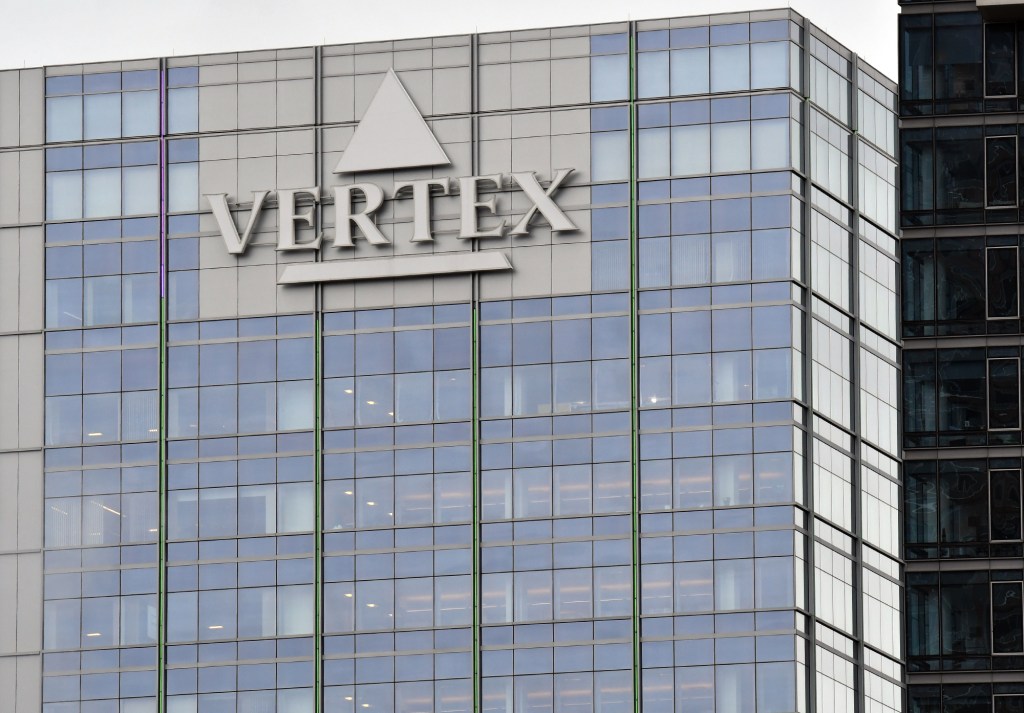
San Diego-based Crinetics Pharmaceuticals is being acquired by Boston’s Vertex Pharmaceuticals for $10 billion — the largest deal in Vertex’s history.
Crinetics creates treatments for endocrine diseases, most notably through its lead product, Palsonify, a daily pill that treats adults with acromegaly — a rare hormonal disorder that causes abnormal bone growth, often resulting in enlarged hands, feet and facial features.
André René Roussimoff, better known as André the Giant and who died in 1993, is a notable public figure who had the disease. Based on national estimates, 150 to 200 people are diagnosed with the disease in San Diego, though acromegaly often goes undiagnosed.
But what really excited Vertex CEO Reshma Kewalramani was Crinetics’ data from its Phase 2 clinical trial for atumelnant, a new daily pill that targets the production of cortisol.
In the clinical trial, atumelnant was used to treat congenital adrenal hyperplasia, or CAH — a genetic disease in which people can’t properly produce cortisol, which can affect growth, puberty and fertility.
“When we saw that data, we were floored. That is very, very important to this field,” said Kewalramani on a call announcing the deal last week.
Atumelnant is also being studied as a treatment for Cushing syndrome, a disease that occurs when the body produces too much cortisol for too long, leading to weight gain, high blood pressure and other serious metabolic effects.
Vertex paid a premium for the San Diego company, purchasing Crinetics for $85 per share, a 102% premium on its price of $42.03 at the close of the market when the deal was announced July 6.
Vertex estimates that Palsonify and atumelnant will add more than $5 billion in annual peak sales potential to its portfolio.
Crinetics has more than 10 drugs in its pipeline, and before the acquisition, the company was working to commercialize its recently approved drug, Palsonify.
Palsonify received Food and Drug Administration approval last September, and by the end of the year, it had generated $5.4 million in revenue.
But commercializing drugs is no small feat for small startups.
It’s common practice in the biotech industry for startups to sell to larger pharmaceutical companies that have the facilities and infrastructure to bring the science to consumers.
According to company filings from February, Crinetics said it expected to operate at a net loss for the “foreseeable future” as commercialization costs were projected to rise.
“Vertex’s global infrastructure and commercial footprint will serve to amplify the reach of our science and allow us to maximize the impact of Palsonify, atumelnant and our pipeline,” Dr. Scott Struthers, founder and chief executive officer of Crinetics, said in a news release.
Vertex declined to comment, and Crinetics did not respond when asked what may happen to its San Diego footprint.
Crinetics’ Sorrento Valley headquarters spans roughly 94,000 square feet of laboratory and office space under a lease that runs through April 2035.
The company has 594 full-time employees, 150 of whom have a doctorate or medical degree.
The companies expect the deal to close in the third quarter.