
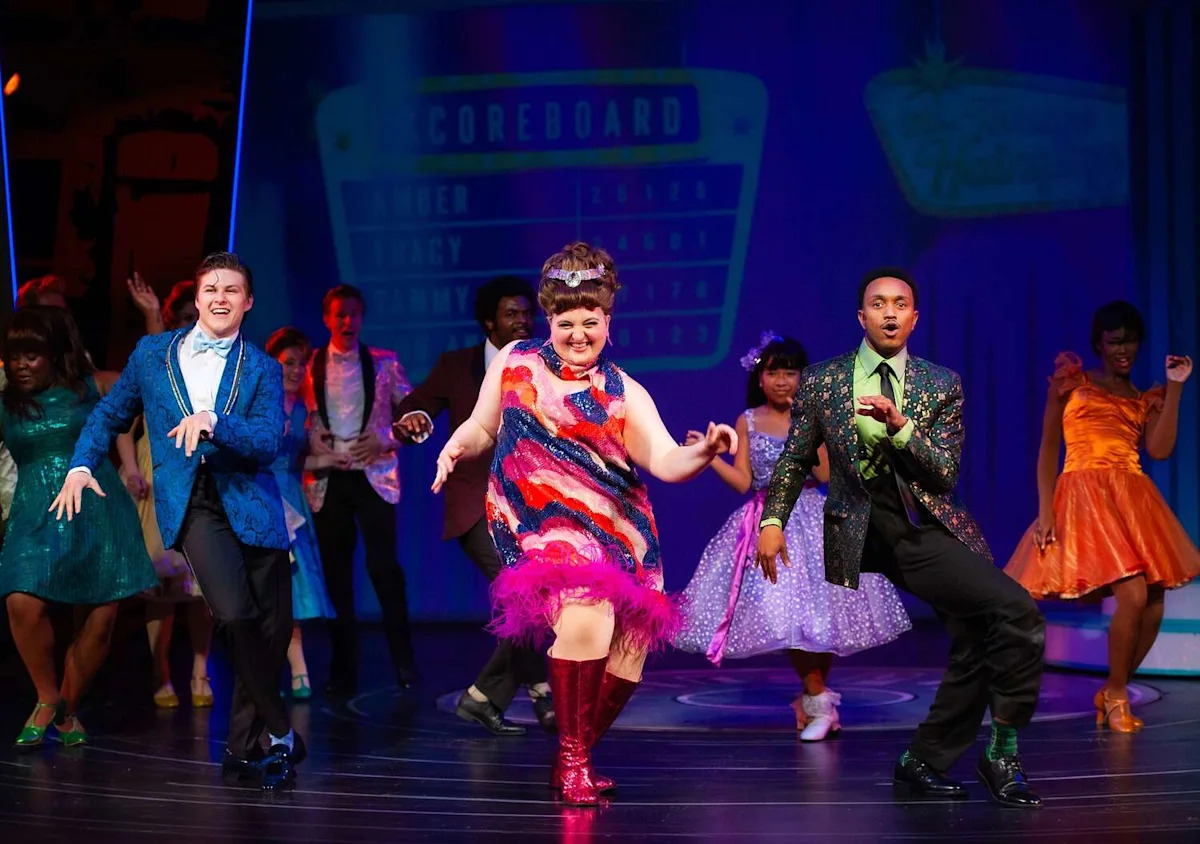
In the vast pantheon of musicals about teens struggling to fit in, “Hairspray” stands out like the kid who proudly sits alone in the cafeteria squirting ketchup and mustard packets down his gullet for lunch.
Whereas shows like “The Prom,” “Be More Chill” and “Mean Girls” practically go “bing!” in their squeaky-clean earnestness, “Hairspray” uses all the beehive hairdos and doo-wop chords as just a veneer. It cracks right in the opening number, when Tracy Turnblad sings of her hometown of Baltimore and how she greets a flasher and a bum on the way to school each day.
Such is the sui generis humor of John Waters, whose 1988 film is the basis for Mark O’Donnell, Thomas Meehan, Marc Shaiman and Scott Wittman’s 2002 musical. If San Francisco Playhouse’s production, which opened Friday, July 18, under the direction of Bill English, doesn’t always nail that wayward tone, it makes a full-throated case for the part of the show that even Waters wouldn’t joke about – the way white people demonize Black music while simultaneously appropriating and bowdlerizing it.

Anese Jade, from left, Cai Rodis, Kareem Jenkins, and Sanaiya Johnson in San Francisco Playhouse’s “Hairspray.” (Jessica Palopoli/San Francisco Playhouse)
It’s 1962, and Tracy (Ella Ruth Francis) and her dim BFF Penny (Samantha Rich) are obsessed with the local TV dance program “The Corny Collins Show,” drinking in the TV set’s glow with their eyes as if it could quench some sexual thirst. Despite mastering a bunch of dance moves like the Stricken Chicken, Tracy can’t get on the show on her own because everyone from her mother, Edna (Jonathan Chisolm, in the role Divine played in the movie), to villainous producer Velma (Alison Ewing) tells her she’s too fat.
More Information

3 stars
“Hairspray”: Book by Mark O’Donnell and Thomas Meehan. Music by Marc Shaiman. Lyrics by Scott Wittman and Marc Shaiman. Adapted from the film by John Waters. Directed by Bill English. Through Sept. 12. Two hours, 45 minutes. $52-$145. San Francisco Playhouse, 450 Post St., S.F. 415-677-9596. www.sfplayhouse.org
But when Tracy, in detention again for teasing her hair so high it obstructs other students’ view of the blackboard, befriends Seaweed (Jordan Covington) and other Black peers, their thrusts and gyrations don’t only get her on the show; they spur her to integrate the all-white program.
Phoenyx Rose’s choreography is a joyous swirl of Elvis the Pelvis jerks and flapping, breaststroking, lassoing, dribbling and monkeying arms. In particular, when Covington seizes the stage, he makes his whole frame so responsive to the music and the energy around him it’s as if he’s dissolved the boundary between himself and the world.

Trevor March, from left, Ella Ruth Francis, Jordan Covington and the cast of San Francisco Playhouse’s “Hairspray.” (Jessica Palopoli/San Francisco Playhouse)
Costumes, by Bethany Deal, don’t merely summon the era’s pastels and avocado and lime greens. They trace, in real time, how characters are coming into their own and how America is changing. Watch as Tracy, transformed by a sequined, cloud-patterned shift mini-dress with magenta feather trim and sparkly go-go boots, takes on Velma’s daughter, Amber (Mackenzie Macdonald), who’s still wearing her full-skirted, below-the-knee chiffon. It’s the ’60s vs. the ’50s, and Baltimore can no more ignore the pull of integration than it can stuff women back into corsets.
If the singing doesn’t always quite make it up to the intended pitch, one number – “I Know Where I’ve Been,” sung by Jeannine Anderson as Black record store owner and TV producer Motormouth Maybelle – is a religious revival.
Tracy’s discouraged in her fight, and some of the Black kids are sick of sticking their necks out for some white girl. But Anderson carries herself with an innate moral authority. Crossing her would be like trying to cross a mountain. When she belts, it’s with an alto that packs the wallop of centuries of history.

Motormouth Maybelle (Jeannine Anderson, front left) and Tracy (Ella Ruth Francis, front right) gather a group (Kaila Dyson, from back left, Anese Jade, Samantha Rich and Sanaiya Johnson) to march in protest in San Francisco Playhouse’s “Hairspray.” (Jessica Palopoli/San Francisco Playhouse)
Likewise, while some of Waters’ crass humor comes off tepidly, as if the actors aren’t totally sure they can get away with it, plenty of performances shine. Ewing makes a crestfallen expression into an avalanche-level event. Trevor March is so pitch-perfect as would-be Elvis Link Larkin, slicking back his hair to show he’s serious about a point, that when he sings the King’s ghost feels present.
In Waters’ universe, suppurating zits, befouled laundry and an uncontrollable lust for sex and hot dogs are what’s underneath all the hairspray. Some of that rot feeds racism, while some of it will keep being there no matter how far the moral arc of the universe bends toward justice.
All that unsparing humanity means that when “Hairspray” tells us to accept ourselves, it’s much more convincing than its more wholesome teen musical cousins.
Subscribe
There’s more to San Francisco with the Chronicle. Subscribe today for just 25¢.
This article originally published at Review: S.F. Playhouse’s ‘Hairspray’ finds the soul beneath the beehive.