
By Dianne Anderson
What was once an old eyesore of a nuisance motel, and a magnet for trouble at 5950 Long Beach Blvd, is now revamped with modern lighting and fixtures, microwaves, refrigerators, on-site laundry, and new bathrooms in every unit.
It’s turning heads.
Beyond the fresh paint, interior upgrades, and landscaping, Mayor Rex Richardson said everyone can take pride in how one of the city’s most dangerous properties, mired in blight, has transformed into a fully revitalized community asset.
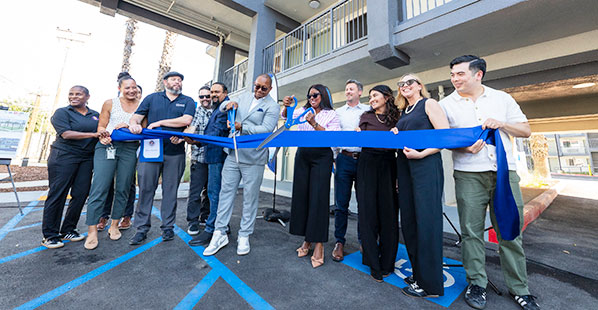
“It was a haven for human trafficking and violence and a number of things were at this site. But as I got out today and walked up and I’m seeing dog runs and fresh paint and the units look incredible,” said Mayor Richardson at last week’s ribbon-cutting for the Homekey Interim housing site.
Richardson said the renovation is a key step in Long Beach’s broader homelessness strategy, and it’s starting to see results.
Just five years ago, the city had no municipal shelters. In the past year alone, including Homekey at 1725 Long Beach Blvd. he said the city opened a youth shelter navigation center, and its newest site adds more than 200 beds.
“What this means is we know that there’s no single solution to homelessness, but there are things we can do to deliver results. If we want to bring people inside off the streets, we have to have places for them to go,” he said.
Since declaring a local state of emergency, with the addition of Homekey 5950, the city has expanded shelter capacity by 84 percent and reduced street-level homelessness by 17 percent.
Richardson thanked the state and the residents who helped launch the city’s first shelter five years ago, and North Long Beach for doing their part to address the issue, even though tough times are ahead.
“We can’t give up on people. We have to have hope that we do our part and they will step up and do their part and get on the trajectory toward recovery,” he said.
Located in Long Beach City Council District 8, Homekey 5950 offers 78 upgraded units, including 12 fully ADA-accessible rooms.
Paul Duncan, Homeless Services Bureau Manager, Department of Health and Human Services, said the facility offers safe, private spaces for homeless adults and couples, and onsite support to transition residents into permanent housing. Priority goes to those who have been homeless for over a year or have health vulnerabilities.
Eligibility is for adults and transition-age youth over 18 who meet federal homelessness definitions under HUD or the McKinney-Vento Act. Families are not served at the facility, but most residents come from unsheltered situations or are transferred from shelters.
“Progress toward housing goals is regularly reviewed. The program has no set stay length but aims to move people to permanent housing as quickly as possible. As residents exit, new participants fill openings, about five to ten monthly,” Duncan said in an email.
Participants access case management for employment and housing, three daily meals, onsite health and substance use care, 24-hour security, and housing referrals.
Last year, the nonprofit First to Serve was selected through a city RFP to manage daily operations, case management, food, cleaning, security, and maintenance, while the city funds, oversees, and owns the property, he said. Funding comes from state Project Homekey and HHAP, with the city pursuing future grants for sustainability.
At the ribbon-cutting, District 8 Councilmember Tunua Thrash-Ntuk called the project “a moral imperative,” and commended the city’s Health and Human Services, Public Works, and City Manager’s Office for their leadership and work.
“This won’t just be a roof over someone’s head. It’ll be a first safe night of sleeping outside of the streets, maybe in months for some. And we hope that by being here with the nonprofits that we’re partnering with, this will be a door to health care, to job training, and mental health services for those who come here,” said Thrash-Ntuk, chair of the city’s Housing and Public Health Committee.
She said the renovated units mean new beginnings to help residents rebuild lives with access to health care, job training, and mental health services, and stands as an example of city and state collaboration.
“We are responding to the community’s need for more housing and stability in this very same neighborhood here we call Coolidge on this side of Long Beach Boulevard. Today we reclaim this space as a transformative source of hope for all in this community. This building is not a problem. It is not a problem to be solved. It is now a solution that we can take pride in,” she said.
City data from the 2025 Point-in-Time Count shows sharp racial disparities among Long Beach’s homeless population, with 34.7 percent Black or African American—the most impacted—compared to 24.8 percent White, 24 percent Latinx or Hispanic, 11 percent identifying as multiple or other races, 3.8 percent Asian or Pacific Islander, and 1.6 percent Native American.
Overall, the aging homeless population is also heavily impacted, with 44 percent over age 50.
Researchers at UCSF Benioff Homelessness and Housing Initiative show broad statewide racial disparities, with Black Californians disproportionately affected.
“Black people have experienced, and continue experiencing, systemic racism in the form of disproportionate levels of policing, housing segregation, employment discrimination, and ongoing disinvestment from Black communities, which have led to their significant overrepresentation in the population experiencing homelessness,” the report said. “People who are Black/African American make up only 7.6 percent of L.A. County’s population, yet account for 31.7 percent of the people experiencing homelessness in the county.”
To see some before and after of Project Homekey, see
https://longbeach.gov/pw/projects/homekey-at-5950-long-beach-blvd/