
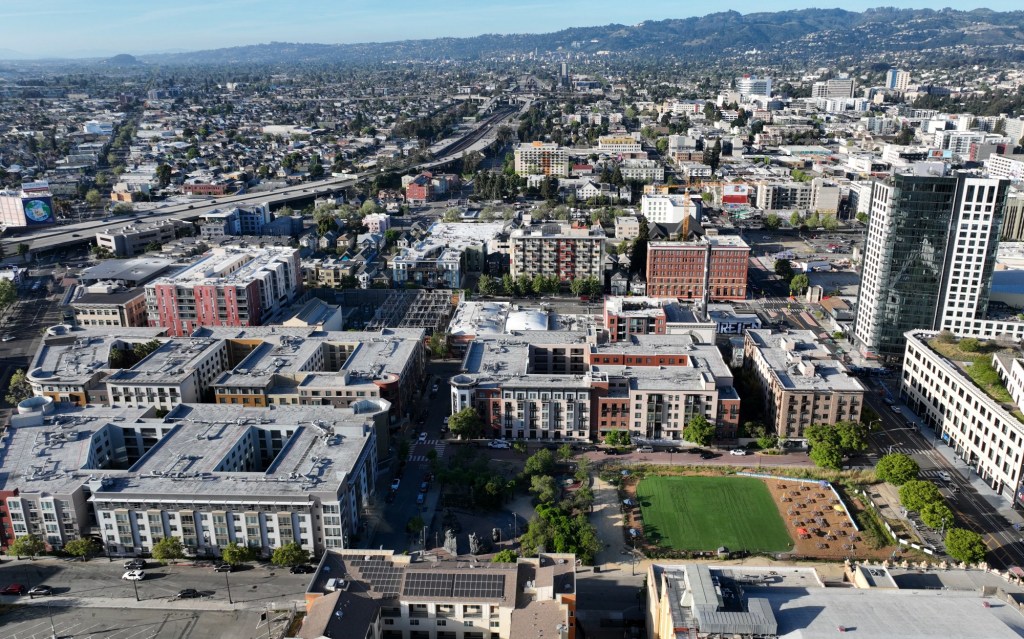
OAKLAND — Large banks and investment firms that foreclose on properties could soon face city taxes under a new ballot measure prompted by the collapse of high-profile office buildings, apartment complexes, hotels and downtown storefronts.
Oakland and San Jose are among a few dozen California cities that collect their own taxes whenever properties change hands, taking a cut of every sale on top of an existing statewide rate that funnels revenue to counties.
Now, voters here will be asked to get rid of exemptions for lenders that seize properties over unpaid loans, which would provide a new source of public dollars amid Oakland’s long-term budget woes.
It is an unusual proposal. Although about a dozen states in the country tax foreclosures, no other California city until now has taken this step, mainly because most governments do not treat lenders as conventional property buyers.
The city does not track foreclosures, so officials project a wide range of potential yearly revenues that would represent a fraction of overall transfer-tax dollars, which this past year totaled more than $68 million.
Initial estimates projected just $400,000 to $1 million in yearly revenue from the measure, but city officials more recently placed the range at $4 million to $13 million, having counted properties voluntarily transferred by borrowers to lenders — what are known as “deed in lieu” foreclosures.
The measure, which requires majority approval, is also far from guaranteed to win over voters. In June, a tax measure failed in Oakland for the first time in 15 years after 54% of voters sided against it.
But with city leaders praying for tax revenues to stabilize after a turbulent few years, Councilmember Charlene Wang hopes to effectively establish a backup plan for a slow-to-recover downtown economy.
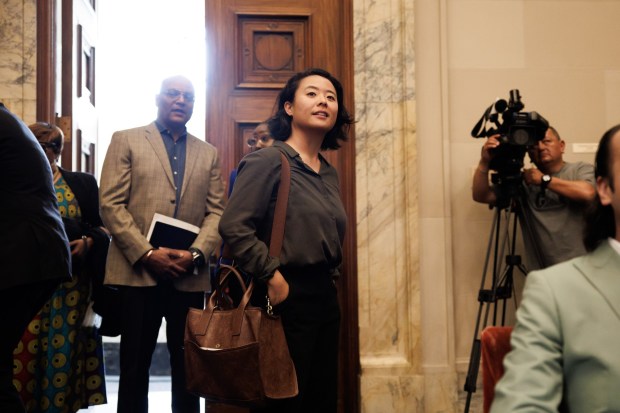 Newly elected Oakland City Councilmember Charlene Wang arrives at her swearing-in ceremony at City Hall in Oakland, Calif., on Tuesday, May 19, 2025. (Dai Sugano/Bay Area News Group)
“This is to help the city avoid — the next time we enter a recessionary period or economic event — not having revenue from these foreclosures,” said Wang in an interview about her proposal, which the Oakland City Council earlier this month unanimously voted to place on the November ballot.
Oakland collects property transfer taxes at higher rates for more lucrative sales. The sale of a home at the median price, $830,000, is taxed at 1.5% and generates more than $12,000 in revenue.
The city is slowly climbing back to revenue levels seen before 2023, when higher federal interest rates led them to plummet following an inflationary spike during COVID-19’s peak years.
For a building worth tens of millions of dollars, the revenue generated by a foreclosure sale could range into the hundreds of thousands.
Lenders would be taxed at the fair-market value of the real estate they foreclose on, though it is unclear when and how those properties would be appraised. Wang did not provide specific information about implementing — and enforcing — the additional taxation.
Upon voter approval, the only remaining foreclosure-related exemptions to the tax would apply to properties owned by smaller community banks, housing with fewer than four units and buildings that within three years of foreclosure are transformed into homeless shelters.
Wang, who is pursuing reelection in November, also wants the measure to incentivize larger banks and Wall Street speculators who buy up distressed debts to not seek foreclosure as the first option when borrowers default on payments.
Some real-estate experts contend, however, that institutions shelling out millions to underwrite a property are already dead set on recouping their investments.
“It seems like a kind of double taxation,” said Kevin Herzberg, a mortgage-banking consultant based in Los Angeles, who noted that the city already collects taxes when the lender transfers a foreclosed property to a third-party buyer.
Because a foreclosure tax is relatively uncharted territory in California, the effects are hard to predict, even among industry experts and pro-housing advocates.
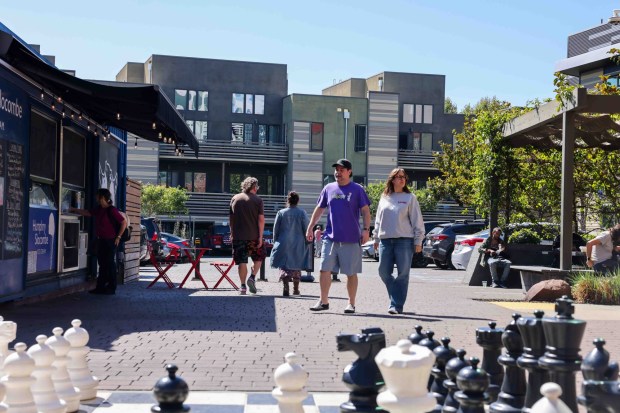 People walk through to Mason at Hive apartments in Oakland, Calif., Friday, July 17, 2026. (Ray Chavez/Bay Area News Group)
When a Telegraph Arts apartment building in Uptown foreclosed earlier this year, the lender — a subsidiary of a large national firm, CW Capital — acquired the 98-unit apartment complex at auction for roughly the outstanding loan amount, $31.1 million.
The price point was nearly 50% below the property’s assessed value in January 2025. To proponents of the new measure, the acquisition would represent a sweetheart deal. But real estate insiders say the corporation also assumes risk by taking on a distressed asset.
“If there’s more risk, the banks aren’t just going to accept that and go away,” Herzberg said. “They’re going to try to pass it on to the consumer or someone else.” Wang disputed this claim, countering that loan interest rates are determined by national capital markets and industry benchmarks.
Regardless, almost everyone aligns on the notion that Oakland’s downtown is struggling, despite the lack of publicly available data tracking foreclosures.
Downtown office vacancies climbed to 26.5% in the first quarter of 2026, up six percentage points from the same period a couple of years ago, per data from Colliers — leaving owners of office buildings “between a rock and a hard place,” said Dave Sandlin, a Realtor based in San Jose.
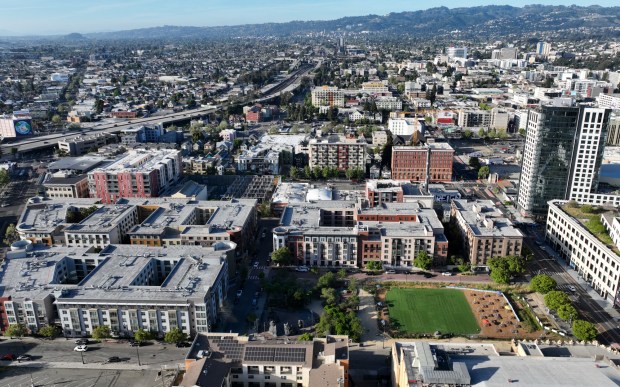 A drone view of the Uptown District in downtown Oakland, Calif., on Tuesday, April 7, 2026. (Jane Tyska/Bay Area News Group)
Tenant-rights groups and real-estate insiders also agree that large corporations drive much of the downtown real-estate economy. CW Capital, the firm that seized ownership of the Telegraph Arts property, has offices in New York, Texas and Washington, D.C.
Representatives for the firm — as well as several other Bay Area real-estate lenders — did not respond to interview requests for this story.
Realtors across the region say crime fears continue to plague economic activity downtown, even with the city reaching historic lows in homicides last year and seeing crime reductions across the board since 2024.
It is a point of frustration for the East Bay’s various pro-housing groups that towering buildings and dense complexes are struggling even in walkable, transit-friendly neighborhoods of the region’s most developed city.
“It is a cyclical problem,” said Brianna Morales, the political director at Housing Action Coalition. “Higher rents mean that people don’t move in, which means that the mortgages can’t be paid. Even getting projects to pencil out is so expensive.”
Shomik Mukherjee is a reporter covering Oakland. Call or text him at 510-905-5495 or email him at shomik@bayareanewsgroup.com.