
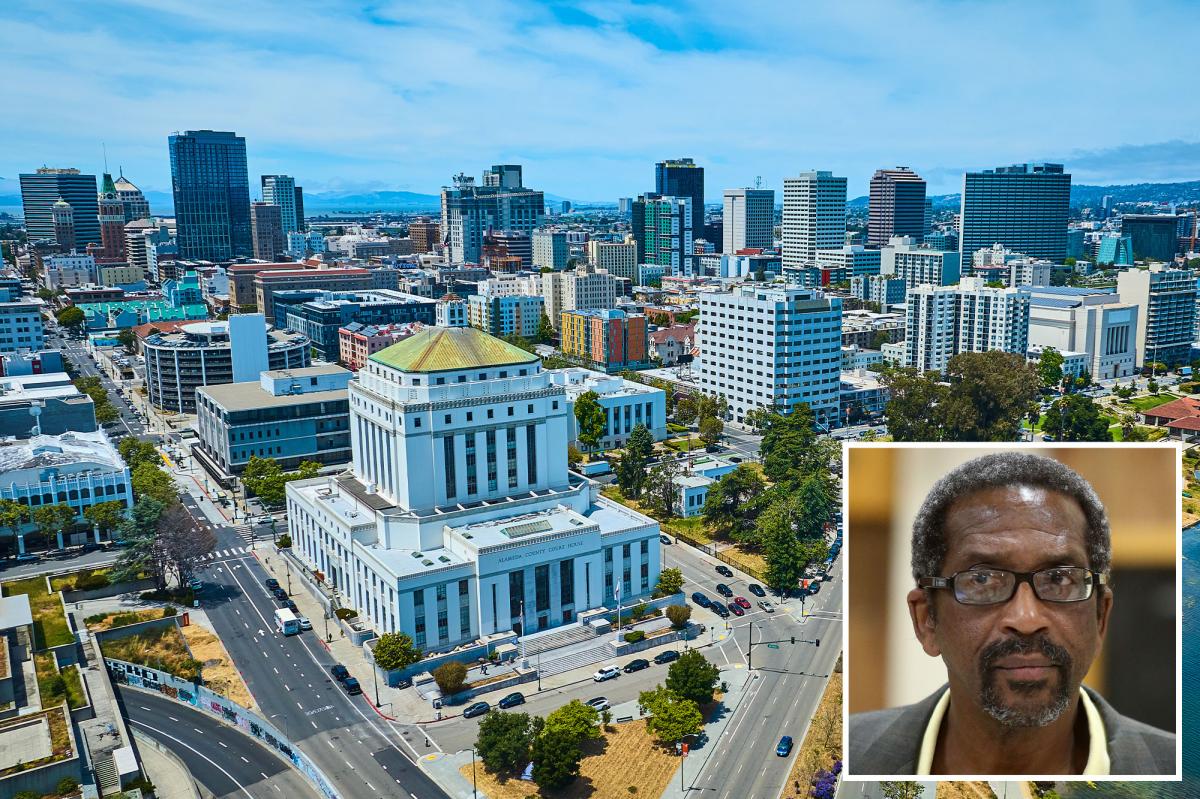
A California county facing a $91 million budget shortfall has become the first in the state to approve a sweeping reparations plan for black residents calling for major changes to housing, education, healthcare and criminal justice — while leaving the door open to cash payments.
The Alameda County Board of Supervisors voted 5–0 on June 30 to accept the comprehensive plan after more than two years of research and community engagement.
The plan largely centers on institutional and policy changes rather than immediately handing out direct payments, though officials have not ruled out eventually putting cash in the hands of eligible residents.
The Alameda County Board of Supervisors voted 5–0 on June 30 to accept the comprehensive reparations plan. Getty Images
The controversial push comes after Alameda County officials warned during this year’s budget process that they were confronting a projected $91 million gap for fiscal year 2026–27.
Supervisor Nate Miley told Fox News that cash payments remain among the possibilities under consideration. MediaNews Group via Getty Images
The county cut 45 vacant positions, slashed spending across departments and renegotiated contracts to ultimately pass a balanced $6.7 billion budget in June amid what officials described as significant fiscal challenges.
Supervisor Nate Miley — who represents District Four and was a leading force behind the reparations initiative — told Fox News that cash payments remain among the possibilities under consideration.
“We haven’t ruled it out. It’s one of the items in the action plan. It’s not the only item.”
“I think if it were the only item, or if it was a priority item, it might be more challenging,” Miley said. “But I do think there’s some low-hanging fruit — some immediate things we can do, and some things we’re already doing.
“And then there might be the more challenging things. A cash payment might be one of those more challenging things.”
The reparations framework calls for expanding affordable housing, supporting black economic development, increasing investments in education and healthcare, and pursuing criminal justice reforms.
Supervisors also approved the creation of a permanent standing committee to oversee the implementation of the recommendations, according to the outlet.
“The committee now has an action plan. It’s in our ballpark,” Miley said. “We need to take it up and deal with it.”
The reparations framework calls for expanding affordable housing and supporting black economic development. Getty Images
Miley identified criminal justice reform, housing, education, and economic opportunity as three major issues the county should prioritize.
“Clearly, economic opportunity is another important factor,” explained Miley. “It’s hard to balance those four and say which is more prominent, but I do think all four of those are significant.
“I see reparations as a path, an opportunity,” he added. “I wouldn’t say it’s a panacea, but I do believe it’s definitely a part of the equation that could help African Americans.”
Alameda County has already partnered with the nearby City of Hayward on a separate effort providing direct financial redress.
The Russell City Redress Fund was initially seeded with $900,000 and has since grown to $1.3 million.
Alameda County has already partnered with the nearby City of Hayward on a separate effort providing direct financial redress. San Francisco Chronicle via Getty Images
The money is intended to provide direct payments to survivors and descendants of Russell City, a multiracial unincorporated community that was seized through eminent domain and bulldozed by local authorities in the 1950s and 1960s for industrial redevelopment.
The debate over direct payments comes as a reparations program in Evanston, Illinois, faces a federal legal challenge.
The Chicago suburb became the first US city to distribute reparations, offering $25,000 housing grants to eligible black residents to address historic housing discrimination.
The US Department of Justice intervened in a federal class-action lawsuit challenging the program in June, arguing that its race-based criteria violate the Equal Protection Clause of the US Constitution.
Miley said cash payments alone would not necessarily accomplish the broader changes county officials are seeking.
“And once again, that’s why a cash payment isn’t necessarily always the objective,” he said.
“The objective is: How do we get people to have housing? How do we get people to be economically stable? How do you deal with criminal justice reform?
“A cash payment doesn’t always mean that those things will occur. We have to change policies, and we have to change programs. I think that’s where we need to invest our resources.”
Steve Hilton, a Republican nominee for California Governor told the Post: “Thanks to 16 years of Democrat one-party rule we have a massive and unacceptable racial wealth and opportunity gap in California, and I am determined to fix it.
“The best way to increase opportunity is not more of the same welfare state bureaucracy but my plan to make our state ‘Califordable.’
“That’s the way to fight the racial wealth gap, not the Democrats’ divisive and unfair reparations scheme.”
Meanwhile, black conservative political commentator Stacy Washington said the county had spent two-and-a-half years focusing on something that ”won’t see black Americans thriving.”
“California was never a slave state and I don’t see anything in the plan where they actually look to make sure that the people who are having this so-called redress actually descended from slaves,” she said.
“What could help is if they focused on actual programs that get parents involved in reading to children from zero to age three, and then children who are enrolled in preschool programs having direct reading intervention.”
Meanwhile, Santa Monica is also taking steps to formally address harm linked to its past actions. The city is committing $3.5 million to this effort, and officials say this money will not impact the budget.
On Tuesday, the Santa Monica City Council approved a citywide Restorative Justice Program.
The program is based on three parts that city officials say will make the process fair, transparent, and legally sound: a dedicated Restorative Justice Fund, a Restorative Justice Commission set up by the City Council, and independent administration.
According to the city, the fund will begin with $3.5 million, which the city will receive after it adopts a Second Amendment to its Development Agreement with the RAND Corporation in mid-2025.