
California has been here before. The fight against gas and oil development began in the 1970s, with the last oil and gas lease offered within southern California’s federal waters in 1984. Ten years later, the California State Lands Commission made the entirety of California’s coast off-limits to oil and gas.
More recently, during President Donald Trump’s first administration, threats to open up California’s coastline to oil and gas resurfaced, but ultimately failed. Now, plans are simmering once again behind the scenes, with a leaked draft of the Five-Year Outer Continental Shelf Oil and Gas Leasing Program proposing to open California’s coast to new offshore drilling and seabed mining.
“Monterey County and 26 cities and counties still have their ordinances in place from the 1980s, [requiring] a vote of the people for zoning changes related to onshore support facilities,” State Sen. John Laird, D-Santa Cruz, told the Big Sur Multi-Agency Advisory Council on Oct. 24.
The leaked proposal, which has not yet been made public, is a part of the U.S. Department of the Interior’s five-year plan, with the Central Coast planning area slated for lease in 2027 and 2029. As a direct response to the proposals during the first Trump administration to open up vast areas of the Pacific to offshore drilling, two California bills – AB 1775 and SB 834 – were signed in 2018 banning new state leases, easements or permits for infrastructure that would be needed to transfer oil from offshore to onshore.
However, not all parts of the coastline are protected equally, and the Monterey County coastline has more robust environmental, regulatory and financial guardrails than other parts of the state, according to former U.S. Secretary of Defense Leon Panetta, who played a key role in legislation that established the Monterey Bay National Marine Sanctuary in 1992.
“We included language that said there would be no oil drilling in the sanctuary. It’s one of the few sanctuaries that has a direct limitation,” Panetta says. “The concern we all have is that this administration doesn’t necessarily pay a lot of attention to the laws.”
Monterey County has 17 marine protected areas – more than any other county in the state – as well as deep waters that pose challenges for offshore drilling. Panetta notes there isn’t much oil in many of the protected areas, let alone space onshore for infrastructure that would be needed. Tourism boards and locals also provide a strong buffer, he says.
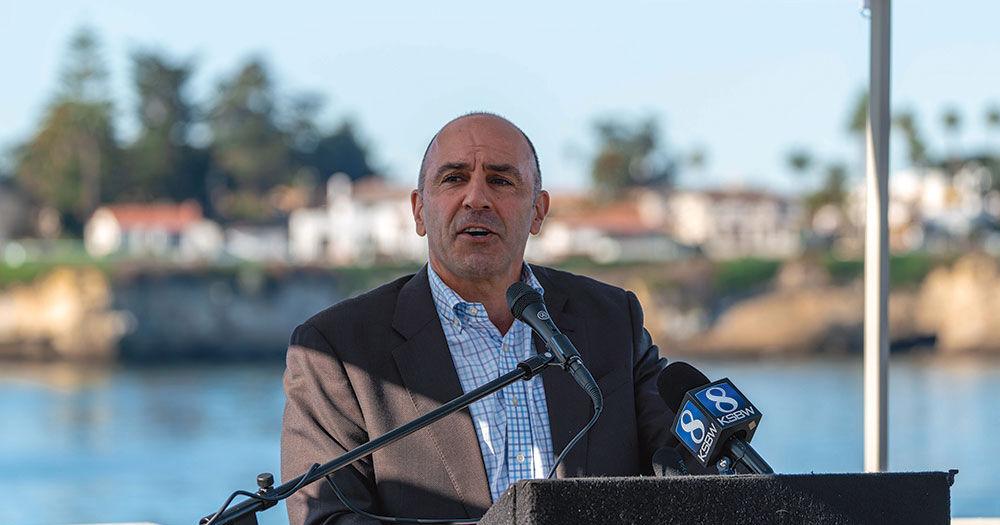
On Wednesday, Oct. 29, U.S. Rep. Jimmy Panetta, D-Carmel Valley, and other local leaders held a press conference in Santa Cruz, speaking to the significance of voter-approved Measure M – a grassroots ordinance first passed there barring gas and oil development.
Still, with a new Supreme Court and a shifting tone in decisions during the current administration, local officials remain on the defensive to maintain the “blue wall.”
“What is different this time is that California’s environmental framework and its public resolve are even stronger,” says U.S. Rep. Zoe Lofgren, D-San Jose. “Beyond those legal safeguards, [our] economy depends on conservation, recreation and sustainable tourism, not extraction. Those financial and environmental guardrails reinforce one another.”