
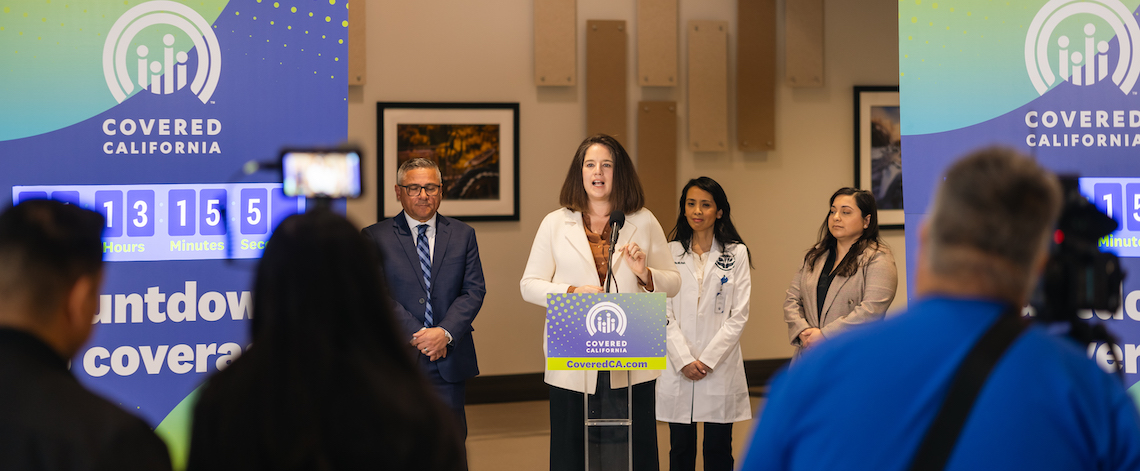
Covered California Executive Director Jessica Altman speaks at an event in Fresno on Jan. 30, 2025. Covered California photo
Health insurance rates for Covered California enrollees in Fresno, Kings and Madera counties will rise an average of 11.8% in 2027, according to a Covered California news release — the highest increase among Central Valley regions and above the statewide average of 9.9%.
The three-county region, designated Region 11, has 48,980 enrollees, the release said. Consumers there could reduce costs by an average of 7.7% by switching to the lowest-cost plan in their current metal tier.
Neighboring regions also face increases above the state average. Region 10 — which includes San Joaquin, Stanislaus, Merced, Mariposa and Tulare counties — will see rates rise 10.8%, with 90,150 enrollees. Kern County, designated Region 14, faces an 11.4% increase.
Statewide increase
Statewide, Covered California announced a preliminary weighted average rate increase of 9.9% for the 2027 coverage year, along with one new carrier entering the marketplace. The exchange said the increase is significantly lower than the preliminary national median rate increase of 14%.
Covered California attributed the proposed rate change to rising health care and pharmacy costs, broader industry challenges and federal actions. The release said federal lawmakers last year did not extend enhanced federal tax credits that helped people afford monthly premiums, and that the Trump administration cut eligibility for lawfully present immigrants, added administrative requirements for families applying for financial help and made it more difficult for gig workers who recalculate income annually.
“The federal government and this administration have made it more difficult for hard-working Americans to access high-quality health insurance at a price they can actually afford,” said Covered California Executive Director Jessica Altman. “The fallout from these federal actions continues to reduce affordability and put health insurance out of reach for too many — something our state is fortunately counteracting.”
Subsidies and premiums
Covered California said most enrollees will be protected from higher premiums through existing federal tax credits and California’s expanded subsidy program. According to the release, 60% of enrollees will see no increase in their monthly premium, and 26% will remain eligible for $0 premiums without changing plans.
In 2026, Gov. Gavin Newsom and the Legislature appropriated $300 million for the state subsidy program, up from $190 million, the release said. As a result, Californians with incomes up to 200% of the federal poverty level — $31,920 for an individual or $66,000 for a family of four — will be eligible for help lowering premiums in 2027. Covered California projects more than 500,000 Californians, about 30% of enrollees, will receive a state subsidy.
The exchange reported 1,785,900 enrollees as of March 2026.
Rates by carrier
Rate changes vary by carrier. Valley Health Plan will see the largest weighted average increase at 20.4%, followed by Molina Healthcare at 16.9% and Balance by CCHP at 14.6%, according to the release. Kaiser Permanente had the smallest increase at 6.7%.
One new carrier, CalOptima Health, is entering the marketplace in 2027 in Orange County’s Region 18, while Molina Healthcare will no longer offer plans in Regions 15 and 18, the release said. Molina’s approximately 1,600 enrollees in those regions will be allowed to choose a new plan.
Enrollment dates
The rates are subject to final review and public comment by California’s Department of Managed Health Care. Final rates take effect Jan. 1, 2027.
Current enrollees can renew or switch plans beginning Oct. 1. Open enrollment runs Nov. 1 through Jan. 31, 2027.
Industry group responds
The California Association of Health Plans, a trade group representing insurers, said the 9.9% average is lower than last year’s 10.3% increase.
“California’s health plans remain steadfast in our commitment to keeping coverage as affordable as possible for California’s individuals and families,” said CAHP President and CEO Charles Bacchi.
Bacchi attributed premium pressure to hospital and prescription drug costs, the cumulative impact of state health coverage mandates, federal changes to Medicaid coverage and reduced ACA subsidies. He also said rates may be further affected by a $1.5 billion MCO tax recently signed into law.
This article was produced with AI-assisted tools and reviewed and edited by The Business Journal editorial team.