
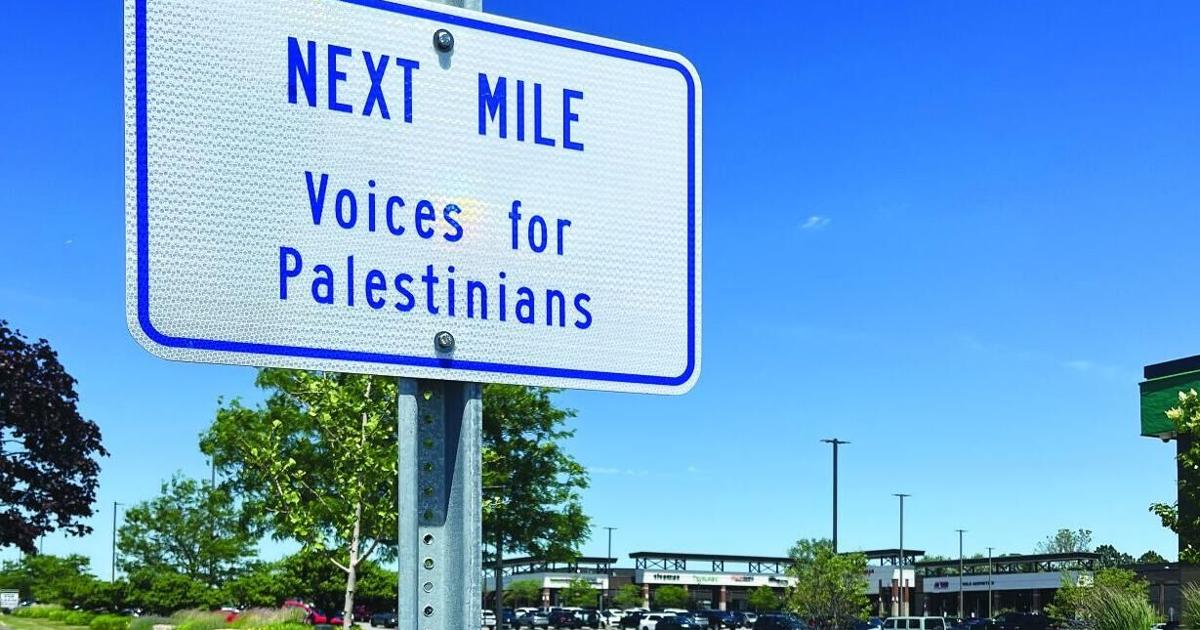
Oakland County officials are reviewing the Adopt-a-Road program after “Voices for Palestinians” signs in West Bloomfield prompted community debate.
On July 7, 2025, West Bloomfield resident Shahaboddin Owlia requested a pair of Adopt-a-Road signs in the name of Voices for Palestinians. Adopt-a-Road, a program through the Road Commission for Oakland County (RCOC), allows members of the public to put up signs in exchange for volunteering at least twice a year to clean up the roads.
In November 2025, the signs were approved, and on June 10, 2026, they were installed by the RCOC on either end of the mile-long stretch of Orchard Lake Road, between Maple and Walnut Lake roads.
Although the signs went up two years after Hamas’ Oct. 7, 2023, attack on Israel, they were requested six months before the March 12 attack on Temple Israel in West Bloomfield — which was assessed by the FBI to be a “Hezbollah-inspired act of terrorism purposely targeting the Jewish community.”
Although Hezbollah is a Lebanese Shia organization and Hamas is a Palestinian Sunni group, the two are close allies and core members of Iran’s “Axis of Resistance,” united by their opposition to Israel and Western influence in the Middle East.
The local Jewish community reacted quickly and strongly. Residents flooded social media with questions and concerns.

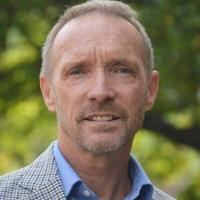
David Coulter
On June 14, Oakland County Executive David Coulter released a statement urging the RCOC — which operates independently of Coulter’s office — to remove the signs, saying in part: “The placement of a ‘Voices for Palestinians’ Adopt-a-Road placard in the heart of Oakland County’s Jewish community is … understandably painful for many of our Jewish neighbors,” it said. “At a time when members of the Jewish community are already experiencing heightened fear and concern, placing such a message in that location appears to disregard the impact it would have and risks being perceived as an act of provocation.
“While the First Amendment protects a wide range of speech — including speech that many may find offensive or disagreeable — courts have long recognized that reasonable, content-neutral restrictions may apply based on time, place and manner. …”
The same day the statement was released, the signs were vandalized; later that day, the RCOC removed the signs.
And the Palestinian community reacted quickly and strongly.
“The reason we took the signs down were twofold,” says Craig Bryson, senior communications manager for the RCOC. “First, in the interest of safety — we didn’t want the signs to be the impetus for any violence, hostility or any other inappropriate behavior on anyone’s part.
“Second, our practice is that we always remove signs that have been vandalized,” he says.
RCOC Board Meeting
Following the removal of the signs, the RCOC and its legal counsel began reviewing its language and Adopt-A-Road program policies, First Amendment rights and sensitivity zones. As yet, they have not determined whether the signs will be reinstalled.
When asked whether the commission had a projected date for a decision, Bryson confirmed they did not.
“We’d like to have the issue resolved, too,” he says. “But we don’t want to rush to a conclusion — we want to perform a thorough, comprehensive investigation with our board and our legal staff. Our goal is the best outcome for everybody involved.”
The RCOC board meets twice monthly; the first meeting after the controversy was held on June 25, at its Beverly Hills offices. As is always the case with RCOC board meetings, this one was open to the public. With prior registration, each speaker was permitted three minutes to voice their opinions.
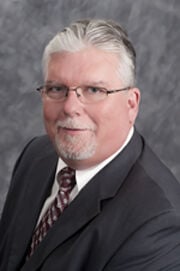
Dennis G. Kolar
Before comments opened, RCOC Managing Director Dennis G. Kolar reviewed the timing of the events before stressing that the reason for the removal of the signs was safety. “I cannot stress that enough,” he said. “The removal was content-neutral and based on safety concerns.”
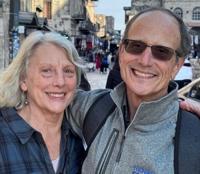
Nancy and David Gad-Harf
Most attending represented the pro-Palestinian community (including a few self-identified Jewish speakers). Speakers on behalf of the Jewish community included David and Nancy Gad-Harf. Both are longtime advocates against antisemitism and for Israel, having worked with the Palestinian community toward strengthening relationships between Arabs and Jews.
Nancy worked for many years with the Jewish National Fund and as a director of the American Technion Society. She also was the longtime program director at Temple Israel, where the family are members and their son became a bar mitzvah and was married. David served as COO for the UJA Federation of Northern New Jersey and spent 17 years as head of Detroit’s Jewish Community Council.
“Nancy and I have been tremendously upset about what’s happening in our community, in our state, in our country and in the world as it relates to Jews and Israel,” David says.
The couple had concerns about attending, especially after the “terrifying” experience of blatant Jew-hatred at the Michigan Democratic Party convention in April, as well as several instances of being refused service for being Jewish in and around Detroit. But they went with speeches prepared.
Upon arrival, the Gad-Harfs spotted several familiar faces of people they’d worked with as advocates for Arab-Jewish peace organizations. “Even people we’d considered friends turned out to be viciously anti-Israel,” Nancy says. “And we did not see anybody we recognized representing the Jewish community.”
This, they both stress, was problematic. In addition to being an intimidating environment, where they admittedly were thrown off their game — despite both being longtime public speakers — they were disappointed to see the number of bodies representing the Palestinian community and only a few from the Jewish community.
“We need to organize so the community can be alerted when opportunities like these arise,” Nancy says.
The Public Comments
While many public speakers were polite and well-spoken, the Gad-Harfs and the few other members of the Jewish community say they found many of the speakers to be antagonistic and misinformed — not only regarding the reasons for the Jewish community’s objection to the signs, but on the complicated details of the Israel-Gaza war and definitions of specific accusations.
“Many of the people were so impassioned while speaking that they strayed off the topic and used it as a platform to decry the horrible things that they say Israel has done,” David Gad-Harf says of the experience.
“The anti-Israel libels of genocide, apartheid and colonialism were mentioned often — even the understanding and meaning of the word Zionism,” Nancy says. “There was one self-identified Jewish man who accused Israel of colonialism in such a hateful way, and that found a lot of applause and cheering. These libels justify their hatred for Israel and for Jews.”
An anonymous elected official close to the situation, in a conversation with the Jewish News, says, “That’s the trouble with public comment. Anyone can speak, and you can’t refute it. So, all the misinterpretations and inaccurate information stands, and then people believe it.”
The first public speaker, who identified herself as a past assistant county executive in Wayne County, objected to Coulter’s use of the word “Palestine” in his written statement, saying it was used as a slur. “By using the slur as Palestine and removing the sign based on what we read in the media, it says ‘you Palestinian people are not welcome in our county,’” she told the commission. “The equation that the Jewish community is offended because the word ‘Palestine’ is there, because there was a recent attack on the synagogue, [is dangerous].”
Pointing out that the attacker of Temple Israel was Lebanese, not Palestinian, the speaker continued: “To equate the act of one violent person with the Palestinian community, you don’t only put our life in danger, you put the life of the Jewish community in danger. [It’s saying that the] Jewish community does not want Palestinians in their roots.”
Another speaker at the public meeting stated that the vandalization and removal of the signs “means people are trying to remove me, my family and all the other Palestinians here. The erasure of my people is disgusting.”

Some members of the Jewish community stress that the reason for the concern about the signs is the placement.
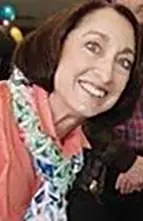
Anita Fishman
Anita Fishman of West Bloomfield, another speaker at the meeting, said, “These signs would have been understood by our community if they were affixed in a different location. The community … is experiencing fearfulness because of hate crimes and antisemitism.”
Similarly, the anonymous elected official who spoke to the JN points out that Owlia, who requested the signs, is a West Bloomfield resident, and it’s his community, too.
“If my family was in Gaza, the way it is right now — I understand their anger and their pain,” she says. “The signs were within the man’s First Amendment rights; everything was done legally and correctly.
“But I don’t support the placement of the signs because they stirred up fear in the Jewish community. You can’t deny the provocativeness of putting the signs in that place and not expect a reaction,” she says. “The purpose of Adopt-a-Road signs is to highlight and promote good deeds, good people and good organizations.
“Ultimately, I want to try to make something positive of the situation. I’m not looking to provoke — I’d prefer to have a conversation. But it has to be the right circumstance.”
Nancy Gad-Harf agrees about the placement. Although West Bloomfield has a large Chaldean Catholic population — many of whom provided care for staff and children at Temple Israel immediately following the March attack — there is not a substantial Palestinian or Muslim presence in West Bloomfield.
“It’s sort of incongruous that they should choose West Bloomfield for the sign to be placed. It would even make more sense if it were in some other part of Oakland County, or Sterling Heights, where it would be clear that they’re actually calling for support rather than trying to make a statement or stir the pot. It would be like the ADL or ZOA sponsoring a sign in Dearborn where there are no Jews.”
When David Gad-Harf spoke at the meeting, his comments were straightforward: “We’re living in a time and place where Jews feel traumatized. There’s a sense of PTSD for those of us in West Bloomfield and beyond, not only because of what did happen at Temple Israel — but also what could have happened.
“But I want to reinforce that we don’t oppose the wording on the signs. We definitely don’t oppose Palestinians. But placing that sign in that place during this time period — so soon after Oct. 7 — is hurtful to many Jewish people in the area,” he said. “Therefore, we urge the commission to adopt a process that would avoid potential future situations causing conflict and harm. I think today’s remarks underscore the danger of having no clear standards for government signs, especially those sponsored by a political or issue-advocacy group.”
When speaking at the meeting, David identified as a Jew and a Zionist and was met with boos. The Gad-Harfs, in their late-70s, were also harassed when leaving the meeting; they were grabbed and even blocked on the sidewalk when trying to get to their car. “We would have felt so much more supported and empowered if there were more of the Jewish community there,” David says.
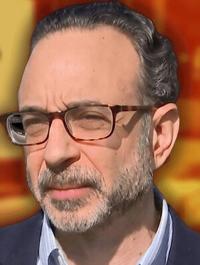
Craig Bryson
Craig Bryson of the RCOC considered it helpful. “We heard a number of different perspectives, and we welcome them all. Because it was a public meeting, people had the opportunity to speak. But we were not counting heads and saying ‘this side wins,’” he says. “It’s obviously an issue that people on both sides are passionate about, but the goal of the meeting was not to get a comprehensive view of the public perception.”
Bryson points out that the RCOC is a data-driven organization heavy with engineers. “This is uncharted territory for us,” he says. “Our goal from the beginning is to beautify the roads in Oakland County. In an ideal world, instead of driving a wedge in the community, maybe we can find a way to bring the community together.”
Nancy Gad-Harf says, “Antisem-itism is a frighteningly huge issue, but there is something we can do: We can make our own community proud to be Jewish, to revel in being Jewish.
“We’ve adopted the position that we don’t want to feel like victims. Synagogues are stepping up, doing things they wouldn’t have before because we are living in a new world. Even the process itself is emboldening.”
The Detroit Jewish News has been supported by readers like you since 1942. Support independent, local, Jewish journalism with a donation today.