
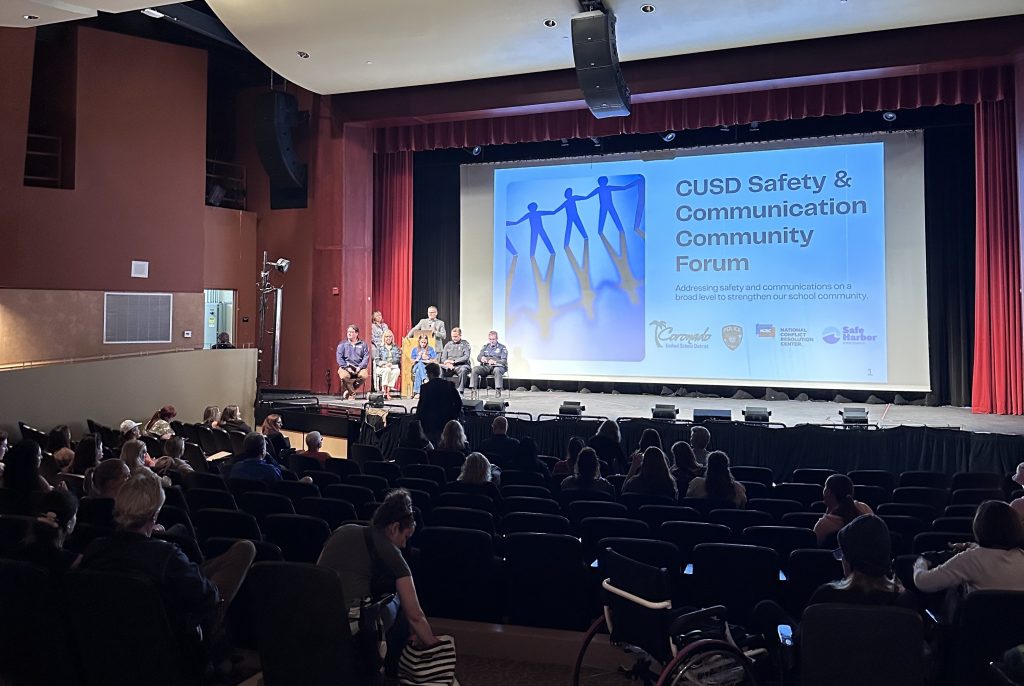
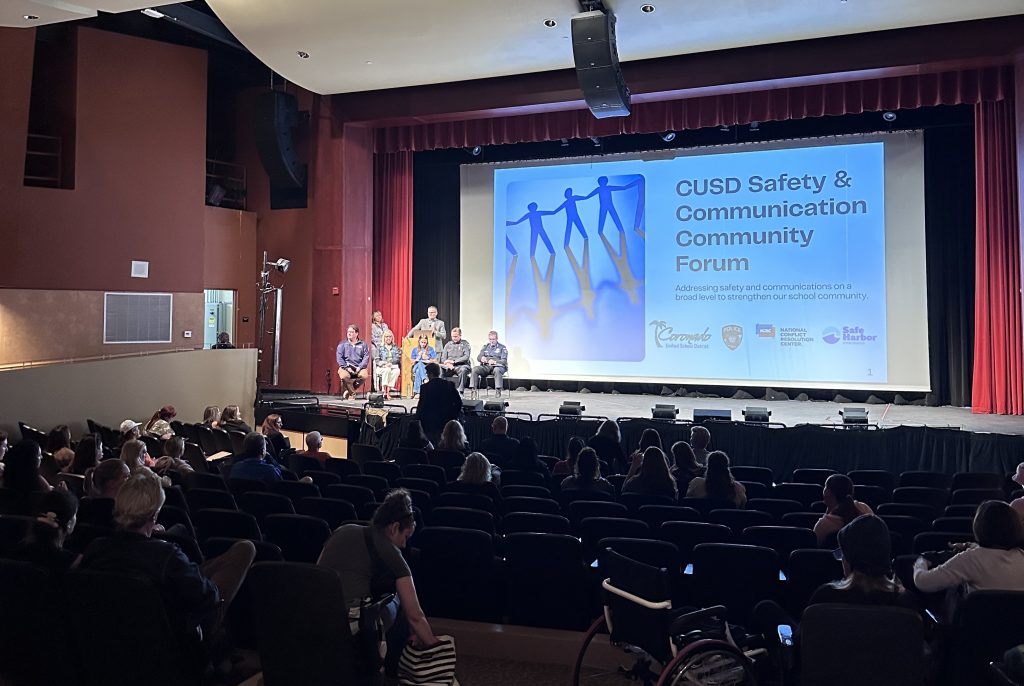
 More than 100 community members gathered at the CUSD school safety forum last Thursday, about two weeks after a middle school student was stabbed in the school library. Administrators from the Coronado Unified School District highlighted the need for improved communication, a revamped cell phone policy, and collaboration with the community.
“We live in a very challenging time right now. Our kids feel it. We feel it,” said Superintendent Karl Mueller. “We want to be partners with all of you to make CUSD the safest place that we can make it.”
The forum lasted 1.5 hours, featuring a panel of speakers including Paul Connelly, the Coronado Chief of Police; Niamh Foley, Director of Student Services for the Coronado Unified School District; Daniel Orth from the National Conflict Resolution Center; and Danielle Maske from Safe Harbor Coronado, in addition to Mueller. The speakers addressed the recent stabbing at CMS and then answered questions from community members that had been previously submitted.
One of the biggest challenges of the incident, according to Mueller, was communication.
“We’ve taken a critical look at our response and our communication, and we’ve already made some adjustments,” he said.
Mueller said going forward, the district will use text instead of email to update parents after an incident takes place. The district will also provide more frequent updates.
The communication will confirm key details, including the status of the threat, and whether a campus is locked down. The district will also share with students that their parents have been notified.
Mueller said both the district and the police department are required to adhere to state codes to protect the identify of juveniles. But the CPD has more leeway in what it can share. The district can’t give out as much detail, as it needs to protect the integrity of the police investigation.
“That’s why there were two different messages to the community,” said Mueller. “This is why the police are able to stay ‘stabbing’ and the district said ‘incident.’ We don’t want to give out details while the police are interviewing students.”
Police Chief Connelly shared information about how the CPD works in situations like the school stabbing. He said that the first priority of the department is to protect the safety of the students. Next, the department will do everything they can to protect the crime scene and initiate the investigation.
Next comes the communication.
“At that point, as soon as we can, we will put out information regarding the crime,” said Connelly. “Our goal is to let everyone know that they’re safe.”
The CPD shares updates through its social media channels: Facebook and Instagram. Connelly said that they were able to put their first post up about 20-30 minutes after arriving on the scene.
Mueller said that the ways information spreads on social media also presents a challenge, as much of it is second-hand and misinformed.
“What you might be reading on social media sites, and the texts you get from your kids may not be accurate,” said Mueller. “We live in a small community and information spreads quickly. Often times that information is accurate, but sometimes there is misinformation circulating that causes confusion.”
Then there are often questions from the community about what consequences were dispensed in response to an incident. Mueller said the district can’t share the outcome of an investigation, or a consequence that was dispensed in response, as it violates the confidentially laws and rights of students.
He said that parents could access the district’s Discipline Action Guide (DAG) for more information on potential outcomes.
When it comes to prevention, Mueller encouraged communication between parents, students, and the district to help stop incidents before they occur.
“Talk to your child,” said Mueller. “Ask them, ‘how was your day?’ If you overhear things among groups of friends, if you are monitoring their social media, ask them those difficult questions about behaviors.”
He also highlighted the use of WeTip, an anonymous reporting mechanism designed to prevent concerning behaviors before they happen.
“All the eyes and ears that we have employed at CUSD are not enough to know what’s going on with every child in our care,” said Mueller. “But the children know, their peers know. The sooner we can get that information, the quicker we can provide an intervention before there is an incident.”
According to Foley, WeTip is basically the “see something, say something” program within CUSD. The district receives roughly 200 to 250 WeTip reports a year and 40% of those are related to bullying. The concerning behaviors shared on WeTip can occur on or off campus and can be reported by students and community members.
Mueller said it’s hard when students come forward after an incident to share worries about a peer. CUSD is hoping to hear concerns ahead of time.
“When we hear of things after an incident, it’s very difficult for us to process that,” said Mueller. “Gosh, if we would have known this three days ago or a week ago. So really talk to your children about WeTip.”
WeTip is often shared as a QR code on the back of student ID badges, on newsletters, and all over campus, according to Foley.
“WeTip is monitored during the school hours by our counseling staff and our administrators, and after hours its monitored by the Coronado Police and a third party agency, where if a certain threat rises to an alarming level there is a human interaction that takes place immediately,” said Foley.
Mueller also addressed the issue of cell phones, saying the current situation was “unsustainable” and it was time for the district to make some very difficult decisions about the roles cell phones play on all four CUSD campuses. He said they were not conducive to a learning environment and they put a strain on administrators who become responsible for social media content and cell phone behavior that shows up on campus.
“We have cell phone pockets for class time, but they are being used at break and at lunch,” he said. “We worry about human to human connection, and we worry about the content they are faced with.”
He said it’s time for a change.
“We are ready and primed as a community, and there will be opportunities for community input, but we are taking a critical look at our cell phone policies across CUSD, because something needs to give here,” he said as the many in the audience applauded.
Moving forward, Mueller said he hoped the district would hold more community forums in smaller, more intimate settings with a back-and-forth exchange. He said the district was also collaborating with partners like Safe Harbor to host parent nights like one on Nov. 17 from 6:30 to 8pm, focused on connection with teenage children.
 Mueller asked the community to work together with the district to make school a safer place, while acknowledging constraints.
“We don’t have control over students cell phone use when they are at home,” said Mueller. “We don’t have control over friend groups and we don’t have control over activities and behaviors that take place on the weekends or after school or during the summer. We want to partner with all of you to insure we are on the same page while providing our children the absolute best.”