
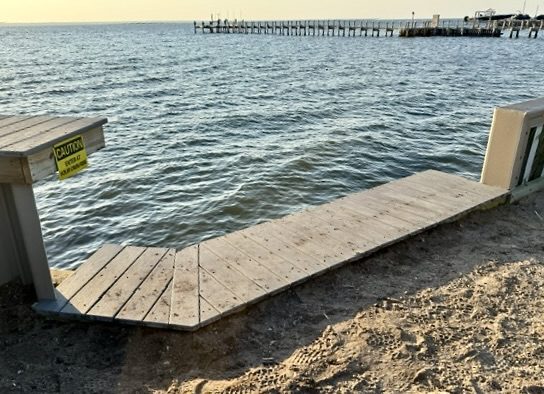
COURT ORDER: Access to the bay has been restored following the removal of a bulkhead in the easement area as per a decision from Judge Craig L. Wellerson of the Superior Court of New Jersey Chancery Division, Ocean County, at the end of last year.
Long Beach Island homeowners involved in appeals of a civil court judgment are all neighbors on a bayside easement in North Beach called “Friends Way,” where a disagreement over a bulkhead has carried on since 2022. Judge Craig L. Wellerson of the Superior Court of New Jersey Chancery Division, Ocean County, ruled on the case in December 2025. However, according to MaryAnn Spoto, communications manager for the Administrative Office of the Courts in New Jersey, appeals were filed this year, keeping the dispute in the courts.
As noted in the trial court opinion, filed Jan. 26 of this year by the clerk of the appellate division, defendants Michael and Margaret Uhrich and William D. Martin Revocable Trust and plaintiffs Kohn & Kohn Realty, Carol L. Kruegle Trust, Jennifer Lawlor, James Hannah, Leslee Jackson, Norma Costa and Claudia Costa are all property owners along the private easement in this northern section of Long Beach Township.
The defendants own homes on the bay at the end of Friends Way, where they constructed a new bulkhead “across the 20 ft.-wide easement area that extends from Long Beach Boulevard to Barnegat Bay,” the document states. “The easement area extends over every lot abutting Friends Way … and is required under local ordinance for the express purpose of providing private pedestrian access to the bay.”
The plaintiffs objected to the defendants’ construction of the bulkhead across the easement, stating it “wrongfully interfered with plantiffs’ easement rights by cutting off plaintiffs’ deeded access to Barnegat Bay.” Legal claims levied against the defendants by the plaintiffs included interference with easement, unlawful obstruction and tortious interference.
Following a three-day bench trial in mid-September of last year and post-trial submissions from the parties, the trial court ruled in favor of the plaintiffs after it determined reasonable access to the bay was denied, “and the newly constructed obstruction must be reduced in height to its former elevation.”
The trial court order from Dec. 15, 2025 specifically instructed that “10 ft. of bulkhead at the terminus of Friends Way be reduced in height by 31 in. to an elevation of 3.3 ft. North American vertical datum zero elevation. It is further ordered that the removal of the top 31 in. of bulkhead shall begin at a point immediately adjacent to the previously constructed Martin bulkhead and continue for a distance of 10 ft. toward the Uhrich property.”
The bulkhead was removed, but the Uhrichs and Martin are appealing to the Appellate Division.
As explained in a Notice of Appeal filed Jan. 26 of this year, Martin has owned his home since 1982, and the Uhrichs purchased their home in 2020. The document states that the Uhrichs had to replace their own aging bulkhead after buying their residence, and “their builder recommended connecting directly to Mr. Martin’s newer, more stable bulkhead in the easement area. The Uhrichs agreed to do so, and the new bulkhead was built across the easement area at the minimum height required by the township ordinance.”
In the notice, the defendants-appellants listed proposed issues to be raised on appeal, including that the trial court: “erred by requiring defendants to lower the bulkhead in the easement area”; “failed to address defendants’ uncontradicted expert testimony regarding rising sea levels and the dangers posed by lowering the bulkhead”; “rejected clear state and municipal policy requiring a cohesive effort to raise the height of bulkheads and the land behind them, and did so without first considering or requiring the easement holders to pursue less dangerous and legal alternatives to lowering the bulkhead”; “erred by directing the bulkhead be lowered without unanimous consent and agreement from all easement holders, some of which the trial court knew did not want the bulkhead lowered and refused to make such a demand on the servient estate holders”; “erred in concluding that lowering the bulkhead, without any proposed additional means to enter and exit the water, is a ‘safe’ condition to which the servient estates are obligated to return the easement area,” and multiple additional points.
A brief filed on June 4 by the clerk of the appellate division says, additionally, that the defendants-appellants believe “The trial court too narrowly focused on the reasonableness of access and did not truly balance the desire for access with the state- and locally-mandated need to mitigate flood damage, nor the servient landowners’ right to protect their land from erosion, damage and flooding. The error was compounded when the New Jersey Department of Environmental Protection confirmed a ladder could be installed on the waterward side of the bulkhead, yet the trial court decided the bulkhead must be lowered nevertheless.”
The defendents-appellants also feel “the trial court erred by failing to require plaintiffs to indemnify and hold defendants harmless from the consequences of lowering the bulkhead and failing to require proof of insurance for owners and tenants who use the easement area.”
Another matter in the briefing stage in the appellate courts is an appeal by the original plaintiffs that states, “Following trial, the court issued an order and written opinion requiring defendants to lower 10 ft. of the Uhrich Bulkhead to the height of the prior bulkhead, 31 in. below the height of the Uhrich Bulkhead. While plaintiffs agree that the law and equity require that the Uhrich Bulkhead be lowered to provide plantiffs safe, reasonable access to the bay, they appeal the trial court’s finding that an opening in the bulkhead 10 ft. across is sufficient to provide such access and seek 15 ft. of access.
“Plaintiffs also appeal the trial court’s rejection of their request for punitive damages due to defendants’ willful, continuous and knowing violations of defendants’ property rights.”
According to Spoto, the next set of briefs is due July 31.
—Juliet Kaszas-Hoch