
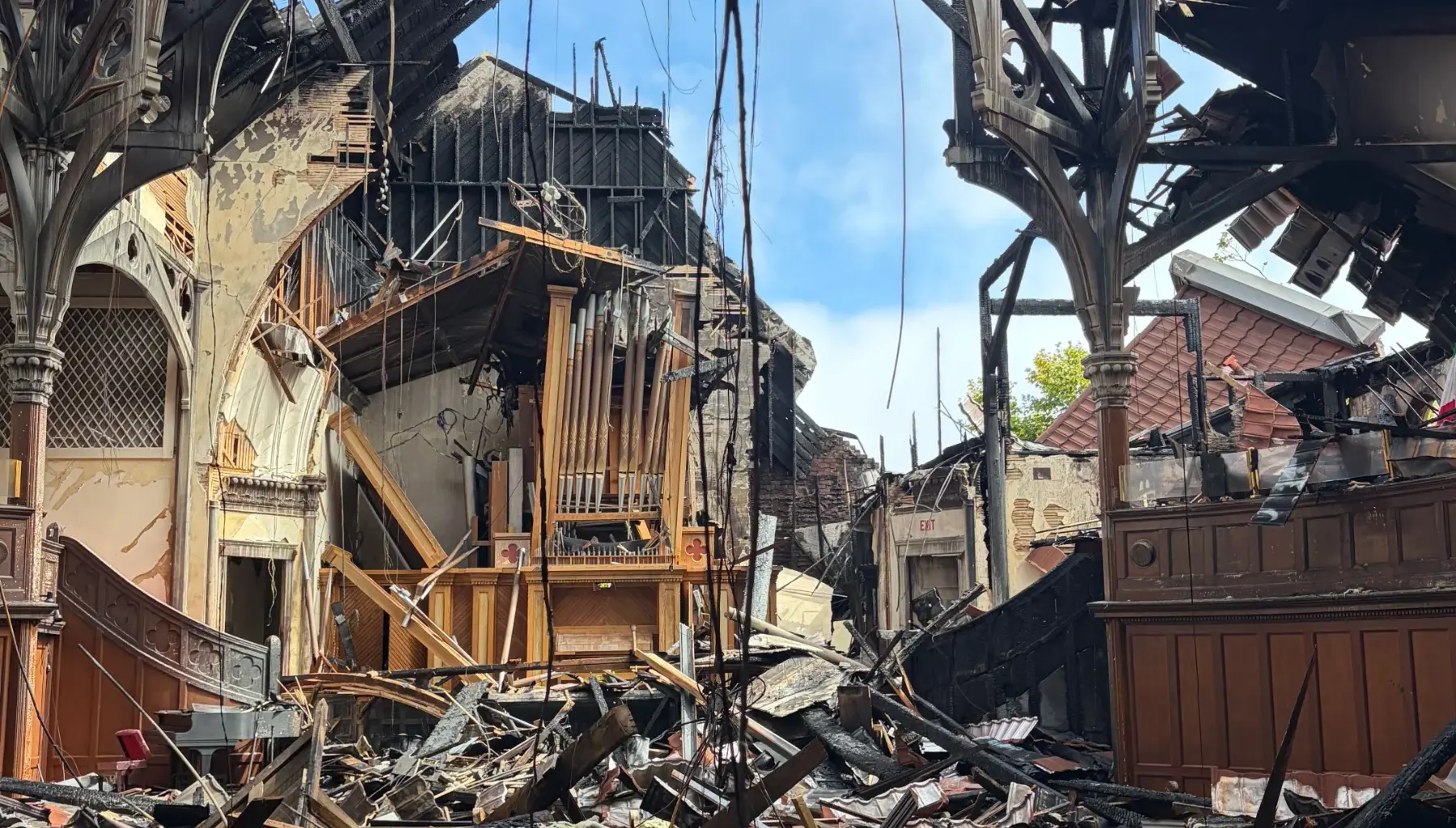
“A black-and-white picture of the sanctuary right now looks like something from World War II,” commented Mark Ferrell, pastor of the San Francisco Central Seventh-day Adventist Church (SFC). We were standing on the balcony, overlooking the worst of the damage from the June 29 fire that destroyed the primary worship space of the church that had been standing for 134 years.
He was not wrong. Blackened wood beams with jagged ends lay at various angles, piled on top of broken, burned, and water-damaged wooden pews. A single chandelier dangled from a solitary electrical cord, swinging and spinning in the wind. The wind—no longer held at bay by walls and a ceiling—whistled through twisted metal and ruffled tithe envelopes. The organ pipes were heat-marked and partially fallen; rubble rested on the end of the grand piano. A microphone receiver swayed back and forth from the balcony, where a sound board rested sideways on the railing. Overhead, where the beautiful wooden ceiling should have been, clouds could be seen through broken boards, scudding across a bright-blue sky. Parts of the city could be seen through what was left of a brick wall.
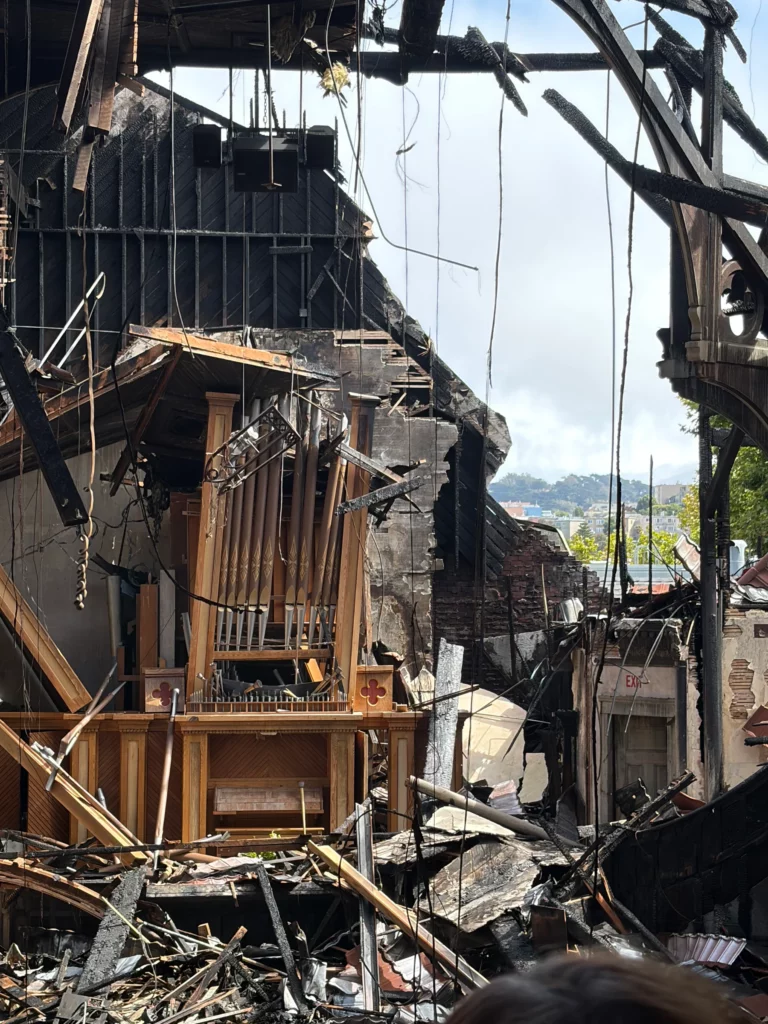 The fire severely damaged the church’s pipe organ, installed in 1986 and featuring parts from organs built in 1903 and 1906. [Photo: Becky St. Clair/Pacific Union Conference]
Downstairs, the damage was not from fire; it was from water. The carpets were soaked and covered in soggy plaster; tile floors had standing water in places; the ceiling panels had collapsed, and insulation hung from the gaping holes left behind. Paint was peeling from the piano in the children’s room. All of this could be seen only with high-powered flashlights, as the building had no electricity, and every window was boarded up to deter looters—who still make nightly attempts to pilfer whatever they can, despite increased police presence in the neighborhood and private security on site.
Scars Are Part of Our Stories
On the afternoon of June 29, Ferrell, a lay pastor, was at work at Stanford University when a text pinged his phone. “I’m probably not the first person to text you this, but I was just watching the news, and the church is on fire.”
“Well, they were the first,” Ferrell said. “I rushed into my boss’s office and said I had to go, and I raced to the church.”
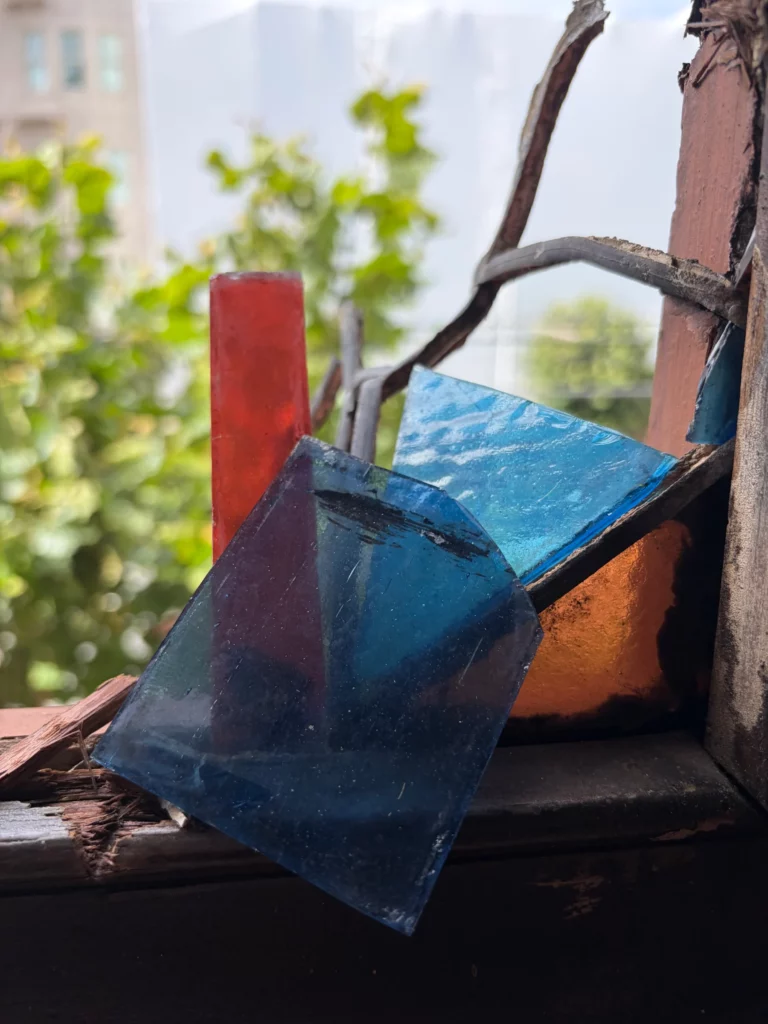 Most of the church’s stained-glass windows were broken or destroyed during the fire and fire suppression efforts. [Photo: Becky St. Clair/Pacific Union Conference]
When he arrived, smoke was pouring from the roof, and dozens of firefighters were on the scene. Ferrell and the battalion chief became nearly inseparable as the chief needed access and layout information for his crew. Ferrell drew him diagrams and showed him photos of whatever they needed.
At one point the battalion chief asked Ferrell if there was anything specific inside the building he’d like them to try to save. “We have to have that pulpit,” Ferrell told him.
The pulpit is a carryover (literally) from the original San Francisco Central church (SFC) on Laguna Street, where both Ellen and James White had once preached, and is therefore a significant piece of Adventist Church history on the West Coast.
Unfortunately, the fire crew could not retrieve the pulpit. Once the fire was extinguished and Ferrell was given permission to enter the building, he and a few elders dug down into the rubble where the pulpit would have been to see if any remnants were salvageable.
“We found the pulpit intact but for a small burned section and a few scorch scars,” Ferrell said with a smile. “We took it to a local restoration company, and they have offered to restore it as a gift to the church. I asked them to repair the burn but leave the scars. Scars are what make us beautiful. Scars are part of our stories.”
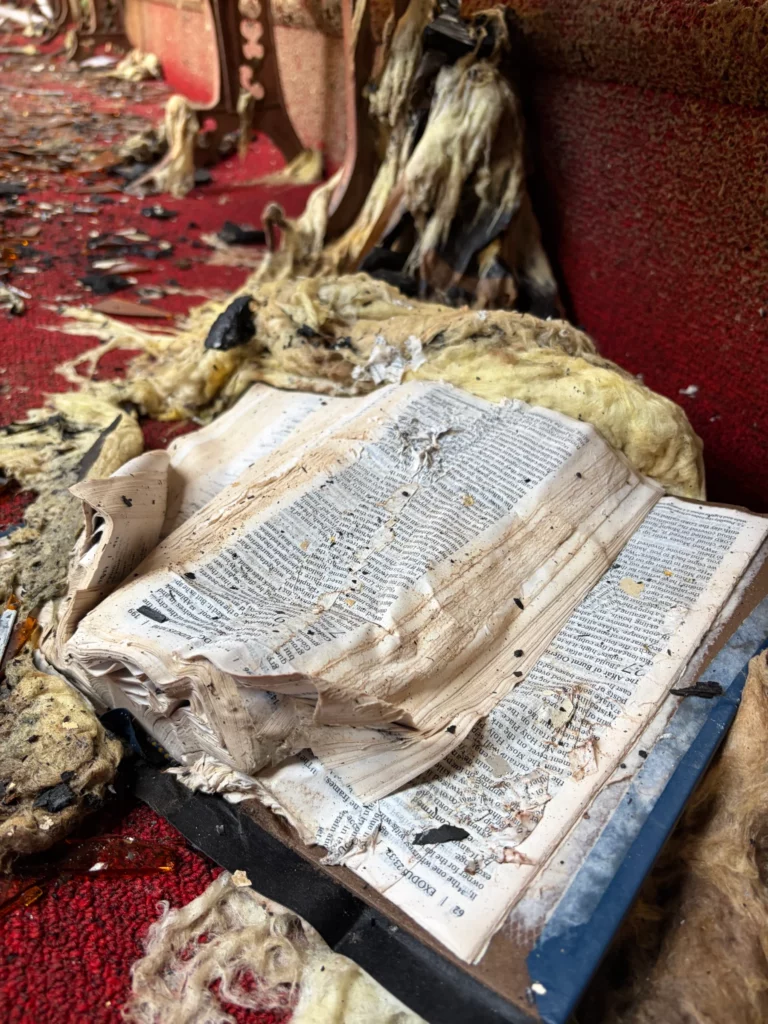 On the Sabbath following the fire, local church pastor Mark Ferrell claimed the promise in Amos 9:11, which states, “In that day . . . I will repair its broken walls and restore its ruins—and will rebuild it as it used to be” (NIV). [Photo: Becky St. Clair/Pacific Union Conference]
We Will Leave Here Healed People
On Sabbath, July 4, their first Sabbath after the fire, the SFC members gathered with their sister congregation a few blocks away, the Philadelphian Seventh-day Adventist Church.
“I was just sitting in my office midweek,” shared Shelton Kilby, pastor of the Philadelphian church, “and I heard a voice say to me, ‘Call Mark.’ I immediately knew what I needed to do.” When Ferrell answered the phone, Kilby said, “Come worship with us this Sabbath. Our church is your church. My pulpit is your pulpit.”
When Sabbath morning arrived, the church gently came alive as members from both SFC and Philadelphian began to arrive. An elder from Philadelphian posted signage so SFC members knew where to go for Sabbath School; SFC holds Sabbath morning Bible study in English, Spanish, and Tagalog. Members hugged and greeted one another and introduced themselves to people they didn’t recognize. Some entered and sat quietly in a pew for a while as light poured through the stunning stained-glass windows on either side of the sanctuary.
The service was unique, with not only pastors from both churches on the platform, but also Virgil Childs, vice president for Black Ministries at Pacific Union Conference; Ricardo Viloria, Central California Conference president; and Stephen Sherrill, city supervisor for District 2 (where these two churches are located).
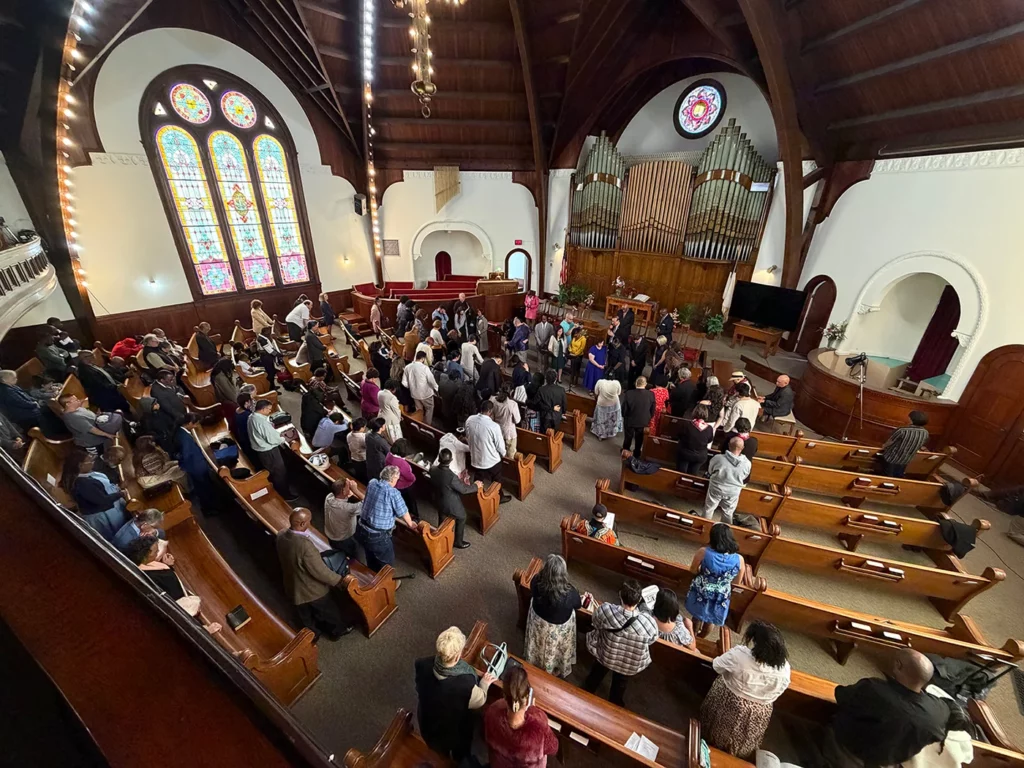 On Sabbath, July 4, San Francisco Central church members joined the San Francisco Philadelphian church in worship. [Photo: Becky St. Clair/Pacific Union Conference]
“Our goal today as we worship together, cry together, and sing together is that we will leave here healed people,” Ferrell stated from the platform that Sabbath.
“I Have Faith Because of You”
When Sherrill spoke, he noted that such a tragedy is not unique in the church’s history. “What I mean by that is that you are welcoming, open, gracious, and kind, and I think today is both a wonderful example of you and this community—but also not particularly special, because you do it every day.”
He continued by saying he wanted to be present at church that Sabbath for two reasons: first, to make sure the SFC church members knew they had the support of the city in the rebuilding of their church. “I know there will be hurdles, but I will be there alongside you,” he said. And second, to say thank you.
“When I saw Mark standing on the street while the fire was still burning and the embers were still hot, while the smoke was still coming out of the church, his attitude was one of hope for the future,” Sherrill commented. “He has incredible grace, incredible faith in God. I can see that in all of you, too. I have faith because of you. I have hope for the future, for these two congregations here today, for this community, and for this country because of you. So I want to thank you for your optimism, your commitment, and your faith.”
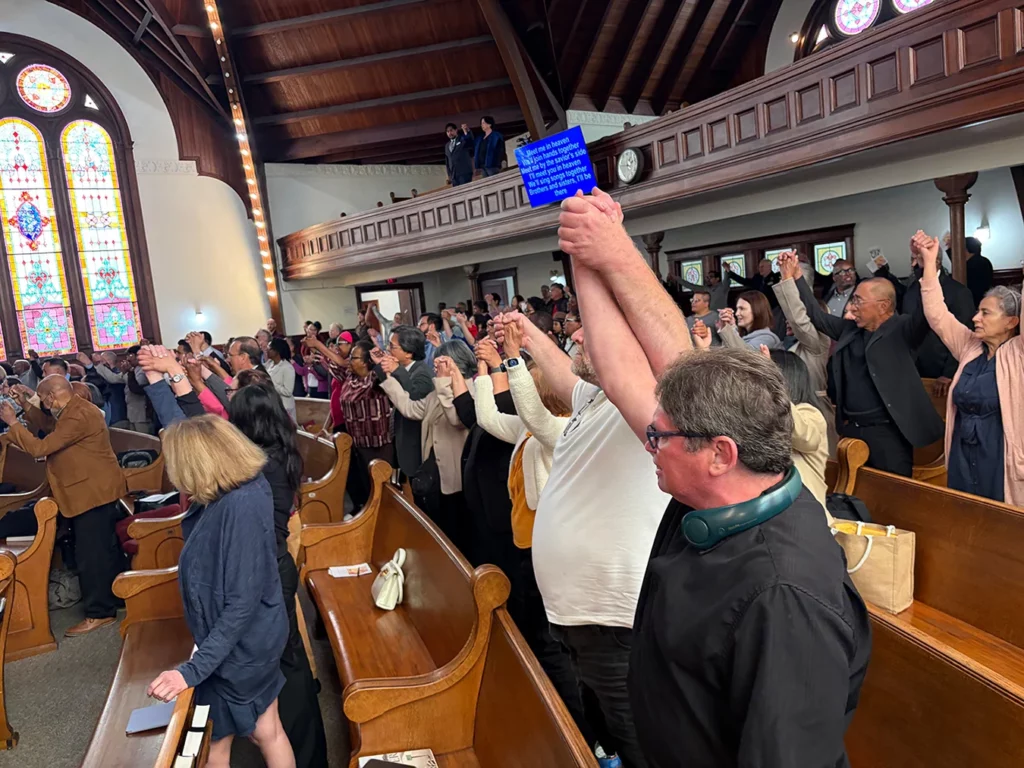 Music played a large role in the July 4 church service, and included a moving rendition of “Side by Side.” [Photo: Becky St. Clair/Pacific Union Conference]
Before he left the platform, Sherrill received a prayer of blessing from the pastors.
Brothers and Sisters, All Are We
Music was a central focus for the remainder of the service. A praise team from SFC led the congregation in several songs, including “We Have This Hope” and “Side by Side We Stand,” a meaningful statement with members of two congregations joining hands across aisles and around the room.
The sermon time was shared by Kilby, Viloria, and Ferrell, each presenting an inspiring and encouraging message from the heart.
Following the service the congregations shared a fellowship meal, provided by the Philadelphian church. Members of the SFC church were invited to go through line first, and for an hour and a half the gym was full of the aroma of home-cooked food and the sound of comfortable conversation.
“This Is My Home”
Though the fire was very much a local experience, it has impacted people far beyond San Francisco’s borders.
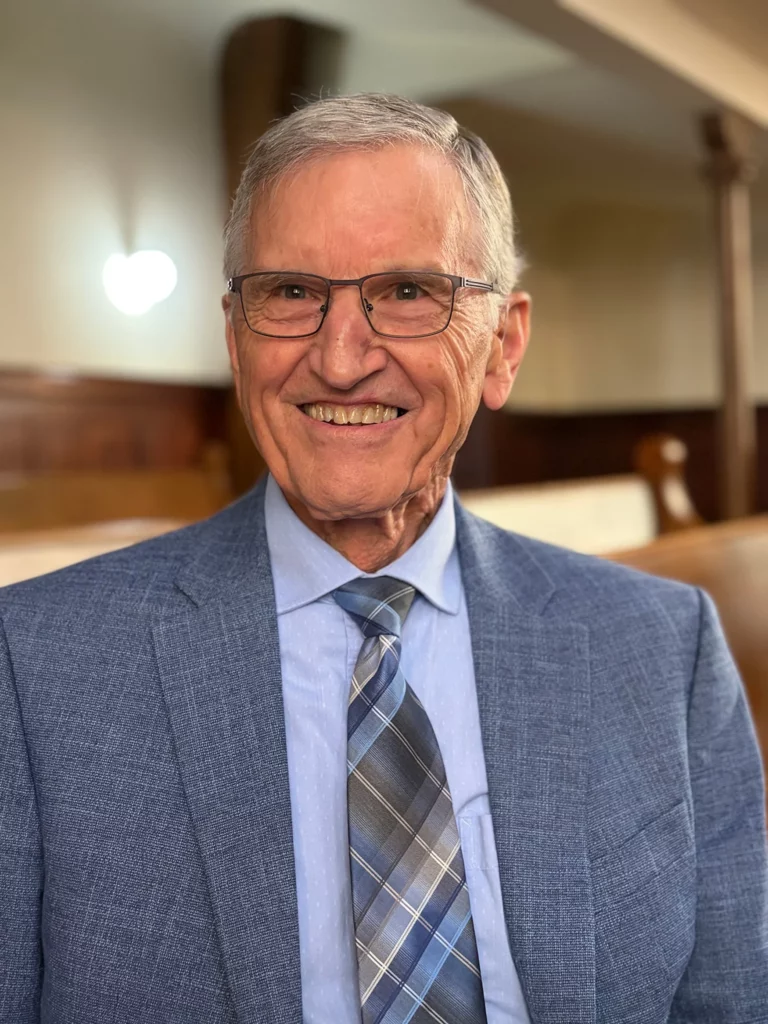 Paul Pellandini, an 82-year-old retiree, traveled from his home in Berrien Springs, Michigan, to grieve and worship alongside members of his former local church. [Photo: Becky St. Clair/Pacific Union Conference]
Paul Pellandini is an 82-year-old retiree living in Berrien Springs, Michigan. On Monday evening he returned home late from a Bible study and found his wife still awake, watching the news. “Come look at this, Paul!” she called. “There was a fire today at San Francisco Central church!”
When Paul was a child, he lived with his single father, his siblings, and a hired nanny in a small two-bedroom house in the heart of San Francisco. Though his family was Catholic, Paul and his siblings attended church on Saturdays with their nanny—at San Francisco Central church. This experience transformed Paul’s faith, and he eventually became an Adventist himself. He holds a special place in his heart for SFC.
As soon as he saw the news Paul felt compelled to travel to San Francisco to worship and grieve his home church alongside its current members. “I had to be here,” he stated, his eyes shining with tears. “This is my home. This is my church.”
Later that afternoon Paul was part of a group that took a guided walk-through of the burned church. He stood, somber, staring down into the rubble. “Unbelievable,” he whispered in a voice full of emotion, his lower lip quivering. Then he walked slowly away, shaking his head sadly.
The Church Still Exists
Cleanup of the burn site is currently being negotiated. The space is not safe for the general public to enter, and the church must obtain an emergency demolition permit, close the street on one side, and haul away the remnants of the building.
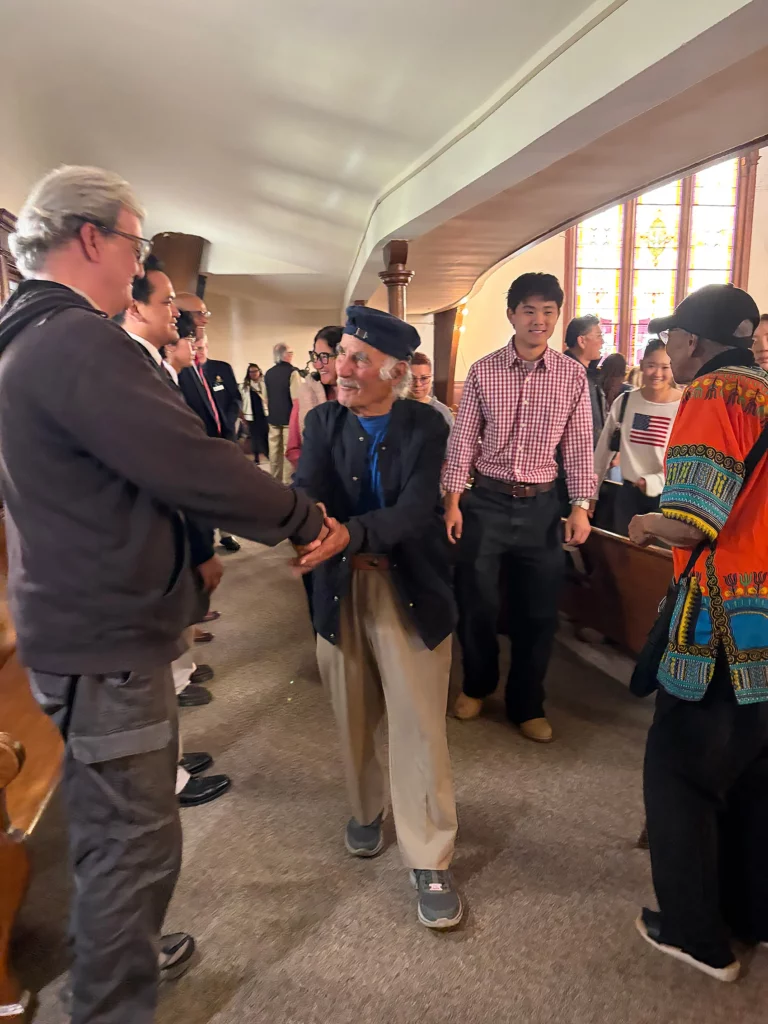 San Francisco Central church members were cheerfully welcomed into the Philadelphian church Sabbath morning. [Photo: Becky St. Clair/Pacific Union Conference]
The most immediate financial need is to get a temporary location up and running. A temporary sound system, livestreaming equipment, and children’s ministry supplies are top priorities. For details on how to contribute, visit sfcentral.org.
As Childs said during the church service on July 4: “The building may be damaged, but the church still exists. Even what appears to be the worst situation is an opportunity for God to reveal His glory. May you be encouraged and restored.”
The original version of this story was posted on the Pacific Union Conference news site.