
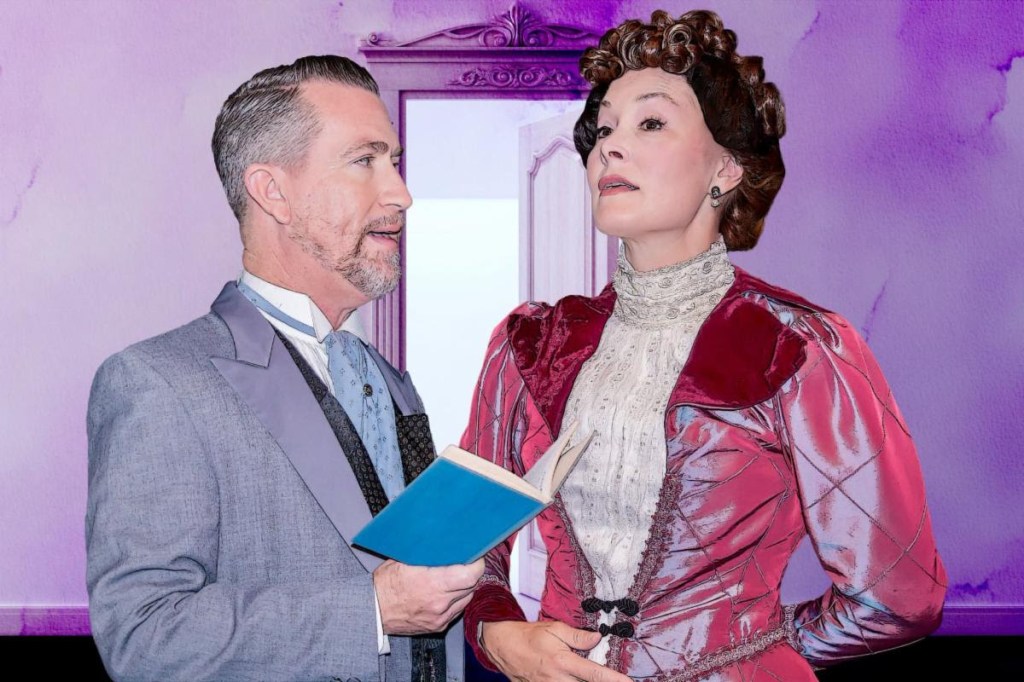
There may be no door slam in theatrical history louder than the one Nora Helmer delivered at the end of Henrik Ibsen’s “A Doll’s House.”
When Nora walked out on her husband and children, she did more than leave an unhappy marriage. She stepped out of the nineteenth century’s prescribed idea of womanhood and into the unknown.
Audiences have been arguing about that exit since 1879. Some early productions even forced Ibsen to provide an alternate ending in which Nora remained with her family, proving that society was apparently more comfortable rewriting a playwright than allowing a woman to leave her husband.
Lucas Hnath’s ingenious “A Doll’s House, Part 2,” now upstairs in the Long Beach Playhouse Studio Theater, asks the question audiences have been debating ever since: What happened after Nora closed that door?
The answer is smart, funny, uncomfortable and, under the direction of Phyllis Gitlin, wonderfully alive.
Fifteen years have passed when Nora returns to the home she abandoned. She has built an independent life and achieved a degree of success that would have seemed impossible when she left. Nevertheless, one unresolved piece of her former marriage has followed her home. Nora needs something from Torvald, and getting it requires reopening conversations everyone in the house believed were long finished.
Hnath does not treat Ibsen’s Nora as a saint, a villain, or a feminist museum piece. She is allowed to be brilliant and selfish, courageous and exasperating. The play’s great pleasure comes from watching four people explain the same history from four entirely different positions.

From left to right: Kelley Barton as Anne Marie and Pagan Urich as Nora in the Long Beach Playhouse’s production of “A Doll’s House, Part 2,” on show through Aug. 15, 2026. (Photo courtesy of Mike Hardy/Long Beach Playhouse).

From left to right: Shawn Plunkett as Torvald and Pagan Urich as Nora in the Long Beach Playhouse’s production of “A Doll’s House, Part 2,” on show through Aug. 15, 2026. (Photo courtesy of Mike Hardy/Long Beach Playhouse).

“A Doll’s House, Part 2,” on show at the Long Beach Playhouse through Aug. 15, 2026. (Photo courtesy of Long Beach Playhouse).
Show Caption
1 of 3
From left to right: Kelley Barton as Anne Marie and Pagan Urich as Nora in the Long Beach Playhouse’s production of “A Doll’s House, Part 2,” on show through Aug. 15, 2026. (Photo courtesy of Mike Hardy/Long Beach Playhouse).
Pagan Urich is marvelous as Nora. Her performance has the assurance of a woman who has spent 15 years constructing both a life and a convincing argument for it. Urich makes Nora’s intelligence exhilarating, but she also permits cracks to appear in the carefully assembled philosophy. Her Nora has not returned to apologize. She has returned believing she can control the conversation. Watching that certainty collide with the people she left behind gives the evening its electricity.
Shawn Plunkett gives Torvald considerably more humanity than the character is often afforded. He does not erase Torvald’s failures, but neither does he play him as a Victorian cartoon husband. His hurt has had 15 years to harden into something quieter and more complicated. Plunkett and Urich circle one another like experienced fighters who remember every blow from their previous match.
Kelley Barton is superb as Anne Marie, the woman who remained behind to raise Nora’s children. She punctures Nora’s grand declarations with the sharp practicality of someone who actually had to live with the consequences. Barton earns some of the evening’s biggest laughs, but never turns Anne Marie into comic relief. Her anger comes from labor, sacrifice and the knowledge that revolutions are often cleaned up by people whose names never appear in the history books.
As Emmy, Nora’s now-grown daughter, Caitlin Durkin brings a startling clarity to the production. Emmy is not merely the abandoned child waiting to condemn her mother. She has formed her own ideas about marriage, love and freedom, and they do not fit neatly into either parent’s worldview. Durkin’s scenes with Urich are especially fine, filled with the awkward fascination of two women connected by blood but separated by almost everything else.
Gitlin understands that the play is not a debate to be won. Each character enters with an argument that seems perfectly reasonable until another character walks in and dismantles it. She keeps the language conversational and the pace brisk without sacrificing the emotional bruises underneath.
The intimacy of the upstairs Studio Theater serves the play beautifully. There is nowhere for these characters to hide, and nowhere for the audience to retreat when the arguments begin landing close to home.
“A Doll’s House, Part 2” is that rare sequel that does not diminish its predecessor. It opens the famous door again and discovers that freedom, marriage, and personal responsibility remain as messy now as they were when Nora first walked out.
Long Beach Playhouse has assembled four exceptional actors and a director willing to trust both the intelligence and the humanity of the text. The result is an evening of local theatre at its very best: intimate, beautifully acted, and certain to continue arguing with you long after you have gone home.
If you go
Where: Long Beach Playhouse Studio Theater, 5021 E. Anaheim St. (Note: the Studio Theater is not ADA accessible).
When: Through Aug. 15.
Cost: Friday adult tickets cost $27; Saturday and Sunday cost $32. There are discounted tickets available for seniors and students.
Info: lbplayhouse.org.