
Three Muslim women ran onto the stage at San Diego County’s Fourth of July celebration and started dancing zydeco.
As a line dance teacher and performer, I knew I could get enthusiastic volunteers to join me on stage, leading the crowd. What I hadn’t expected was how fast they ran.
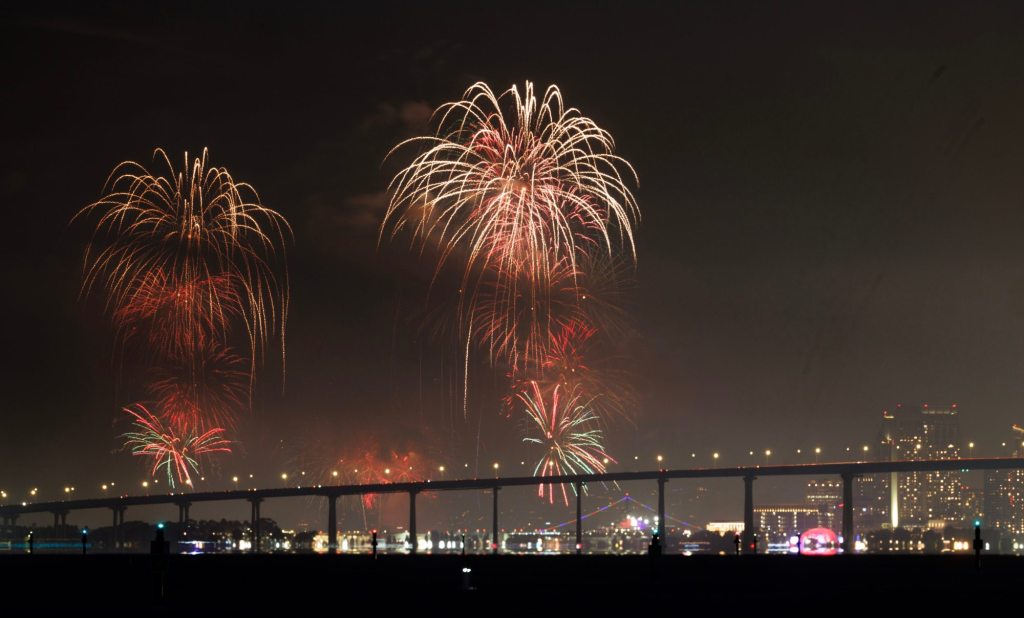
There they were, front and center, finding the rhythm of music born from the Black Creole communities of Louisiana on San Diego County’s stage at Waterfront Park, minutes before the West Coast’s largest fireworks show lit up the sky over the bay.
“This Fourth of July is unforgettable,” said Rachel, a San Diegan who stopped me after the fireworks.
She wasn’t talking about the Big Bay Boom.
“Honestly, it was shocking. Fun but thought-provoking. I kept thinking, why didn’t I know most of this? I’m still processing. But I’m hopeful. Like maybe we can actually get somewhere.”
Others found it unforgettable because, for the first time, the holiday felt like it was celebrated with them in mind.
Across the country, America 250 celebrations have largely followed a familiar template — perform patriotism. San Diego did something different. On Feb. 11, the San Diego County Board of Supervisors made a historic 3-2 vote requiring the semiquincentennial celebration to reflect the county’s full racial and ethnic makeup. Supervisor Monica Montgomery Steppe said telling the full truth is part of loving your country honestly.
I was invited to curate and emcee the Black and African Community Stories segment, the finale before the fireworks. As I invited others, I kept hearing the same response: “I don’t do the Fourth of July.” Many Black, Hawaiian, Latino and Native American San Diegans had quietly opted out, not out of apathy, but because of what the holiday has historically represented.
Makeda Cheatom, founder of the WorldBeat Cultural Center, felt the same. By the end of our conversation about why this year was different, she was quite excited. Her journey from sitting the holiday out to celebrating this year was shared by others I spoke with, and reflected what the board’s vote made possible. Below is how we honored it.
We designed the segment to take people on a journey.
First came celebration of our humanity. The WorldBeat Center opened with libations, African drumming and dance, getting the crowd on its feet within minutes.
Then came reckoning. Starla Lewis performed spoken-word pieces — “I Am America” and “Can You See Yourself With Me?” — naming the complexity of loving a country that has not always loved us back. America loves the rhetoric of freedom but struggles with the pursuit of justice. We named that gap not to condemn the country, but to call it toward its own ideals.
Then came joy as resistance. The crowd line-danced zydeco, many hearing it for the first time. Black people created gospel, blues, jazz, zydeco, etc., from conditions designed to destroy them. Joy has never been the opposite of struggle.
Then came reclamation through a fashion show. Black cowboys reclaimed our history in the American West. Performers in ancient Egyptian attire reminded us our story did not begin with oppression. One model wore traditional African clothing rooted in ancient hieroglyphics. When history excludes Black achievement, we make it easier to believe today’s disparities are natural rather than constructed.
We closed with remembrance and hope through a candlelight ceremony honoring ancestors whose sacrifices built the bridges we now walk on while carrying forward the torch they passed to us. One woman who had never celebrated the holiday found herself thinking about her late grandparents in the Philippines after writing their names on our ancestral wall.
What happened at Waterfront Park on July 4 belongs to more than that night. It shows what America looks like when it tells the truth about itself, whose contributions built this country, whose history has been erased and what it takes to build a more perfect union.
The question now is whether we will keep that door open by teaching fuller history in our schools, communities and homes.
That question did not end with the fireworks. It remains as alive today as it was the night three Muslim women danced zydeco on a county stage and made a crowd of strangers feel, for a moment, like they belonged to the same American story.
Kwamu-Nana is an emcee and experience curator, specializing in celebrations of life. She lives in La Jolla.