
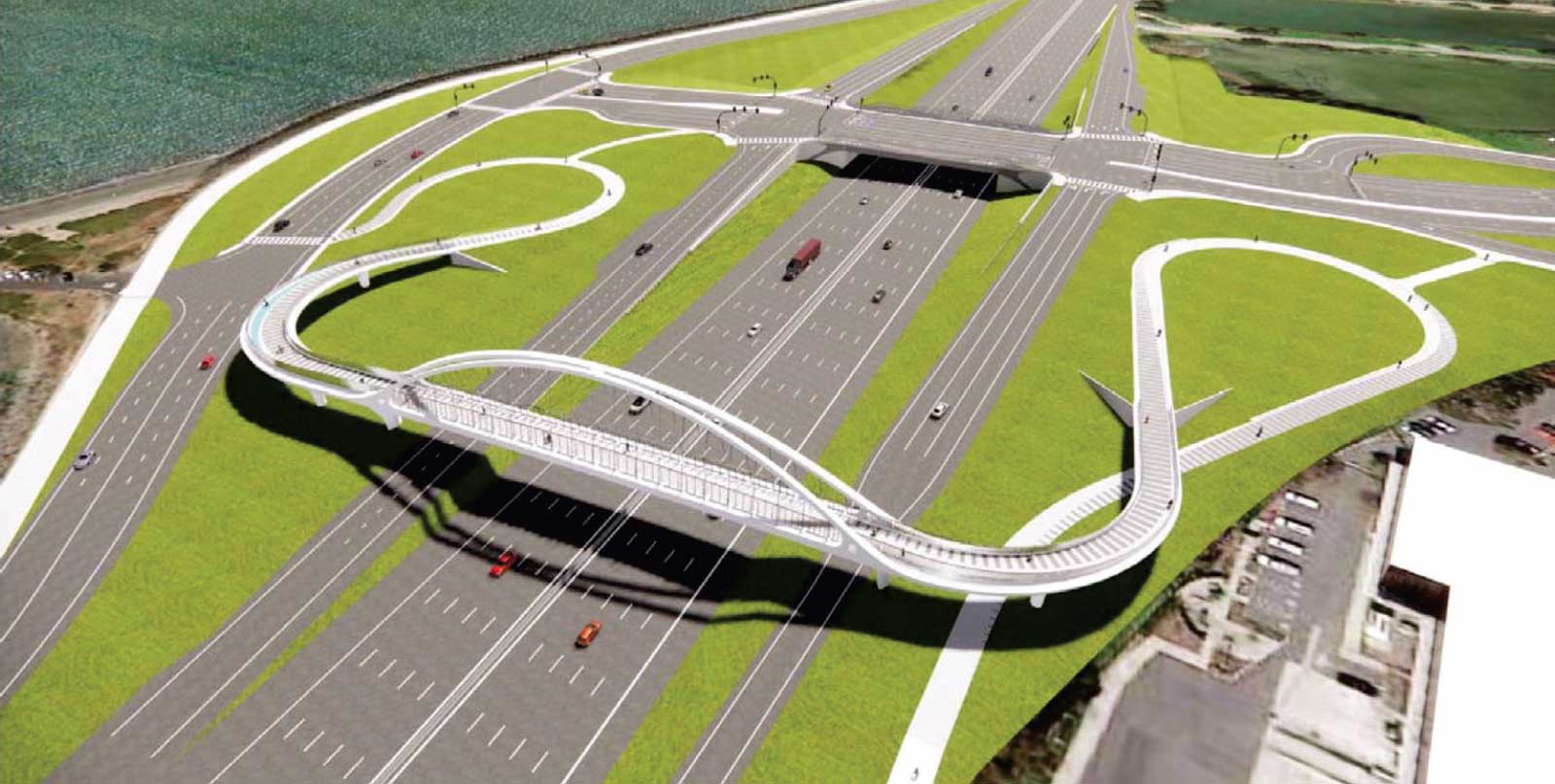
After years of planning, environmental review and public outreach, the long-awaited Interstate 80/Ashby Avenue Interchange Improvements project has reached another milestone—but Emeryville and West Berkeley residents hoping for a safer bicycle and pedestrian connection to the Bay Trail will still have a lengthy wait.
Alameda County Transportation Commission (Alameda CTC) recently announced that the project’s stand-alone Phase I Bicycle and Pedestrian Overcrossing (BPOC) has entered final design and right-of-way acquisition, advancing the bridge as the first phase of what was originally envisioned as a much larger interchange reconstruction.
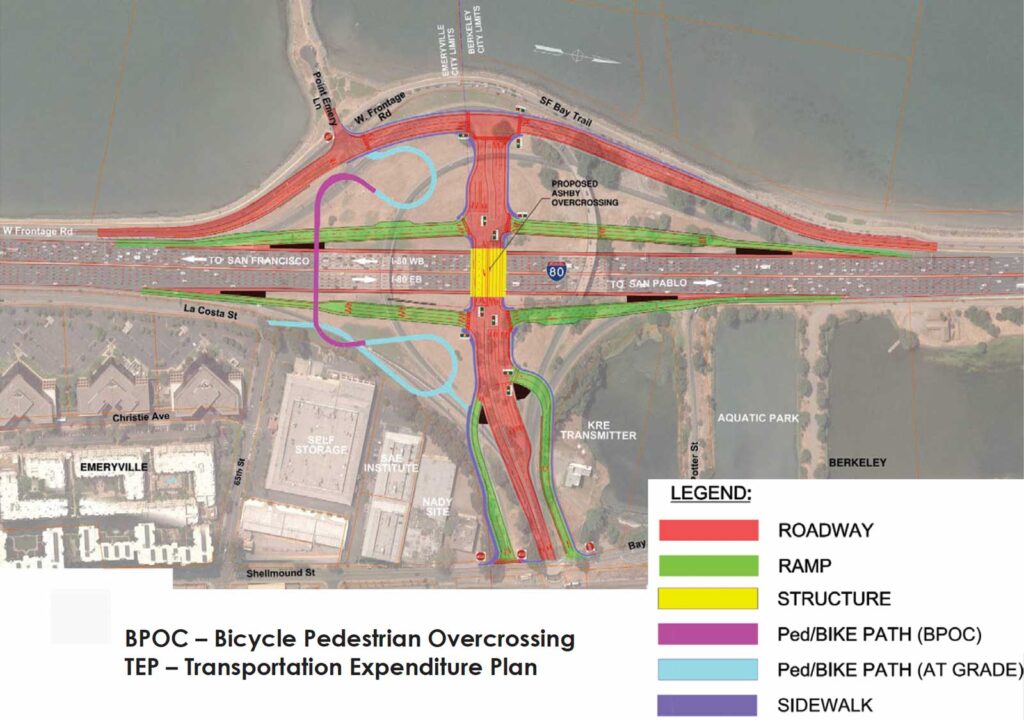 Map showing all phases of the I-80/Ashby Avenue Interchange Improvements project.
A Decade-Long Vision
The larger interchange improvement project has been under development since 2017 and is intended to modernize the aging Ashby Avenue interchange while improving connections between Emeryville, Berkeley and the East Bay shoreline. A centerpiece of the project is a dedicated bicycle and pedestrian bridge spanning I-80, creating a long-planned east-west link between Emeryville’s growing bicycle network along Shellmound Street and the San Francisco Bay Trail while improving access to the shoreline.
Currently, people walking or bicycling must detour north to the University Avenue overcrossing or south to the Powell Street undercrossing to reach the waterfront. The proposed overcrossing would eliminate that gap, creating a safer and more direct route for cyclists and pedestrians. During the early planning process, some residents and bicycle advocates favored a , saying it would provide a stronger connection between Emeryville’s downtown, the peninsula and the Bay Bridge Trail. The current alignment near Ashby Avenue was ultimately selected.
When Alameda CTC , the proposal envisioned rebuilding the entire interchange—including replacing the existing roadway bridge, reconfiguring freeway ramps and constructing the overcrossing—as a single $157 million project. Construction was expected to begin in 2024 and conclude in 2026.
Environmental review under both the California Environmental Quality Act (CEQA) and National Environmental Policy Act (NEPA) was completed in December 2023, allowing the project to advance into design.
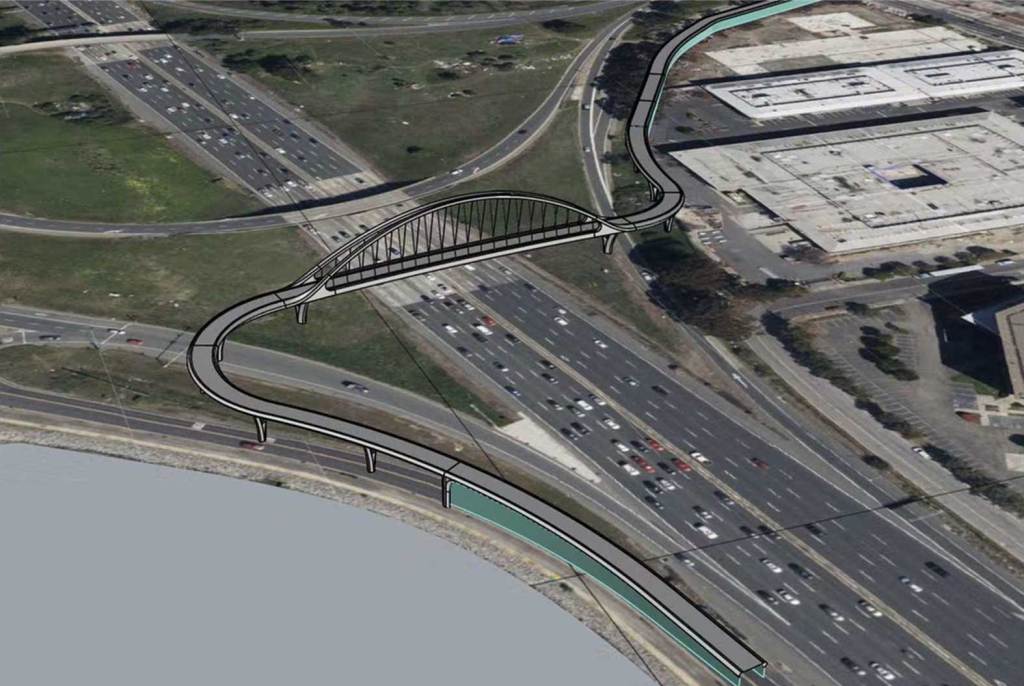 Overhead rendering of the Ashby Bicycle and Pedestrian Overcrossing (BPOC).
Funding Shortfall Forces New Approach
Despite clearing environmental review, the full interchange reconstruction proved too costly to advance as originally envisioned.
In April 2024, Alameda CTC amended the voter-approved 2014 Transportation Expenditure Plan to split the project into phases, allowing the bicycle and pedestrian overcrossing to move forward first while postponing the more expensive roadway bridge replacement and interchange improvements until additional funding becomes available.
“To accommodate this phased approach, the overcrossing approach ramps were redesigned because the existing roadway overcrossing must remain in place until additional funding is secured for its replacement,” explained Alameda CTC Assistant Director of Policy and Government Affairs Remy Goldsmith.
The redesign allows the bridge to function independently while the existing Ashby roadway bridge continues carrying vehicle traffic. Plans also include a realignment of the West Frontage Road to eliminate an at-grade bicycle and pedestrian crossing, new connections to existing bike facilities on Shellmound Street and a small vista point overlooking the Bay.
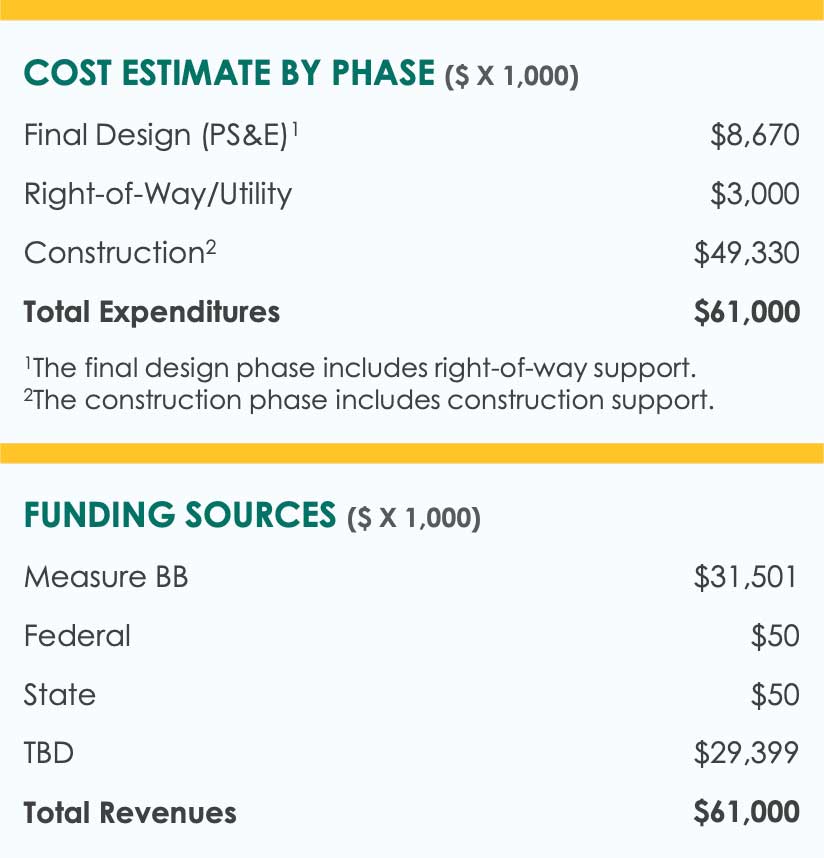
The standalone Phase I project is now estimated to cost approximately $61 million, with about $31.5 million already committed through Measure BB. Alameda CTC is seeking an additional $25 million in Regional Measure 3 funding, leaving roughly $29.4 million still to be secured through grants and other sources.
New Timeline Emerges
The remaining portions of the original project—including replacement of the Ashby roadway bridge and freeway ramp improvements—have not yet been funded or scheduled.
The revised timeline marks a significant departure from the project’s original schedule. Instead of breaking ground in 2024 and opening in 2026, final design is expected to continue through 2028, with construction now anticipated to begin in Spring 2029 and conclude by the end of 2030, assuming the remaining funding can be secured.
If that schedule holds, nearly 13 years will have elapsed between the start of formal environmental work in 2017 and completion of the overcrossing. While the broader interchange reconstruction remains unfunded, advancing the bridge as a stand-alone project preserves one of its most anticipated benefits: closing a long-standing gap between Emeryville’s bicycle network and the Bay Trail while improving access to the shoreline.
Related
You have Successfully Subscribed!