
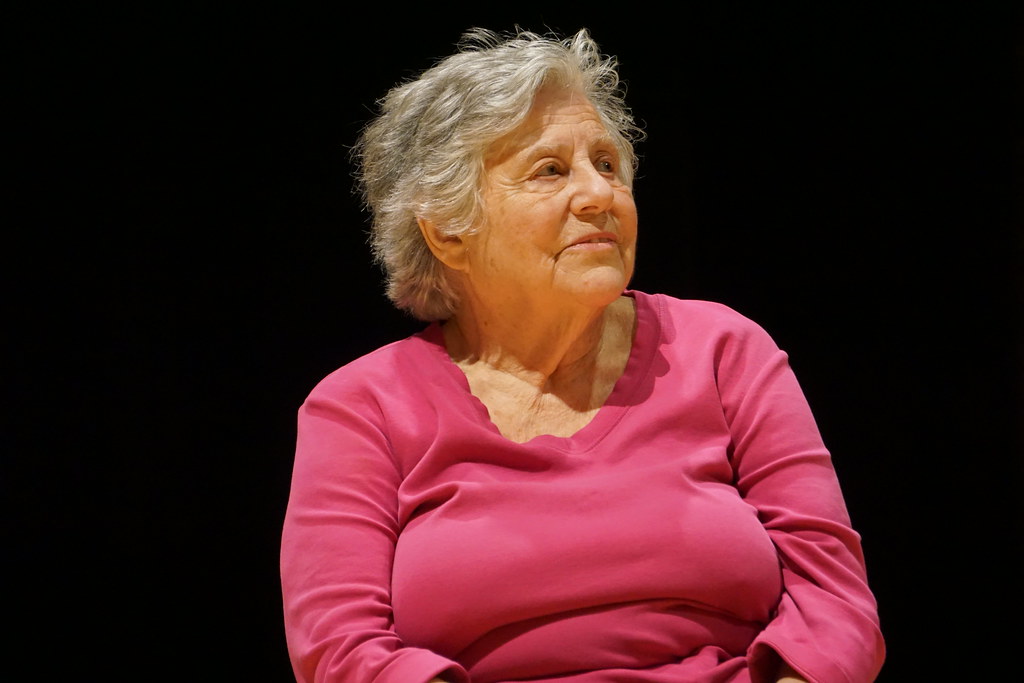
 Flora Russ at her retirement in 2018. Credit: Mark Copland/BUSD
Flora Russ, beloved aunt, family matriarch, pioneering educator, mentor and friend to generations of Berkeley students, teachers, and families, died May 25, at the age of 86.
Born in 1940, Flora grew up in Dayton, Ohio, alongside her parents, Minnie and Julius Teres, and her older twin sisters, Helen and Sandy. After graduating from Roosevelt High and then the Ohio State University in 1962, she taught in Northeast Ohio and Lawton, Oklahoma, before permanently relocating to Berkeley in 1968 to join the faculty at King Junior High and, later, Berkeley High School.
From the moment she arrived at King, Flora made it her mission not only to instruct her students, but to guide the new educators joining the ranks. She quietly became a pillar of support; during her free periods, she walked discreetly up and down the hallways, checking in to ensure the new staff members were thriving. She regularly engaged them in conversation in the lunchroom, the teachers’ lounge, and the mailroom. Always ready with a warm smile, sound advice, and comfort, she earned the endearing affection of her colleagues within weeks. Her dedication knew no bounds.
Nothing was too much to ask of Flora. After transitioning to Berkeley High, she taught a full schedule plus every summer session to help struggling students recover credits to graduate. Her personal philosophy was unshakeable: “everyone graduates.” When occasionally criticized by peers for not employing “tough love” or making young people deal with the consequences of their choices, she would kindly respond, “They are going to face plenty of consequences, with or without a diploma. Better to face them with one than without.”
Initially a math teacher, Flora transformed her classroom into a workshop for discovery. She pioneered creative, kinesthetic teaching. Her most legendary project challenged her students to physically manifest place value and powers of 10 using aluminum pull-tabs. The true lesson, however, lay in the architecture. The resulting structures of one, 10, 100, 1,000, 10,000, and finally 100,000 rings hung proudly on her classroom wall. The structure was a three-dimensional matrix stretching 10 feet across and over 6 feet tall. Flora’s crew was working toward the 1 million ring milestone when they were forced to abandon the project because the immense weight was causing the classroom’s walls to buckle.
By 1973, Flora became one of the first educators in the region to teach computer programming at the junior high level, unlocking a lifelong love of technology for generations of students. Ever a pioneer, she was among the first wave of American educators to travel to mainland China on a cultural exchange during the normalization of U.S.-China diplomatic relations in 1979.
Over the course of her 50-year career, she taught science, math, credit recovery, and work experience at both the middle and high school levels. In 1991, she founded the Computer Academy, known today as AMPS (Academy of Medicine and Public Service). Though Flora officially retired in 2018 after five decades in Berkeley Public Schools, the lure of helping children quickly brought her back to the classroom as a long-term substitute and a dedicated tutor for students unable to attend school due to medical or personal hardships.
The thousands of students who passed through Berkeley schools during her tenure knew Flora as someone who would go to the ends of the earth to support each child in reaching their potential. It is impossible to quantify the number of lives she touched, though countless alumni have echoed the sentiments: “Ms. Russ saved my life,” or “I would not have made it without her.” Her involvement in their lives never ended at the schoolhouse door or even at graduation. She regularly checked in with Berkeley employers regarding the current and former students on their payroll, always looking to place even more young people into local businesses. She was incredibly proud of what her students accomplished and would brag about them to family and friends much like a parent is wont to do.
Flora was a woman constantly matching friends in need with people who could help. A simple day out with her meant pausing for job updates from local employers, introductions to shop proprietors, and impromptu roadside chats with friends working in their yards. She could scarcely go anywhere in town without a joyful, unexpected reunion with former students or their families.
In the late 1980s, Flora met the love of her life, Jerry Grigsby. They spent 20 years together until his untimely death in 2006. Together, they faced the aftermath of the 1991 Oakland Hills firestorm, which destroyed her home, living closely in a small apartment until they could rebuild together. Following Jerry’s passing, Flora formed a profound, enduring closeness with his daughter, Stacy, who became like a daughter to her. Their bond grew over the years into a pillar of mutual support, extending warmly to Stacy’s sons, Jordan and Jeran.
During family gatherings back in Ohio in the 1960s and ’70s, Flora earned her lifetime status as the coolest member of the family in the eyes of her young nieces and nephews by being the only adult who would intentionally choose to sit with them at the kids’ table. A solo plane trip across the country to spend an extended stay with Aunt Flora was a foundational rite of passage for each of them before they reached adulthood.
In addition to her partner, Jerry, Flora was preceded in death by her parents, Minnie and Julius Teres; her grandparents, Mary and Alexander Terespolski, and Sarah and Hyman Haves; her two sisters and their spouses, Sandra (Alan) Katz and Helen (Jerry) Jacobson; her uncle and aunt, Manuel (Betty Jo) and Carl (Sari) Haves; aunts, Florence Haves (for whom Flora was named), Ida (Lou) Hoffman, and Esther (Stanley) Weinstein; and five of her cousins.
She is survived by her five nieces and nephews, Jody and Mike Uth, Susan and Rob Godes, Michele and Bill Plesich, Jeff and Stephen Jacobson, and Dan Jacobson, and their children and grandchildren; her late partner’s children, Stacy Wagner and John Grigsby; Stacy’s two sons, Jordan and Jeran, and their families; and her cousins, Mickey Hoffman and Karen Jo Haves.
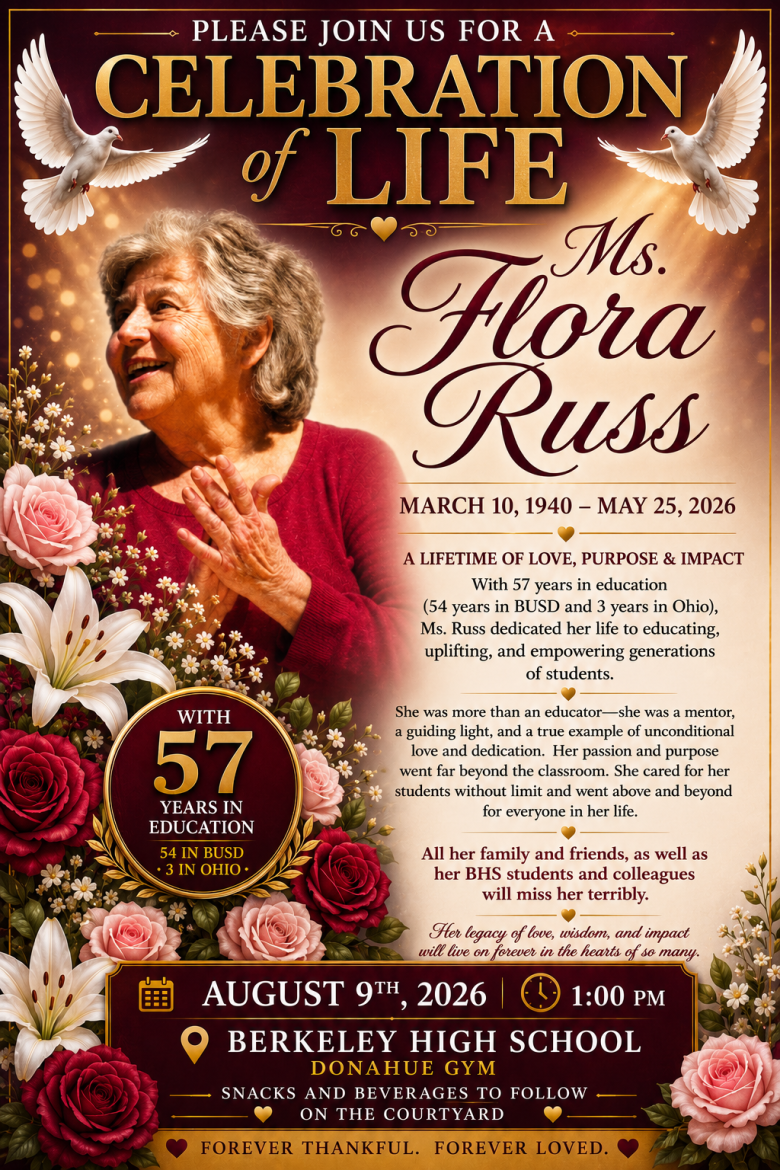
All are invited to a celebration of life, which will be held on Aug. 9, at 1 p.m. in the Berkeley High School Donahue Gymnasium, 1980 Allston Way.
Two students whose lives Russ touched
Susannah Bell, Rory Bled, and Alan Miller — all teachers at Berkeley high — shared this remembrance of their colleague’s extensive impact.
This extraordinary human being is responsible for the high school graduation of literally thousands of young people, many of them going on to college as the first in their families to do so. They’ve become community organizers, teachers, artists, firefighters, nurses, college professors, urban planners, entomologists, electricians, recording engineers, filmmakers, educators, psychologists, doctors, entrepreneurs who give back to community, medical examiners, detectives, forensic scientists, cosmetologists, architects, lawyers, legislators, and mayors.
Most share the value of stewardship and strive to repair the world because of Flora’s influence. Flora Russ embodies hope. She doesn’t have a cynical bone in her body. Her far-reaching impact is best embodied through the life stories of two of her students.
Lily Dorman-Colby, Berkeley High Class of 2005. Her parents struggled with mental health and addiction issues, making it difficult to take care of themselves let alone Lily and her three brothers. As she traversed the foster care system, Lily fought to keep her siblings together. During the beginning of her sophomore year Lily struggled in her English class, but with Flora’s help, she was able to transition into the small school Flora founded. Within CPA, Lily was able to flourish. In spite of severe dyslexia, Lily was able to graduate and attend Yale University. Between college and law school at UC Berkeley, she wrote language for bills about the foster care system that would later become state and federal law. Lily is now an attorney, the founder of the National Network for Fostering Sibling Connections, and a fearless advocate for children in the system.
Victor Rios, who grew up in some of the most violent neighborhoods in Oakland, joined a gang (as depicted in the PBS Frontline documentary “School Colors” and the 2018 film “The Pushouts”), served time in juvenile hall for multiple felonies, and dropped out of school. He returned only because Flora convinced him to. She believed in him when few others did, helped him catch up on credits, walked him through graduation in 1995, and guided him through his college applications. Victor is now an author, theorist, sociology professor, highly-sought-after speaker, husband, and father. He has started nonprofits to support marginalized youth, advised the Obama administration and was honored for his work and leadership by the Biden administration. Victor calls Flora Russ his most important mentor.
Flora’s commitment to equity in education is unparalleled in our district. She leaves behind a legacy of tireless service to those students who had been marginalized or who had previously been underserved. Her legacy will live on in the students and teachers whose lives she touched for generations to come.
“*” indicates required fields