

Coronado is about to become the newest member of San Diego Community Power, the community choice aggregation, or CCA, program that offers an alternative to San Diego Gas & Electric for electricity sources.
The Coronado City Council, on a 5-0 vote, approved a pair of resolutions Tuesday to sign a joint powers agreement with Community Power and kick off the regulatory process to formally join the CCA. If everything goes smoothly, Coronado customers can begin receiving electricity from Community Power in March 2028.
“This started back in 2022,” Councilmember Kelly Purvis said, referring to a subcommittee that examined the pros and cons of Coronado joining a CCA. “We’ve looked it at very, very carefully. I had my doubts and I came around. And choice for me was the big reason for going this way — and the rates (for Community Power) are lower right now.”
The City Council selected Purvis as Coronado’s representative on Community Power’s board of directors. Councilmember Carrie Downey will serve as the alternate.
The City Council will have a second reading of the ordinance on Sept. 1, and Community Power’s board is expected to formally consider Coronado’s membership when it meets on Sept. 24.
Judging by a statement released by Community Power’s board chair, it sounds like a done deal.
“Community Power was built to give people real choice and answer directly to the customers we serve, not shareholders,” said Terra Lawson-Remer, who is also chair of the San Diego County Board of Supervisors. “We’re proud to welcome Coronado as we build a cleaner, more affordable energy future together.”
In 2022, Coronado adopted a Climate Action Plan that seeks, by 2030, to reduce greenhouse gas emissions within the city by 39% below 2016 levels.
In place since 2021, San Diego Community Power already serves about 970,000 customer accounts in the cities of San Diego, Chula Vista, La Mesa, Encinitas, Imperial Beach, National City and the unincorporated communities of San Diego County. Community Power is the second-largest CCA in California.
The addition of Coronado will bump up the number of accounts by approximately 10,000.
Community Power is one of 25 CCAs that have sprung up across California in recent years.
Created by the California Legislature in 2002 to encourage the growth of renewable energy and provide competition to traditional investor-owned utilities, CCAs are designed to offer customers higher percentages of renewable sources at comparable or slightly lower rates.
When established, CCAs purchase electricity generation for residents and businesses in their respective municipalities.
Utilities such as SDG&E don’t go away under the CCA model. They still perform all the responsibilities outside of purchasing power — such as delivering electricity via transmission and distribution lines; maintaining poles and wires; and handling customer services, including billing.
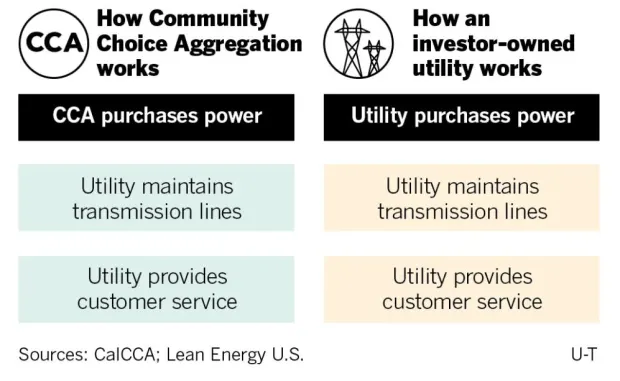 The San Diego Union-Tribune
As per state rules, potential Coronado customers will automatically get enrolled in Community Power — residents and businesses won’t have to fill out any forms.
Customers will not receive a separate bill. Rather, they will still receive a monthly statement from SDG&E that will include a notation saying “CCA Electric Generation” under the summary of current charges on Page 1 of their bills.
For customers who prefer to remain with SDG&E for their power purchases, they will have the ability to opt out for free.
Community Power offers three different plans for its customers:
PowerOn, the default program that has a portfolio of 53% renewables, plus 2% from carbon-free sources such as hydroelectricity. By comparison, SDG&E’s renewable portfolio stands at 41%.
PowerBase, a less expensive option with a renewable energy content of 45%.
Power100, offering generation that pencils out to 100% renewable sources of energy, but it’s more expensive than PowerOn and PowerBase.
According to projections, Community Power residential customers in 2026 enrolled in PowerOn who use an average of 341 kilowatt-hours of electricity will pay 1.28% less compared to SDG&E per month (which works out to a savings of $2.10).
Those on PowerBase will pay 3.38% less, for a savings of $5.56. But residential customers enrolled in Community Power’s Power100 program are projected to pay almost 1% more compared to SDG&E on a monthly bill, which works out to $1.30 higher.