
Every day, lifelong Angeleno Evan Lovett walked to his office across the L.A. River to work. He has always known it was there, but never questioned why what looked like a large suburban freeway drain was considered a river. Sure, there were small islands housing overgrown trees and some funny-looking birds with small bodies and long skinny legs, but it couldn’t possibly be a river.
But it was, and Lovett wanted to know why.
L.A. is home to beautiful, culturally diverse landmarks and historic sites that can be found all across the city. Ken Bernstein, L.A. City Planner and the author of Preserving Los Angeles: How Historic Places Can Transform America’s Cities, works to preserve cultural landmarks within the city. He said that so much is changing that could be of concern to people, and that historic places provide a “sense of familiar, a well-loved bridge” from the past to the present.
“Many historic places need to be experienced to feel their power and impact,” Bernstein said. “Our historic buildings have a unique power of place that is heightened by direct experience.”
Many corners shine with plaques commemorating some building, parade, protest or historical event solidified into the concrete. Beautiful public art — some commissioned by the city and some done by residents on their own free will — lines the walls of corner stores and apartment complexes. Statues, almost 100-years-old, cast shadows now used as shade from the hot sun. All for free, all for Angelenos to enjoy.
However, as deep as Los Angeles’ history is, not all residents know the significance of the neighborhoods they inhabit or the roads they use to commute to work. So, practical historians like Lovett — initially curious to know the history behind these plaques, public art displays, statues and roads — offer answers through social media.
Lovett is not alone in this conquest. Since the onset of the COVID-19 pandemic, an influx of content creators have cropped up across Instagram and TikTok with short-form educational videos that share niche L.A. history topics.
Scroll to continue reading
Here are four you should follow.
Evan Lovett: @lainaminute
Urban Theorist Mike Davis is to blame for the way Lovett views L.A. While studying to become a journalist at UCLA, Lovett took an urban sociology course that changed his view on the city. While he doesn’t share Davis’ signature pessimistic outlook on Los Angeles, he can agree on one thing: to love something is to hold it accountable.
Around the start of the COVID-19 pandemic, Lovett began creating videos on L.A.—quick videos all under a minute—and was positively received on various social media platforms. At the start of his educational content-creating journey, Lovett was working as a reporter and never expected social media content to be his full-time job.
“I am a reporter through and through, and I think that’s where a lot of my coverage and the approach to my coverage comes from,” Lovett said.
He explained that L.A. has a pattern of bulldozing its past to make room for the present, and that his motivation to uncover the history beneath the rubble is to acknowledge what once was, before making room for what now is.
Lovett’s videos usually consist of himself, selfie-style with sunglasses on, standing in front of whatever that day’s topic may be. His enthusiastic voice shares the history of the location, its significance and why it’s relevant to Angelenos today.
“Every single neighborhood of Los Angeles has important history and has had an impact on the development of the city and often the world,” Lovett said.
Lovett has noticed that viewers are receptive to his minute-long educational videos, which have garnered attention worldwide. He said that when visitors come to the City, they use his videos as a guide to experience real L.A.
Lovett hopes that his content — which also includes a podcast where he dives deeper into L.A.-related historical topics — connects all Angelenos whether they’ve been here since yesterday or the day they were born.
“There’s a lot of good people really working to uncover, uplift and magnify the history of Los Angeles that we might have lost or preserve what we still have,” Lovett said.
Ansley Layne: @spookyfoodie
Unlike her fellow creators, Ansley Layne was not born and raised in L.A., and grew up in another rapidly changing city: Las Vegas.
Crediting her love for the paranormal and seedy history to her father, Layne grew up surrounded by true crime and Old Hollywood history. Her father, a true crime reporter and mob historian, shared his passion for crime history with Layne, leading her to love all things spooky. Rather than uncovering who may have killed the Black Dahlia, however, Layne chooses to interact more with the living.
“Growing up, we used to go to a lot of casinos, and I’d be around dive bars because my dad was a single dad and a reporter,” Layne said. “He had the police radio in the living room and sometimes I’d go with him to these crime scenes so he could report them.”
For the past three years, Layne has travelled across L.A. County — sometimes venturing beyond the Orange Curtain — documenting dive bar culture and sharing the history these places hold. She speaks with regulars, both living and passed on, about why a place is important and holds significance to the surrounding community.
“When I talk about the term haunt, I don’t mean ghosts. I mean a place where people frequent often, a place that’s lived in,” Layne said. “Dive bars honor their dead. They honor their afterlife, they honor regulars who have lived and passed away.
Layne has expanded her horizons past haunted bars and ventured into restaurants with rich history or importance to a community in L.A.
In one video, Layne is buying meat from Dollar Hits, a Filipino market in a strip mall, and grilling it right outside the storefront. In another, she is drinking “Hollywood’s best martini” and eating organ meat at Musso and Frank Grill. The common denominator, however, is that both establishments are treated with respect and honored for what they have offered the community of L.A.
Layne feels that when she enters these spaces, she becomes a part of history herself. While the oral history these bargoers or unofficial counterseat czars retell may not be documented in any book, they are just as important in weaving the fabric of the city’s history.
“Dive bars and diners are humanity. They’re there for you on your good days and bad days. They are chosen family, it’s a routine, we need more routine,” Layne said. “There’s something really special about that.”
Additionally, she notices an impact through her content creation. Layne said that people have used her videos as a passport on where to go in the city, creating a checklist of historic places to visit and patronize as long as they’re around.
“I’ve really been passionate about historic preservation and supporting small business,” Layne said. “That’s kind of where my content has been going throughout all of this.”
These historic establishments with tears in the corner of leather boots and dollar bills stapled onto the wall may be a little more run-down than your shiny $20 cocktail bar, but Layne said that is what people are really looking for.
“I’m Gen Z, and a lot of us grew up in the digital age and are more nostalgic about the past. We like the more dingier, grungier stuff because we didn’t have that,” Layne said. “I think we’re getting more attached to the dive bar culture.”
While it might have started with L.A.’s dark history, Layne intends to continue tying the past into the present and advocating for younger generations to patronize old bars and restaurants just as Angelenos have done for decades.
Greg Ruben: @gregruben
After spending nine years in New York, Greg Ruben returned to his hometown of L.A. with a new perspective. After being away for so long, he realized how much he had taken for granted growing up here, and with that, he began researching the oddities of what makes the City so unique.
“I started researching to satisfy my own curiosity and around the same time, a friend encouraged me to download TikTok,” Ruben said. “I found an audience really quickly and I’ve been doing it ever since.”
Ruben began making TikToks during the COVID-19 lockdown. Although not of a history or journalistic background, Ruben has read several books on L.A. and considers himself a short-form documentarian. His short-form videos are intended to investigate how history continues to inform the L.A. we live in today.
“History continues to inform the world we live in today, which I think it’s often blind to people,” Ruben said. “It’s a really interesting aspect of living in Los Angeles, being a relatively young city. This presence of every group, every era of L.A.’s history is still very much around us.
Through a combination of library research, speaking with other historians, interviewing everyday people with a deep connection to the story and referencing his own collection of books on L.A., Ruben thoroughly researches the topics he chooses to cover before creating any content. His videos, often with cinematic qualities and a heartwarming or funny story, are both equally entertaining as they are informative.
“My style and format comes naturally out of me, it’s kind of done through instinct,” Ruben said. “Some videos utilize humor and some don’t and that is often a response to the nature of the material, but also how I’m feeling in the moment.”
Ruben calls the process of making these videos a “mental workout,” both satisfying his curiosity and creative side. He said that there isn’t a goal to educate people, but it is an upside to the job. Rather, he hopes that his videos help change the way people see their surrounding environment.
There are several places Ruben feels at home across the City, and his content creation has only further connected him to the community of L.A. In a city where you can feel easily alienated, Ruben said, having an understanding of history can help you know why things operate the way they do and find solace in the uncertain.
Etan Rosenbloom: @etandoesla
After losing his childhood home in Altadena to the L.A. wildfires last year, Etan Rosenbloom felt a call to advocate for engaging with L.A. history, keeping it alive for as long as it can stand.
While feeling stir-crazy during the pandemic, Rosenbloom took his bike out for a ride to get some fresh air and decided to venture off to a random destination he saw on his maps. Rosenbloom felt disconnected from L.A., unable to enjoy the City he had spent most of his life in, so the ride served as an emotional release. When he arrived at his destination, however, he was a little confused about what he stumbled upon.
The caption read, “This weekend I began what will surely become a lifelong journey that I’ll probably never complete: visiting all of the sites in Los Angeles listed by the National Register of Historic Places. My first stop was one of my favorite spots near me, the awe-inspiring Portal of the Folded Wings Shrine to Aviation.”
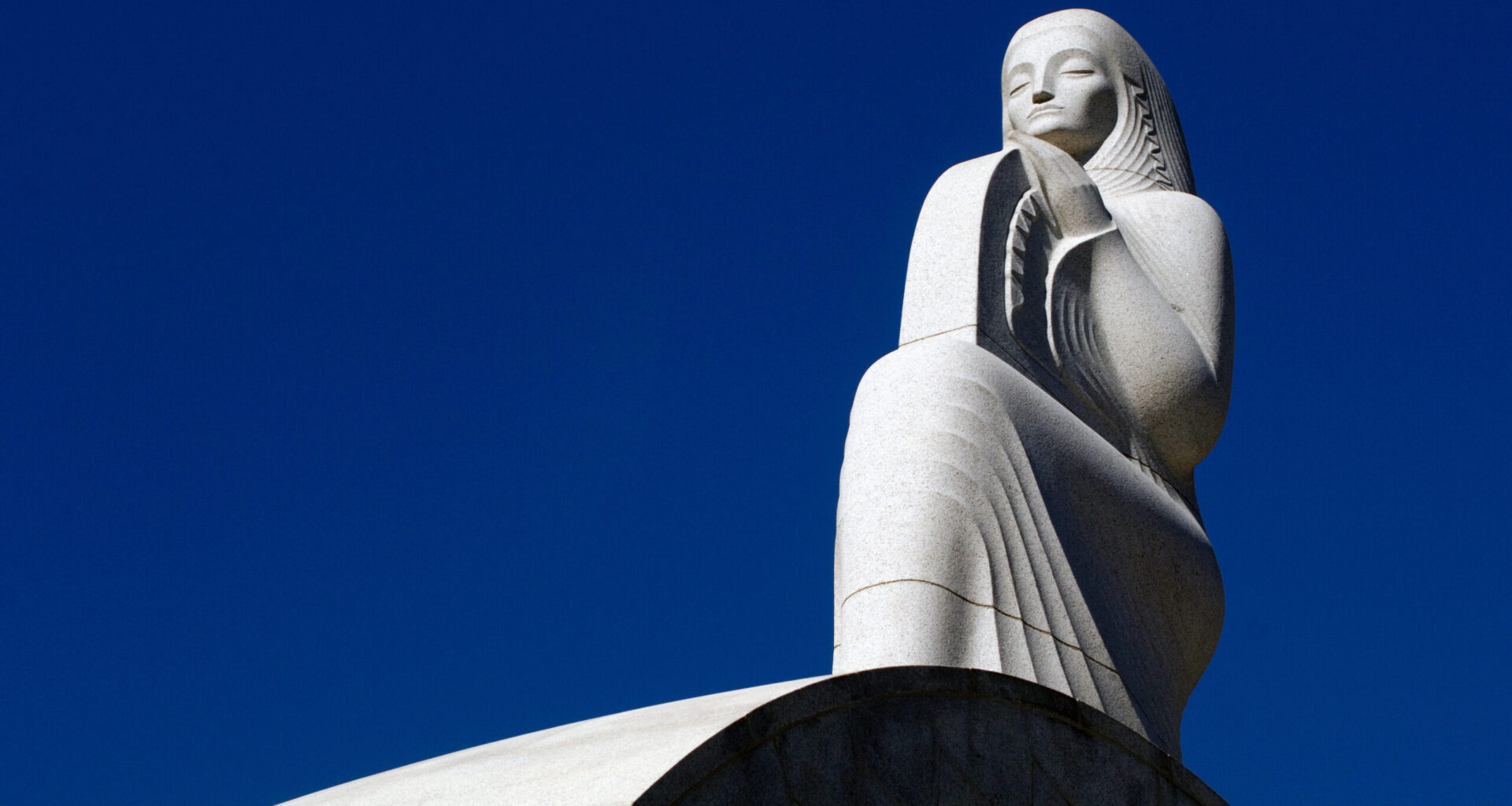
Standing tall in front of him was the Portal of the Folded Wings Shrine to Aviation, a massive ornate Spanish-style arch that served as the entrance to the Valhalla Memorial Park Cemetery. Rosenbloom, unsure what to make of this, took a selfie in front of the National Register placard, uploaded it to Instagram and moved on with his day.
However, he couldn’t help but think of what other L.A. landmarks are unheard of.
“If I’ve been living in L.A. for four decades and I’d never heard of this place, I wonder what else is on the national register that I’ve never encountered before,” Rosenbloom said. “I was like alright, I’m all in. I’m going to commit myself no matter what it takes to visit every single one of these [landmarks on the National Register].”
So, the journey to see every landmark began.
He began an Instagram page uploading pictures and short-form educational videos about the landmarks. Additionally, a blog that goes a little further into detail about the site.
Rosenbloom started to feel more connected to L.A., branching beyond his usual engagement through restaurant openings and music events, moving onto something a little more permanent. Trendy locations, Rosenbloom said, are meaningful to a community for a moment. These landmarks, however, have stayed consistently meaningful for past, present and future generations to come.
“I’ve explored parts of the City that I have never been to before. I’ve connected with so many people that are just experts in their local history,” Rosenbloom said. “The things that continue to be meaningful to a community long after they’re built, those things say more about a City.”
There are a couple of landmarks on the register that Rosenbloom cannot share with the public via socials because they are privately owned, but he has had the luxury of visiting them for his personal enjoyment. The challenge for Rosenbloom goes beyond the content, and is more so just for himself.
Rosenbloom urges Angelenos and visitors alike to engage with these landmarks, if not their local community overall. It is one thing to see an object in the museum, it is another to fully immerse yourself in a home that is almost as old as the City itself. While the only authentic way to experience the history you view is to time travel to the day something was built, there are ways to go beyond the surface.
“We can get closer by reading memoirs and looking at old newspaper articles about what happened at that particular time, but it’s fundamentally impossible to truly understand,” Rosenbloom said. “To me, that’s one of the great joys of doing this, putting yourself in the shoes of other people from other times.”