
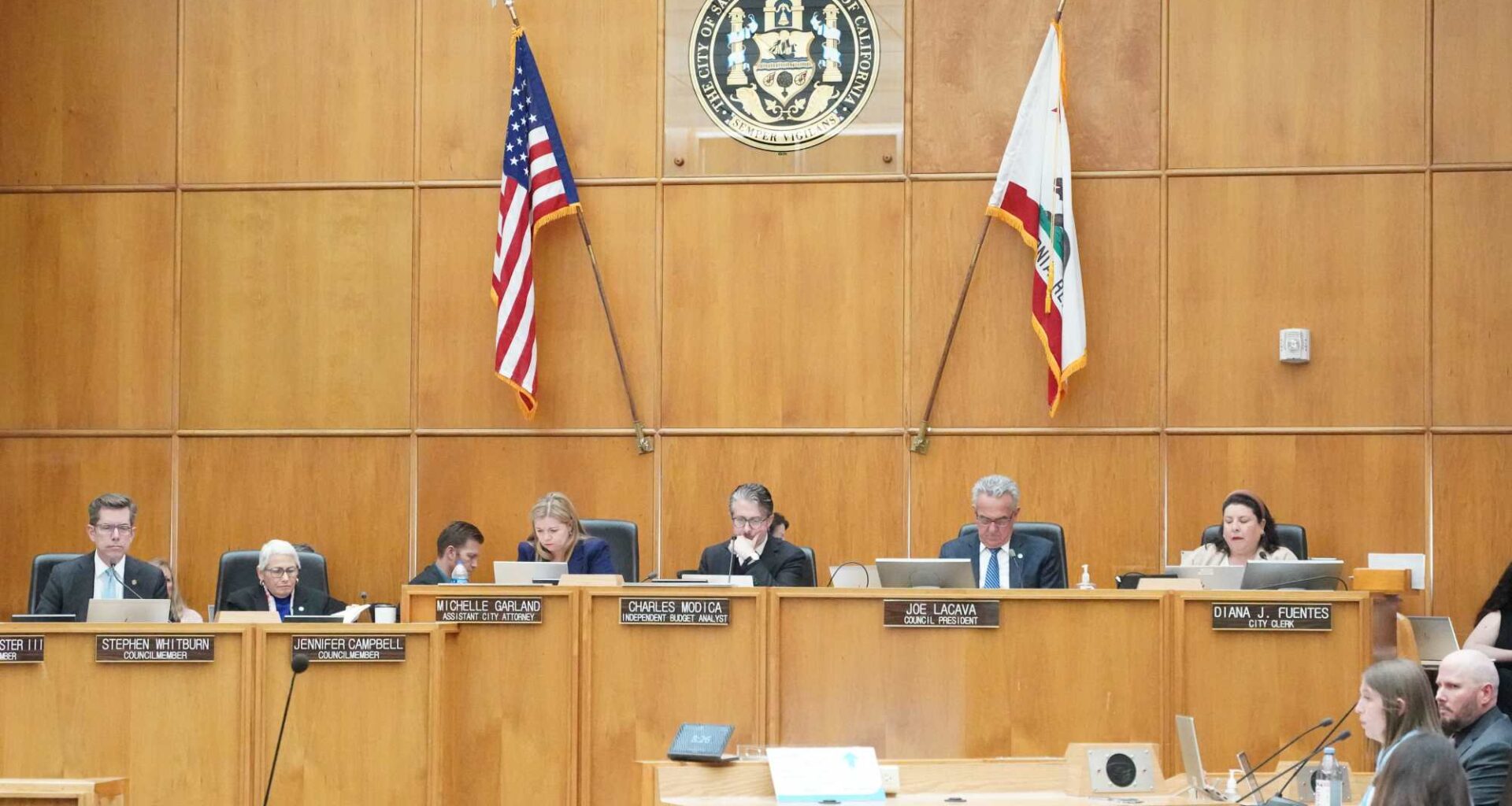
The story of Emerald Hills is rooted in surmounting barriers and providing opportunity. In early July, the City Council was faced with the legal barriers of an appeal for a project that would bring 123 for-sale single-family homes to a privately owned lot in Emerald Hills. Ultimately, there was no legal basis for overturning the project, and the appeal was denied. With this project moving forward, the opportunity introduced broader consideration on whether we would allow history to guide our understanding of what this community has been and what it can become. For Emerald Hills, history offers an important indication that this community has always been defined by change, and equally as important, racist tactics and exclusion.
From 1929 to 1958, Emerald Hills Country Club and Golf Course stood about 10 miles east of downtown San Diego and was one of the area’s notable private courses. From its clubhouse, visitors looked out over hills with sweeping views of downtown, the bay and the mountains to the east. By 1958, the land was converted for residential use, transforming open land into the community we know today.
That growth reflected some of the era’s most exclusionary housing practices. Like many postwar subdivisions, property deeds included racially restrictive covenants barring sales to Black residents and other ethnic groups. Although these covenants were later ruled unenforceable, the redevelopment of Emerald Hills complements the broader history of exclusion and inequality in San Diego’s housing system.
That history carries a pointed irony into the present. Today’s calls to preserve Emerald Hills exactly as it is risks protecting the physical legacy of exclusion while opposing opportunities for future generations to put down roots in the same community.
More troubling, this debate has not remained a disagreement over housing policy. Opponents have intentionally misinformed the public, circulated racist caricatures of Black community leaders, harassed Black and Brown residents who support the project, and created an atmosphere in which intimidation has replaced respectful civic dialogue. That conduct, unfortunately, reinforces the same exclusionary impulses that shaped Emerald Hills from the beginning.
The actual legacy of Emerald Hills is one of resiliency. The site previously associated with the Country Club is now home to Christian Fellowship Church, a culturally significant institution whose congregation includes generations of Black civic and community leaders. Nearby, the neighborhood’s park is slated for long-overdue improvements, reflecting continued investment in the community.
The surrounding housing stock has given a meaningful opportunity to generations of San Diego residents, from first-time buyers to families pursuing move-up housing. For many, these homes became a foundation for stability and generational wealth, with some families choosing to pass the property down through generations.
History matters when evaluating new development, and the history of Emerald Hills tells us that change has always been part of this place. The appeal asked us to preserve the status quo, but history teaches us that the status quo in Emerald Hills was itself shaped by exclusion. The question is not whether change will occur, but whether it will expand opportunity or preserve barriers rooted in a history we should strive to leave behind.
That is the main reason why it was important for this project to move forward. The decision was really about supporting the creation of 123 for-sale single-family homes. The development will reconstruct a decades-old deteriorated street, adding four pocket parks, improving stormwater infrastructure, installing new sidewalks, increasing tree canopy and creating a pedestrian trail system. It will also generate Development Impact Fees that will be reinvested into community improvements in Emerald Hills without placing additional strain on the city’s budget.
The same community that once poured into me and afforded me opportunities to become the man I am today is exactly why I choose to expand opportunity for others. I choose to build a stronger District 4. I will continue to fight to ensure every family and person has the same opportunity to achieve homeownership and build generational wealth. That is the story worth telling.
Foster represents San Diego City Council District 4. He lives in Valencia Park.