
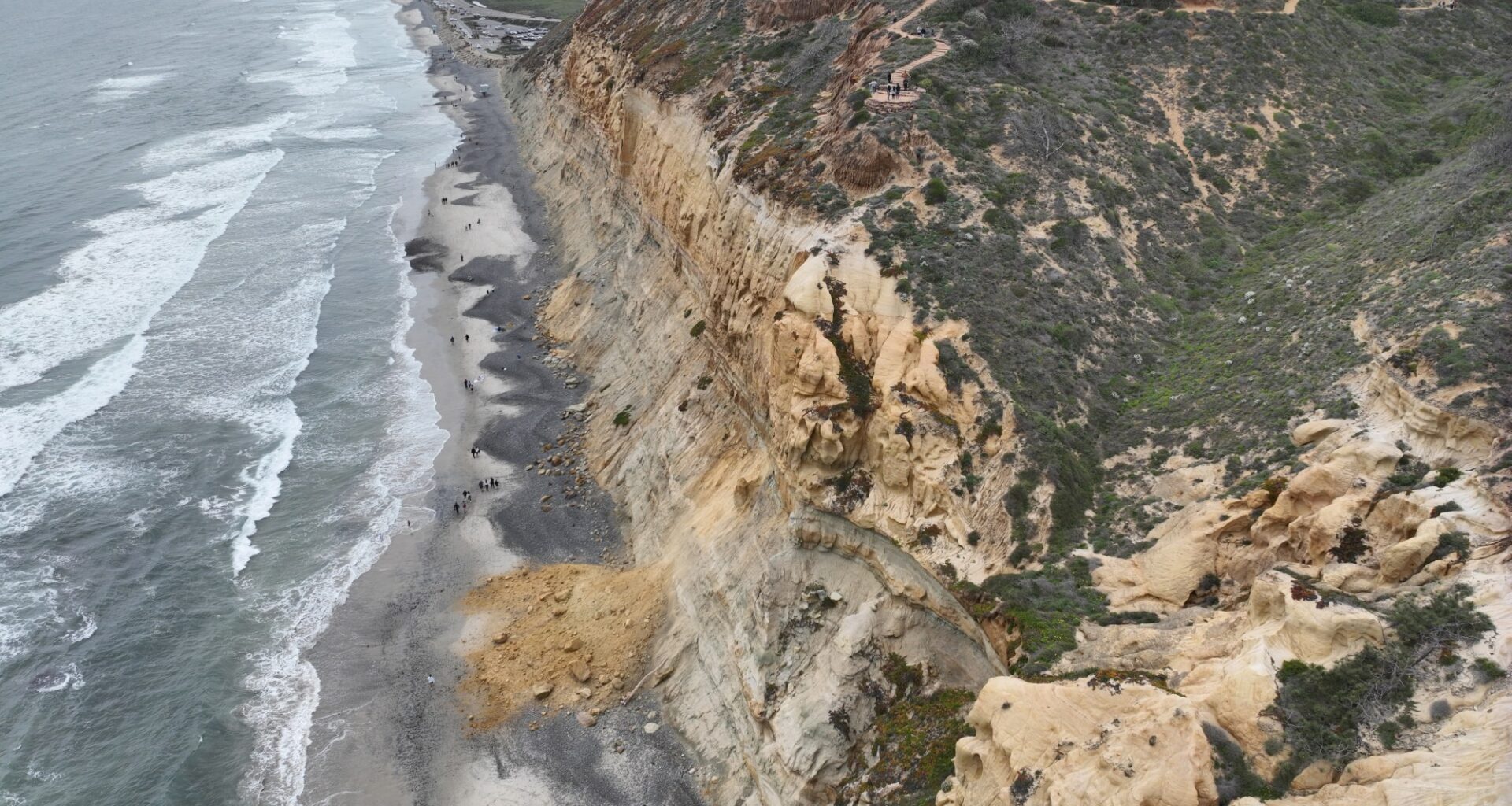
Approximately 70% of California’s coast contains eroding coastal cliffs.
When these cliffs fail, the impacts can range from significant and cause crumbling infrastructure, to deadly when falling rocks pose imminent danger to beachgoers.
But a new study stemming from four years of research at UC San Diego’s Scripps Institution of Oceanography in La Jolla offers potential early warning systems that could curb coastal destruction and danger.
“Scientists have been trying to predict earthquakes for a very long time,” Scripps geophysicist Mark Zumberge said in a press release from Scripps. “This study provided a unique opportunity to leverage what we’ve learned with earthquakes and apply it for these coastal hazards.”
For the study, Scripps coastal geomorphologist Adam Young and Zumberge leveraged a variety of in-ground monitoring tools and laser imaging technologies at a handful of vulnerable sites such as Beacon’s Beach and San Elijo State Beach in Encinitas and the Railway Corridor in Del Mar.
In particular, the team used a truck-mounted mobile light detection and ranging (also known as lidar) system, sensors and drones to track movement and change on the cliffs.
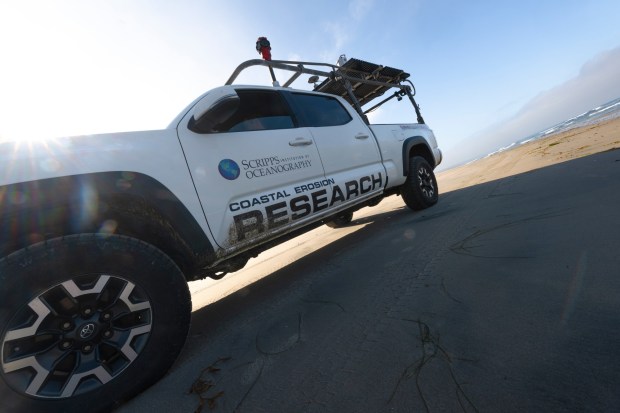 Scripps Institute of Oceanography’s research team conducted weekly mapping by the coast from 2022-2025 to better understand the timing of cliff failure following rainfall. They were able to create detailed spatial maps with a truck-mounted mobile lidar system. (Erik Jepsen / UC San Diego)
With this equipment in place, the Scripps team tracked two collapses in Del Mar and three in Encinitas during the four-year study period, and each time their sensors detected movement hours or even days before the cliffs fell.
In one specific instance in Del Mar in April 2024, by detecting a 0.1-inch crack in the cliff-top that extended 30 feet out, Scripps researchers keyed in on a possible issue weeks ahead of time.
As the crack slowly widened, researchers determined it “would lead to imminent failure” and were therefore able to predict a landslide days before it happened. The research team then connected with appropriate authorities to make sure when the cliff did collapse, nobody was present. When the landslide occurred, an estimated 200 tons of material collapsed from the cliffs.
Next steps
Some of the recommendations in the study include implementing effective signage, making public service announcements and appearances at pop-up events, and raising awareness about the danger of cliff failures.
It also advocates for establishing a systematic plan of action that involves coastal managers, marine safety units, rail operators and other representatives should cliff failure occur.
Future work could include a phone app that uses Scripps’ most recent beach survey, the latest nearshore wave forecast and predicted tide heights to calculate the estimated distance people should stay away from cliffs.
Previous cliff failures and legislation
The Scripps study was published nearly seven years after a tragic event about 20 miles north of La Jolla at Grandview Beach in Encinitas where three women were killed after a 30-by-25-foot section of a cliff collapsed onto the beach.
That August 2019 event wasn’t the only fatal cliff failure in recent California history. According to Scripps, coastal landslides have been the cause of at least 25 fatalities on California beaches since 1941. Incidents have occurred in Big Sur, Santa Barbara, San Francisco and Point Reeves, among other locations.
Following the Encinitas event, state Assemblywoman Tasha Boerner (D-Encinitas) — whose 77th Assembly District includes La Jolla — introduced Assembly Bill 66 and sought state funding to improve coastal monitoring and gain a deeper understanding of bluff failures.
A subsequent bill she introduced, Assembly Bill 72, authorized Scripps to conduct research on the cliff landslides and offer recommendations related to a coastal cliff landslide early warning system.
Boerner praised Scripps’ latest findings in a statement.
“Bluff collapses are a constant threat to coastal neighborhoods in my district and across the California coast, presenting the risk of fatalities, injuries, and millions of dollars in damage to vital infrastructure,” Boerner wrote. “With this study completed, the science is clear: We can save lives, protect our coastal economy, and vital transportation networks in the face of sea-level rise with a bluff-collapse early warning notification system.”
Read the full study along with researchers’ recommendations at siocpg.ucsd.edu/California%20Coastal%20Landslide%20Early%20Warning%20Research.pdf