
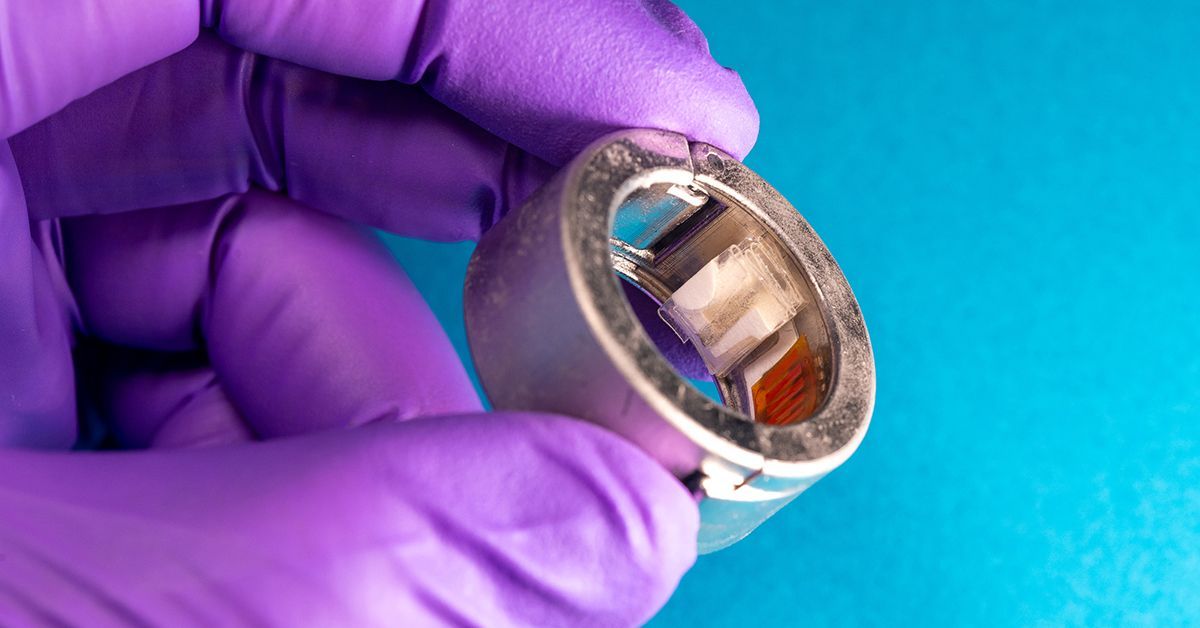
The biomarker smart ring is a fully integrated prototype that includes all the necessary biomarker sensing technology, low-power electronics and a flexible battery. Biomarker information is sent wirelessly to a smartphone app. The ring draws sweat passively using an osmotic hydrogel, a soft polymer that creates a pressure gradient to pull fluid from the skin painlessly. It works similarly to how water travels from soil to the leaves in plants. The collected sweat is analyzed by an electrochemical sensor array within the ring. Through repeated measurements, subject-specific calibration factors are established to convert current responses into concentration values. These calibration factors enable more personalized insight into the biomarker trends.
The ring is powered by a flexible zinc-silver oxide rechargeable battery that supplies power for up to 12 hours of operation between charges. The electronic board dimension ranges smaller than a US quarter coin. The outer shell of the smart ring is made from a 3D‑printed polymer. “Such integration onto the small footprint of a ring form factor is amazing,” Wang said.
Fully study: “A Fully Integrated Smart Ring for Daily Biochemical Monitoring.” Co-first authors of the study are Tamoghna Saha, Shichao Ding and Siyu Qin, all at UC San Diego.
This work was supported by the UC San Diego Center of Wearable Sensors (CWS) and the National Science Foundation – UC San Diego Materials Research Science and Engineering Center (DMR‑2011924).
Read more news about: Health Innovation