
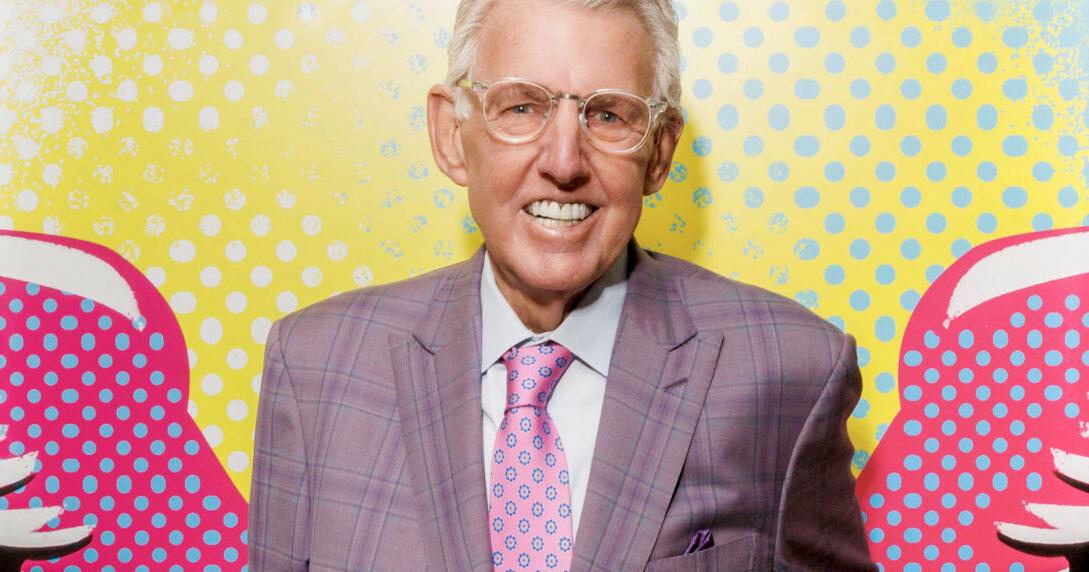

Clint Reilly at the San Francisco Examiner’s and Nob Hill Gazette’s San Franciscan of the Year Awards, held in the Julia Morgan Ballroom, in 2025.
Drew Altizer Photography
Clint Reilly, an East Bay milkman’s eldest son, left a Roman Catholic seminary three years short of the priesthood and poured his zeal into politics, pioneering the modern American campaign and launching a generation of California political leaders, including Senator Dianne Feinstein and Representative Nancy Pelosi. His second act was still more improbable: He became one of downtown San Francisco’s only noninstitutional commercial landlords, fought twice in federal court to maintain regional media competition, gave away millions of dollars to the City’s schools, parks, clinics and museums, and ended as owner and steward of some of its most storied institutions — the San Francisco Examiner, Nob Hill Gazette and Merchants Exchange among them.
“I love this photo,” Mr. Reilly said of this image of him and Janet Reilly, taken at their home for a holiday card.
Courtesy the Reilly Family
Mr. Reilly died July 18 in San Francisco. He was 79.
The seminary never entirely released him. Mr. Reilly entered at 14 and studied nine years for the priesthood before leaving in 1969, often explaining afterward that he had wanted to “help make history, not simply bless it.” But the departure proved less a break than a translation. In Catholicism, he observed, the priest is not the leader but a facilitator of leaders — and that, he often said, was the political consultant’s calling at its best.
Viewed across a half-century, his careers formed a single ministry conducted through secular instruments: campaigns, buildings, lawsuits, newspapers and scholarships, each pressed into the service of what he called the greatest act of charity — helping to create a just society.
Mr. Reilly with Dianne Feinstein around the time of her successful campaign against a 1983 recall attempt.
CLINT REILLY ORGANIZATION ARCHIVE
By the time he quit politics, Clinton Reilly Campaigns had run hundreds of races and helped establish practices that became the industry’s standard equipment: computer-assisted targeting that eschewed zip codes in favor of sorting the electorate into like-minded slivers, each reached with its own tailored message; slickly produced mail and television spots that peers came to call the California School; and a full-service campaign shop uniting polling, mail, advertising, fundraising and field organizing under one roof, modeled intentionally on a commercial ad agency.
The New York Times once described the operation as the most successful political consulting firm outside Washington, D.C.; the Los Angeles Times pronounced him “the gold watch of political consultants.” His clients included Feinstein, Pelosi, Senator Barbara Boxer, Mayor Richard Riordan of Los Angeles and much of the Democratic leadership of California.
Mr. Reilly as a young political advisor with students at UC Berkeley in the early 1980s.
CLINT REILLY ORGANIZATION ARCHIVE
“He didn’t just build a company,” Eric Jaye, a San Francisco strategist who worked for him, has said. “He in many respects helped create an industry.”
Then, in 1995, at 48, he walked away — and compressed a second life into a single year. He married Janet Koewler, a public relations executive he had met through the Riordan campaign, ending what he later called a lifetime as a bachelor; and he bought the Merchants Exchange building, a 1903 landmark at the heart of the Financial District. Around that address he assembled the estate of a civic patriarch: a real estate portfolio, a premium events company, a restaurant, a Napa vineyard, two magazines, a newspaper — and a scholarship program he came to regard as the point of it all.
Bess and Joseph Reilly with their first child, Clinton Thomas Reilly, as a baby.
Courtesy the Clint Reilly Organization Archive
None of it mellowed him, exactly. In his early consulting years, Mr. Reilly was among the most respected — and intimidating — personalities in California politics, a perfectionist who made 3 a.m. phone calls, went years without wearing a watch so as not to know when to stop and demanded the absolute best from his staff at all times.
He did not defend all of it. His straightforward style could be challenging for some, he acknowledged. Mr. Reilly was open about other traits as well: a drinking problem he ended in 1981, followed by counseling he continued for decades and a habit of relentless self-scrutiny that could sound like the confessional he had trained for.
One of his longest battles was with the Hearst Corporation. The most consequential lawsuit came in 2000, when Hearst moved to buy the San Francisco Chronicle and dispose of the Examiner, its flagship since 1887. Mr. Reilly sued to block the deal in federal court — granted standing, remarkably, as a simple consumer of news.
Mr. Reilly with former President Joe Biden, Jill Reilly, former Vice President Kamala Harris and Janet Reilly at the Julia Morgan Ballroom in San Francisco in 2023.
Drew Altizer for Drew Altizer Photography
As a former political professional, he argued that news monopolies were poisonous to democracy. He lost, but the trial forced the Examiner’s publisher to acknowledge under oath that he had offered favorable editorial treatment to public officials in exchange for support of the sale — testimony that cost the publisher his job.
Judge Vaughn R. Walker, while ruling for Hearst, pronounced the company’s conduct “malodorous,” called the lawsuit a public service and ordered Hearst to cover Mr. Reilly’s $2 million in out-of-pocket legal fees. The Examiner — whose survival Mr. Reilly counted as the case’s true verdict — kept publishing.
He sued again in 2006, when Hearst helped finance MediaNews Group’s acquisition of nearly every other paid daily in the Bay Area and the two companies quietly agreed to explore combining a range of business operations. A federal judge enjoined the arrangement; on the eve of trial, the companies settled, abandoning the cooperation plans, unwinding Hearst’s path to a stake in the Bay Area papers — and once again paying Mr. Reilly’s costs.
Governor Gavin Newsom and Clint Reilly in conversation, as they often were over the years of their relationship.
Jana Ašenbrennerová for Drew Altizer Photography
An additional element of the settlement agreement brought Mr. Reilly into close collaboration with the 11 MediaNews–owned titles. To facilitate an ongoing local voice in each community even as the papers marched inexorably toward consolidation, Mr. Reilly worked with the publishers and opinion-page editors to recruit independent community members from Vacaville to San Jose to serve on the editorial boards of each paper.
For three years, a rotating array of teachers, businesspeople, clergy, nonprofit leaders and others served one-year terms in each of the 11 communities served by MediaNews. One further term made the settlement a curiosity of American press law: Mr. Reilly received a weekly quarter-page of his own in all 11 newspapers. For three years, he filed a column nearly every week — 156 of them, some 100,000 words in total.
The Reilly family — Clint, Ava, Janet and Jill — at a Catholic Charities Loaves & Fishes Dinner in San Francisco.
Natalie Schrik for Drew Altizer Photography
The columns read like the man: passionate, self-deprecating and unexpectedly devotional. He joked that the “résumé police” might object to a columnist no newspaper had hired, and he admitted he broke into a cold sweat wondering whether he had anything to say.
He did. He reflected on his own seminary classmate, who was named among the church’s pedophile priests and faulted Pope Benedict for failing to defrock him when he had been asked to do so in 1985; he argued for ending mandatory celibacy for priests; he ruthlessly scolded his own class, writing that a culture that deified private wealth worshiped a false god and that men like him should simply be taxed more.
He expounded on the financial crisis and the Affordable Care Act battles that dominated President Barack Obama’s first term, calling for accountability for the big banks and steeling Democrats’ spines on the health care fight. One of his columns, a paean to the department store chain Mervyn’s, sundered by its private-equity owners, elicited hundreds of heartfelt comments from throughout the region.
Above all, he wrote about newspapers — his parents had pored over the Oakland Tribune each evening after work — and about the working families of the postwar Bay Area, of whom he observed: “Ink flowed through the Bay Area’s veins.”
Mr. Reilly with several of the Bay Scholars his nonprofit organization has supported over the years with scholarships to attend regional Catholic schools.
Annie Barnett Photo
The final beat of Mr. Reilly’s career had a symmetry no novelist would risk. In 2016, the milkman’s son bought the Nob Hill Gazette, the chronicle of the City’s social and philanthropic life; in late 2020 — as the pandemic emptied downtown and the City’s monied class decamped to Napa and Tahoe — he decided to buy the ailing San Francisco Examiner itself, completing the purchase in 2021.
The paper upon which William Randolph Hearst had founded an empire, and whose fate Mr. Reilly had first gone to court over two decades earlier, now belonged to the consumer of news. There was a smaller symmetry, too, which he relished: Julia Morgan, Hearst’s architect, had kept her office for 45 years in the Merchants Exchange — the building Mr. Reilly bought, and the grand ballroom of which he named for her.
Clinton Thomas Reilly was born in Oakland on January 13, 1947, the eldest of the 10 children of Joseph and Bess Reilly. Six days per week, his father drove a Berkeley Farms milk truck through the Berkeley hills, delivering to professors’ houses and sometimes taking his oldest boy along. His mother ran a concession stand at Oakland Coliseum for 24 years, retiring as one of the longest-serving employees in its history.
The Reilly family — Clint, Jill, Ava and Janet — in their 2015 Christmas photo.
Spencer Brown
The family was poor in the cheerful, crowded way of the postwar East Bay — his father liked to recall that the house had no curtains, and that strangers knocked to ask whether it was for rent.
The decisive event of his childhood was a death. His sister Jill — his closest companion, who helped propel him to his fifth-grade class presidency with the slogan “Take a hint, vote for Clint” — died of a brain tumor when Mr. Reilly was 12. Soon after Jill died, his mother recalled, he announced he would become a priest. Forty years later, he gave his first daughter his sister’s name.
He entered St. Joseph’s Seminary in Mountain View at 14, continuing to St. Patrick’s in Menlo Park, where he took a degree in philosophy — Aristotle and Aquinas first, then Heidegger and the existentialists, whom he mined for years afterward.
The Reillys with Paul Pelosi and Speaker Emerita Nancy Pelosi at UC Davis’ Manetti Shrem Museum of Art in 2023.
Drew Altizer for Drew Altizer Photography
The seminary of his adolescence was a hermetically sealed chamber. Then the Second Vatican Council cracked the windows, and through them streamed the tumultuous 1960s of the Bay Area. Under the Rev. Eugene Boyle, the archdiocese’s social-justice firebrand and his lifelong mentor, Mr. Reilly led fellow seminarians in producing their 1968 “Little Kerner Report,” a 577-page study of race and poverty that accused white San Francisco of sleeping through a revolution. (Mayor Joseph Alioto dismissed it as the work of cloistered students.)
He left in 1969, three years short of ordination. That Christmas, he wrote his parents a seven-page letter — kept ever since — announcing himself “a restless man” who could not settle for least best, vowing to drain himself in the service of others and promising, since little could be done without money, to make his meager talents pay.
They paid slowly. He opened a waterfront junk shop called Walls and Corners on the stretch of shoreline where Levi’s Plaza now stands, selling the castoffs of a fading analog age as curios for a modern one: milk cans by the thousands (Macy’s bought them for window displays), wooden Coca-Cola cases and, in one characteristic wager, an entire Benicia warehouse of monolithic foundry patterns — ship anchors, giant gear wheels — bought whole and retailed as objets d’art.
Mr. Reilly with Rita Semel, who passed away in May, at a Catholic Charities event.
Natalie Schrik for Drew Altizer Photography
He followed Father Boyle into the farmworker and civil rights movements, speaking for Boyle in the early 1970s when a coloring book urging children to kill police officers was found in the church basement where the priest had let the Black Panthers run a food program for neighborhood children. The scandal nearly destroyed Boyle before a congressional inquiry established that the FBI had planted it.
In 1971 he won his first campaign: Richard Hongisto’s insurgent run for San Francisco sheriff. The education came in 1974, when he persuaded Father Boyle to run for the state assembly and watched a fraudulent last-minute mailer sink him by a few hundred votes. Four years later, he enjoyed a major breakthrough, steering future Congressman Robert Matsui through a crowded Democratic field and on to a general election victory.
In 1979 he ran Supervisor Quentin Kopp’s mayoral challenge and forced the heavily favored incumbent, Dianne Feinstein, into a runoff — a losing race that ironically brought him closer to Feinstein, who called on Mr. Reilly to fend off a recall attempt in 1983. That commanding victory became the blueprint for winning such campaigns, one that Mr. Reilly deployed nearly 10 years later to save California State Senate leader David Roberti from a similar attempt.
The Reilly family with former President Barack Obama and Janet’s mother, Margaret Koewler, in 2012.
Courtesy Clint Reilly Organization Archive
Clinton Reilly Campaigns opened in 1982, and for 13 years its founder was the biggest gun for hire in California politics. His star-studded roster of candidates grew with each cycle. Statewide initiative campaigns for the insurance industry swelled the firm’s coffers. “I basically didn’t have to work a day in my life for the rest of my life,” he later told the Los Angeles Times. He helped to elect Frank Jordan mayor of San Francisco in 1991; two years later he engineered an upset win for Richard Riordan in his campaign for mayor of Los Angeles. In 1994 came the defeat that trailed him longest — hired late to rescue Kathleen Brown’s foundering run for governor, he served through an Election Day defeat in which Pete Wilson outspent her by a ratio of more than 2.5 to 1. The press and pundits blamed him for weeks. Years later, in a column, he offered his own verdict: The side with superior resources usually wins.
A last, doomed campaign — Mayor Jordan’s 1995 reelection, remembered chiefly for the candidate’s ill-advised freelance stunt with two radio shock jocks — provided a comic punctuation mark on Mr. Reilly’s consulting career.
His new life arrived all at once in 1995, when
Mr. Reilly bought the Merchants Exchange building, the 16-story landmark at California and Montgomery streets, from Walter Shorenstein and the Swig family, then the reigning names of San Francisco real estate. (A smaller building on Pacific Avenue, acquired in 1992, had been the quiet start; the Merchants Exchange was the statement.)
Mr. Reilly, Caitlin Curran Kavanagh (far right) and the Bay Scholars team, along with students in the program.
CLINT REILLY ORGANIZATION ARCHIVE
Over the following decades the building became less a property than a parish. He poured millions of dollars into the building to restore it as a premium corporate address and made its Julia Morgan Ballroom the City’s ceremonial living room, host over the years to musicians, athletes and politicos — including Obama, Steve Jobs, Jane Goodall, Jay-Z and Tom Brady, among countless others — and to the galas, trade shows and political dinners of a metropolis.
In 1999, his daughter Jill was born. That same year, he made his one run for office, spending millions of dollars of his own money in a bruising campaign for mayor of San Francisco that collapsed when two late entries reshaped the race against Mayor Willie Brown. Pundits and politicos anticipated an eventual second attempt, but Mr. Reilly turned his attention to other interests: political fundraising, more downtown building acquisitions, art collecting. His second daughter, Ava, was born in 2001.
A pattern emerged in Mr. Reilly’s second act: He doubled down on the City when confidence in San Francisco was at its lowest. As the nation’s financial system buckled in 2008, he and his wife each launched nonprofit organizations. Hers was Clinic by the Bay, a free clinic for the working uninsured that opened in the Excelsior in 2010; his was Bay Scholars, a scholarship fund for students who could not afford the kind of rigorous Catholic education that had bolstered his own prospects.
Mr. Reilly with Michael Drake, the former president of the University of California, at a Bay Scholars luncheon.
Drew Altizer Photography
On Martin Luther King Jr. Day in 2010, into the teeth of the recession, he opened Credo, an Italian restaurant, on the ground floor of his Pine Street building with Father Boyle, then 88, on hand to bless the room and then-Mayor Gavin Newsom proclaiming “Credo Day” in San Francisco. Credo — Latin for “I believe” — was Mr. Reilly’s creative ode to the competition of ideas that underpinned American democracy. When a Chronicle critic dismissed the food with a single star, the owner professed serenity: He had sued the paper’s parent company multiple times, he noted, and saw no reason they would turn the other cheek. “William Randolph Hearst didn’t,” he wrote.
Bay Scholars became, by his own reckoning, the point of the whole sprawling enterprise. Beginning with 10 scholarships in 2008, the program grew to underwrite 508 students in the 2025–26 school year, carried through 18 college-preparatory high schools around the Bay on more than $16 million in aid. Roughly 60 percent became the first in their families to earn college degrees, and nearly all enrolled.
The hardscrabble East Bay kid whose own path had run through a Catholic seminary was buying the same passage, at scale, for children like he had been. He read every application himself each winter, pressing the program to take more students than it had the year before. He routinely pressed staff in his businesses to succeed because their success would ultimately translate to additional support for Bay Scholars, and he regularly brought staff members to school luncheons and events to speak to students.
Mr. Reilly with Rachel Teagle, the founding director of the Manetti Shrem Museum of Art at UC Davis.
Drew Altizer Photography
The giving ran wide as well as deep. In 2001 Archbishop William Levada made him the first lay chairman of Catholic Charities CYO, the region’s largest social-service agency, where he and his wife founded the Archbishop’s Loaves & Fishes Dinner, which raised more than $6 million during his tenure alongside more than $1 million of the couple’s own giving. A serious art collector since his consulting days — heavily concentrated on Bay Area Abstract Expressionists and Figurative artists — he was, with his wife, a major donor to the San Francisco Museum of Modern Art and to the Asian Art Museum, whose $52 million bond campaign for a new Civic Center home he had managed pro bono in 1994.
His board service and patronage reached from the Manetti Shrem Museum of Art at University of California, Davis, to the Presidio Tunnel Tops park and the Robert T. Matsui Center for Politics and Public Service at University of California, Berkeley — the latter named for the congressman whose 1978 campaign had first carried Mr. Reilly into the political big leagues, making one of the consultant’s earliest clients, a half-century on, a cause.
Former Mayor Willie Brown joined Mr. Reilly and the Nob Hill Gazette’s 45th anniversary celebration in 2024 in the Banking Hall of the Merchants Exchange.
Jessica Monroy for Drew Altizer Photography
The portfolio thinned gracefully at the end. In 2024 he sold the Little Fox Theatre building at 535 Pacific Avenue to LoveFrom, the design collective of Sir Jony Ive, Apple’s former design chief. Credo closed the same year, after a 15-year run. In January, the Bay Area Council inducted him into its Business Hall of Fame — jointly, fittingly, with his wife Janet.
In addition to his wife, who serves on the University of California Board of Regents and as chair of Clinic by the Bay, Mr. Reilly’s survivors include their daughters, Jill and Ava Reilly; his mother, Bess Reilly (age 101); seven brothers and one sister; and numerous nieces and nephews.
He had, in a way, already written the eulogy that fit him. In 2010, Mr. Reilly used one of his columns to bury two friends: a doctor who lived next door and never sought the limelight, and a seminary classmate who, dying of cancer, spent one of his last afternoons arranging a wheelchair for a neighbor sicker than himself.
Such people, Mr. Reilly wrote, were the quiet heroes who transform the world by leaving “their own small corner of the universe” better than they found it. Then he reached for T.S. Eliot’s question — “Do I dare disturb the universe?” — and rendered his verdict. Both men, he wrote, had.
In Memoriam
A memorial service will be held at St. Ignatius Parish, 650 Parker Avenue in San Francisco, on Monday, August 3, at 10 a.m. Reception to follow. Family and friends are invited to attend and celebrate a life spent in service to San Francisco.
In lieu of flowers, memorial donations in Mr. Reilly’s name may be made to Bay Scholars or Clinic by the Bay
He used his final column, nearly a year later, the way he had used campaigns, courtrooms, buildings and scholarship checks for a half-century: to argue that cynicism about public life was the one indulgence a citizen could not afford, and to ask his readers to volunteer for a candidate or a cause — any candidate, any cause — and to believe that great things could still be achieved.
Over and over, Mr. Reilly dared. The universe was disturbed.
Frank Holland is the principal of ORSO Creative + Strategic, a Washington, D.C.–area public affairs firm. He served as an executive within the Clint Reilly Organization and as strategic partner to Clint Reilly for more than 10 years.
In the years after he founded the educational nonprofit Bay Scholars, Clint Reilly kept up a remarkable ritual: He carved out time from the de…