
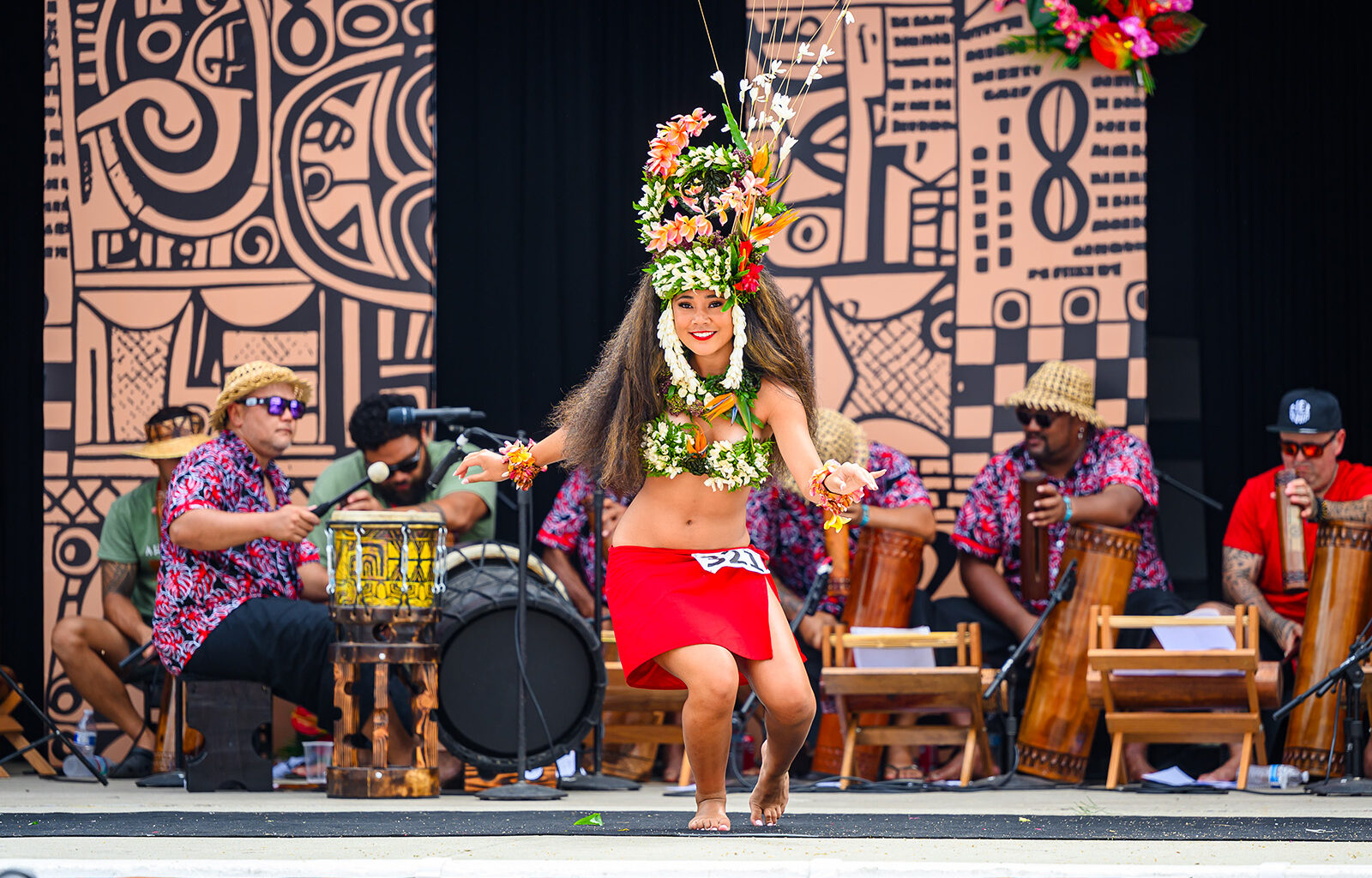
Competitive Tahitian dance, or ‘Ori Tahiti, is a lot harder than it looks.
Though it was legally banned and deemed indecent in the 19th century, Tahitian dance has grown to become an internationally renowned source of cultural pride.
Hundreds of dancers of all ages will perform ‘Ori Tahiti next weekend at Heiva San Diego, in hopes of winning one of five trips to Tahiti.
The three-day event staged at Harrah’s Resort Southern California is celebrating its 16th year with the crowning of Mister and Miss Heiva 2026, along with a Tahitian marketplace selling island clothing and art, a fashion show, a gala buffet, and ‘Ori Tahiti dance performances and competitions.
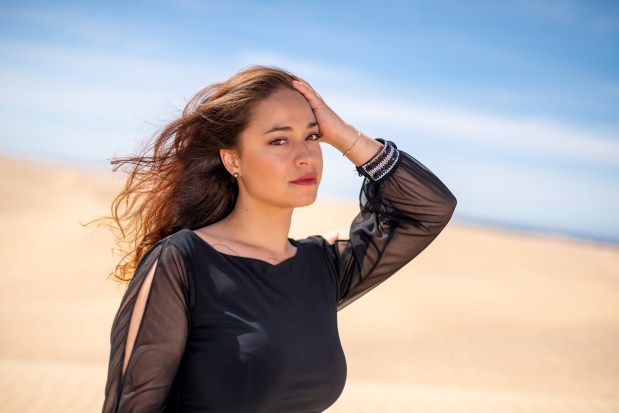 Lindsay Reva Coulomb is the founder of Heiva San Diego. (Bryson Kim)
“The growth has been incredible,” said Lindsay Reva Coulomb, an award-winning wedding planner who founded the event with her mother, Heiva SD president and travel industry professional Maeva Tarahu-McNicol.
“When we first started, we had maybe 60 to 90 attendees, around 65 solo competitors and about five vendors. Today, we have 45 vendors and more than 500 competitors, with anywhere from six to a dozen groups participating in the group competition. What began as a small local event has grown into a three-day production that brings competitors and guests from Tahiti, Mexico, Japan, and around the world.”
‘Ori Tahiti techniques
Unlike fluid belly dancing or the gently swaying Hawaiian hula, the Tahitian Otea, typically performed by females, takes incredible stamina.
It’s far more complicated than jiggling the buttocks because the movement language incorporates hip circles (Fa’arapu), figure-eight hip rolls (Varu) and the most difficult move — bouncing while rolling the hips in a squatting position (Tifene).
Males traditionally perform the Pa’oti, or scissors dance, which also involves considerable thigh strength. While in a squatting position, the dancer rapidly opens and closes his bent legs while his arms are outstretched.
Opening night on Friday will showcase the Mehura competition, a more languid dance style, with graceful arm movements that have a theme or tell a story.
Mister and Miss Heiva 2026, Elijah Tiguelo, 24, and Ivana Moi, 18, also will be crowned that evening.
Moi just graduated from Carlsbad High School and since the age of 4, she has trained and competed with the world renowned Nonosina Polynesia dance studio, based in Anaheim.
“It was a big commitment going back and forth to practices,” Moi said. “Through their training, I was able to become one of their soloists and be a part of productions that placed first in several competitions.”
‘Ori Tahiti competitions are typically divided by age, solo, group and skill level.
At Heiva San Diego, three judges from Tahiti will scrutinize technique, interpretation and cultural authenticity. The Otea, or fast dance competitions last for just under two minutes.
Moi said the hip rotation called Fa’arapu, derived from the Tahitian word meaning “to stir or to mix,” is “like you’re mixing your hips but your feet cannot be moving.”
“Your heels have to be glued to the ground,” she explained. “Your shoulders and your arms have to be loose, like water, and honestly, and the only thing that’s moving like crazy is your butt.”
Additionally, the Tahitian Otea soloists must improvise to live drum accompaniment performed on traditional percussion instruments.
“It’s hard,” Moi said. “A lot of people don’t know that we have no clue what types of beats are going to be played.”
As Miss Heiva San Diego, Moi will be a representative for Polynesian culture, but she won’t be competing this year because she is continuing her education at Arizona State University.
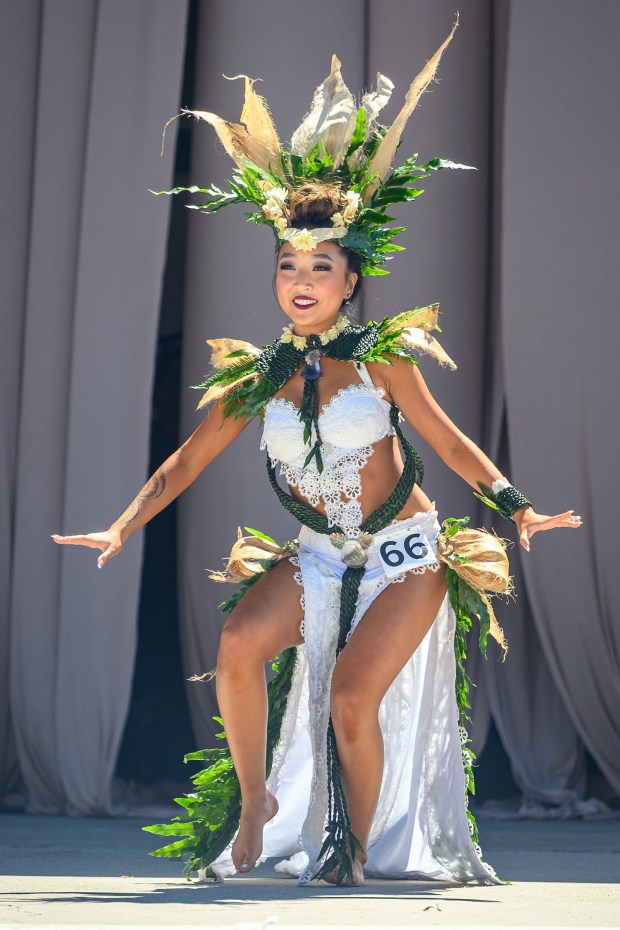 Kalea Minabe, from Te Rahiti Nui school, is one of the dancers who will take part in the 2026 Heiva San Diego, a Polynesian dance and drumming competition running July 31 through Aug. 2 at Harrah’s Resort Southern California in Valley Center. (Bryson Kim)
Costumes
Janice Minabe is an ‘Ori Tahiti dance instructor and the director of Te Rahiti Nui, a Tahitian dance studio in San Diego.
Her 19-year-old daughter, Kalea, also teaches at Te Rahiti Nui and she will be one of 30 students competing at Heiva San Diego.
For the past three years, Kalea has won Best Costume at Heiva San Diego, in addition to winning multiple ‘Ori Tahiti competitions in Paris, Bora Bora and throughout California.
Besides teaching, Janice Minabe offers costume workshops and designs her daughter’s competition wear, including the towering headdress, which is likened to balancing a small floral garden on top of the skull.
Tahitian costumes are an investment, ranging from $100 to $500 or more, depending on the exotic flowers and traditional materials used.
Minabe’s designs can include fresh greenery and orchids, gladiolas, red and pink ginger, plumeria, ferns, tea leaves and the tiare’, which is also known as the Tahitian gardenia.
There’s a deadline, too, in that fresh flowers must stay fresh throughout the competition.
“It takes two days of work to make my daughter’s costume,” Minabe said. “We have a large ice chest with ice packs, and even if I’m not hot, the air conditioner is running high, just to keep these flowers alive.”
History
During the 19th century, traditional Tahitian dance performed at the annual Heiva (pronounced Hay-vah) was forbidden.
Christian missionaries who traveled to the Polynesian islands found the dancing too provocative and in 1819, they convinced King Pomare II to legally ban the “heiva,” or community festivities. But through oral tradition, the people passed down their history and rituals.
When Tahiti was annexed by France in 1881, Bastille Day in July included Polynesian cultural practices and the festival was named Tiruai, the Tahitian word for “July.”
Then, in 1956, a high school principal named Madeleine Moua formed a popular dance troupe that revived ‘Ori Tahiti and the annual Heiva celebration not only flourished throughout French Polynesia, it spread to other countries.
On the island, Heiva i Tahiti has been celebrated every July since, with traditional dance, drumming, singing and sports, such as javelin throwing and canoe races.
Coulomb said she hopes that those who attend Heiva San Diego this year will leave with a deeper understanding about Polynesian culture, that it is more than beautiful costumes, music and dance. “There is history, language, family, and meaning behind what they see on stage,” she said.
“If someone comes to Heiva San Diego knowing very little about Tahiti and leaves feeling curious, connected, and wanting to learn more, then we’ve done something meaningful. More than anything, I want people to feel the spirit of our culture and the joy, the strength, and the sense of community that have kept it alive for generations. Everyone is welcome.”
Heiva San Diego 2026
When: 6 p.m. Friday; 9 a.m. Saturday and next Sunday
Where: Harrah’s Resort Southern California, 777 S. Resort Drive, Valley Center
Tickets: $10-$30 general admission, $135.23 gala buffet dinner, $193.92 VIP seating including lunch
Online: heivasandiego.com