
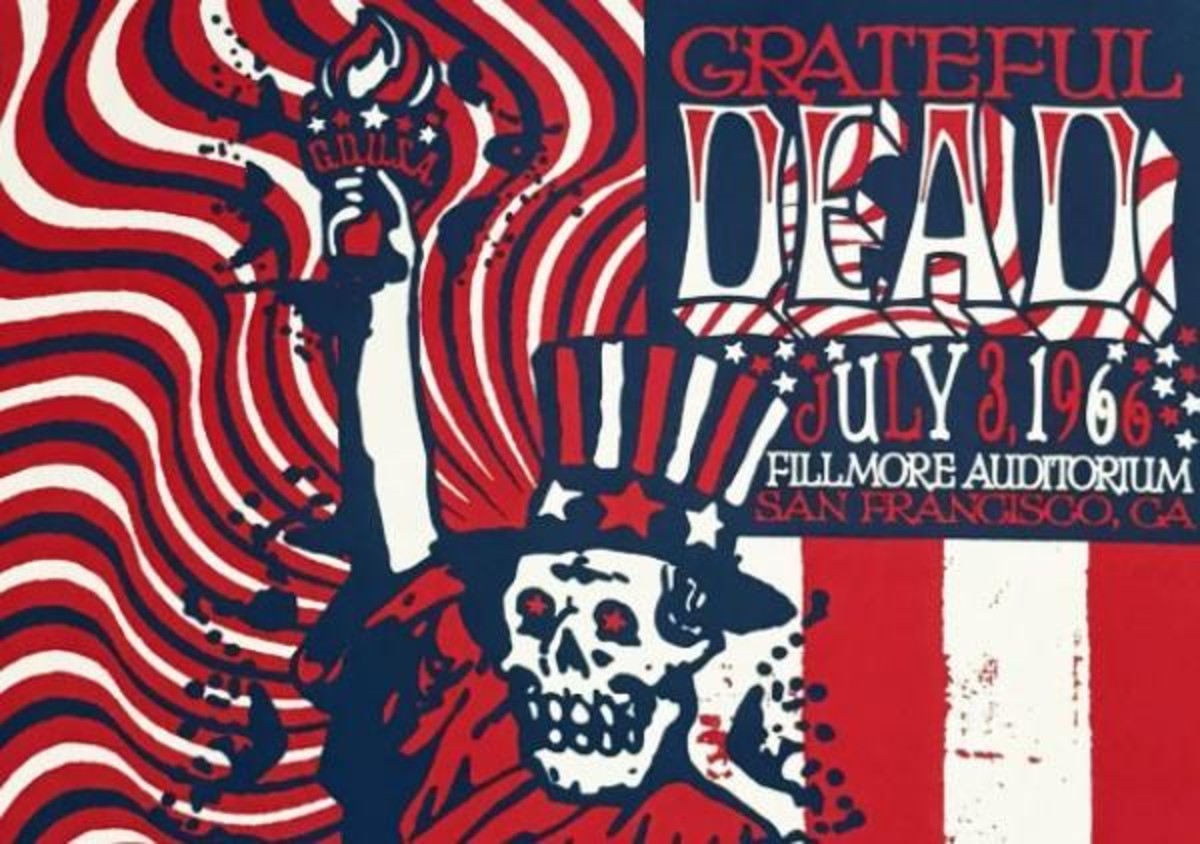
Scrutinizing the titles within the various Grateful Dead vault series, including Dick’s Picks, Road Trips and Dave’s Picks, the archivists have paid precious little attention to the formative years of the band as it slowly but surely morphed into the psychedelic warriors who ultimately became famous (strictly?) on their own terms.
In that light, the standalone release of Fillmore Auditorium, San Francisco, CA – July 3, 1966 carries more than a little intrinsic value, despite the fact that the show has been issued before: it was part of the massive 80-CD box set of 2015 30 Trips Around The Sun.
But even if the reappearance of this early live recording of the Grateful Dead is largely a means to tap into the vinyl market–and by extension the demographic that favors that configuration–it’s nevertheless a thought-provoking listen for both the novice and the deeply devoted.
For instance, it is both eye- and ear-opening to take note of how many selections in this two-set tracklisting became tried-and-true entries in the band’s long-term repertoire. “Big Boss Man,” “I Know You Rider,” “Cold Rain And Snow” (at a much peppier pace than later on) and “Beat It Down The Line” (where Bob Weir wails effervescently) are only the most prominent of the durable choices.
Those chestnuts are juxtaposed with Martha Reeves and the Vandellas’ “Dancing In The Street,” a cull from the Motown catalog that went in and out of the Dead’s repertoire over decades. Years before Bob Weir took the helm on it, however, co-founding member Ron ‘Pigpen’ McKernan commandeered the tune, and the vocalist, harpist, and keyboardist is also at the helm of most blues numbers.
The truncated take that opens this roughly ninety-minute set, “Nobody’s Fault But Mine,” is one of those, as is his own original “Tastebud.” And while Jerry Garcia may be front-and-center singing and soloing during “Sitting On Top Of the World,” the sound of the Farfisa organ his hirsute bandmate plays is the dominant instrumental tone there, just as the man’s harmonica is prevalent during the traditional “Keep Rolling By.”
McKernan’s preaching supersedes much improvisation there, reminding how notable it is that extended, purely instrumental interactions are scarce during this San Francisco show. This despite the fact that the Dead were mentored at the time by recordist and sound man (and renowned acid manufacturer) Owsley Stanley; the chronology in author Jesse Jarnow’s liner notes vividly depicts this early quintet lineup’s place in the group’s overall history.
Indeed, the generally short and to-the-point performances on these two compact discs capture an ensemble that had not yet begun to explore deep space. So, the near-eight minutes of “Viola Lee Blues” is the longest cut here except for Wilson Pickett’s “In The Midnight Hour:” roughly twice the duration of the former, the latter is a crowd-pleasing, set-closing turn for McKernan at center stage.
Garcia’s solo authorship of “Cream Puff War” may explain why this reading turns a little more extemporaneous over its five-plus-minute duration. As such, it also stands as a demonstration of the clarity and relative depth of the audio here: produced by David Lemieux, and restored using Plangent Processes’ speed correction, Jeffrey Norman’s mastering ensures clarity for the snappy drive of Bill Kreutzmann’s drumming as it aligns with the mobile pulse of Phil Lesh’s bass work.
The latter’s song contribution here, “The Monster Cardboard Cowboy,” comprises convoluted changes, including vocal tradeoffs, making it one of, if not the most, interesting pieces of material in the nineteen here. And it’s well positioned in the Dead’s second interlude of two that summer pre-holiday night, leaving the dance band portion of the show as the finale that ensues only after the ensemble skips lightly through the group-composed “You Don’t Have To Ask.”
The involved progression in musicianship there mirrors how the red, white and blue artwork of Darryl Norsen for Fillmore Auditorium, San Francisco, CA – July 3, 1966 expands upon the simplified color scheme of its previous iteration a decade ago. In the end, this Grateful Dead concert–part of an occasion dubbed ‘Independence Ball’ by famous venue operator Bill Graham–is deceptively revelatory.